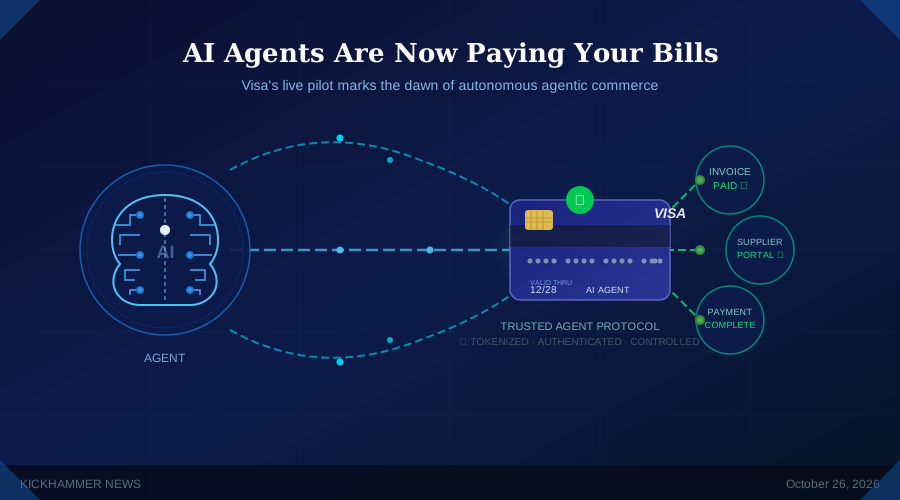
The first autonomous B2B payment was quiet. No fanfare, no dramatic unveiling on a stage. Somewhere inside a corporate accounts-payable system, an AI agent logged into a supplier portal, authenticated its identity, verified an invoice, and moved money — from start to finish, without a human hand on the keyboard.
Visa, BILL, and Billtrust announced the live pilot on October 21st. With it, a threshold quietly crossed: AI agents are no longer just answering questions and drafting emails. They are now spending real money in production systems. Here is what that means — and what it doesn’t.
What the Pilot Actually Does
The mechanics matter before the implications. Visa’s pilot uses the Trusted Agent Protocol (TAP) — an authentication standard Visa co-developed with Microsoft, Shopify, and Adyen specifically to give AI agents a verifiable, auditable identity in commercial transactions.
When a BILL Payment Agent needs to pay a supplier invoice, it doesn’t log in the way a person does. Instead, it presents tokenized payment credentials tied to that specific buyer’s approved payment instructions. Billtrust, on the supplier side, uses TAP to verify that the agent is who it claims to be and that it is authorized to execute the specific transaction being requested. If the credentials check out and the transaction falls within the buyer’s pre-defined controls — amounts, merchant categories, timing — the payment completes. According to Billtrust’s head of product Kunal Patel, an approved invoice “moves straight through to completion” with no human logging in to submit it.
This sounds mundane. It isn’t. The barrier that has historically blocked accounts-payable automation was never invoice matching or approval workflows — software solved those years ago. The barrier has always been supplier portals requiring authenticated human login. Somebody had to navigate to a portal and click “pay.” TAP is designed specifically to crack that barrier by giving AI agents a verifiable identity that portals can trust. It targets the last mile of a workflow automation problem that has consumed enormous back-office labor for decades.
Four Protocols Are Racing to Own the Infrastructure
Visa is not the only player here, and TAP is not the only standard. Four competing protocols are now active, each backed by a different coalition:
- Trusted Agent Protocol (TAP) — Visa’s standard, co-developed with Microsoft, Shopify, and Adyen. Focuses on identity verification and time-bound transaction challenges to separate legitimate agents from malicious bots.
- Agent Pay — Mastercard’s framework, launched in April 2025 with partners including Microsoft, PayPal’s Braintree, and IBM. Mastercard completed its first live agentic transaction — a tokenized ride-share booking executed through an AI agent for HSBC in Hong Kong — in September 2025, making it the first network to go live.
- Agentic Commerce Protocol (ACP) — Built by Stripe and OpenAI. This is the standard that powers ChatGPT’s Instant Checkout and is already in production for consumer purchases.
- Universal Commerce Protocol (UCP) — Google’s open-source standard built around tokenized payments and verifiable credentials that agents present directly to business backends.
Visa is betting on interoperability rather than winner-takes-all. Its Intelligent Commerce Connect platform, announced in April 2026, is a single integration point that sits above all four protocols and routes transactions regardless of which standard the initiating agent used. Seven pilot partners are already live. The pitch to merchants: don’t bet on which protocol wins — Visa’s acceptance platform handles all of them.
The strategic logic is familiar. Visa built its global position partly by being the network that worked everywhere regardless of the issuing bank. It is now trying to replicate that position one layer up: the network that accepts any agent regardless of which protocol issued its credentials.
What the Market Projections Actually Mean
The scale forecasts attached to agentic commerce are striking, and they deserve scrutiny before being taken at face value. McKinsey projects $3–5 trillion in global agentic commerce by 2030. Gartner estimates that 20 percent of all digital commerce will flow through AI platforms by 2030, and that AI agents will command $15 trillion in B2B purchases by 2028 — a figure comparable to the entire annual GDP of China.
The range between those projections — a factor of three to five — reflects a genuine disagreement about the pace of enterprise adoption, not a rounding error. McKinsey’s lower bound assumes that agentic payments remain concentrated in structured, high-volume workflows like invoice processing and procurement, where the ROI case is already clear. Gartner’s higher figures assume that agents expand into less structured commercial activity — negotiations, exception handling, multi-party contracts — where the trust and liability questions discussed below are far from resolved.
The more immediately useful figure is Bain’s US estimate of $300–500 billion. B2B payments in the United States run roughly $25 trillion annually, with an estimated 40–50 percent still flowing through checks and manual ACH processes that require human authentication at every step. The near-term addressable market for agentic payments is not all commerce — it is specifically the fraction of that $25 trillion that is high-volume, low-exception, and currently bottlenecked by portal authentication. That is a large but bounded number, and the current pilot addresses exactly that segment.
The Questions That Still Don’t Have Answers
The live pilot is small. Participating companies are not named publicly, geographic scope is undisclosed, and none of the three partners has released transaction volume figures. The more significant unknowns are structural — and unlike the projections, they don’t have well-reasoned answers yet.
Liability when an agent pays wrong. Visa’s Payment Controls allow businesses to set transaction-level limits by amount, merchant category, location, and timing. But limits only catch what you anticipated. Novel fraud vectors emerge at the edges of rule sets, not in the middle of them. Card dispute mechanisms were designed for a world where a human being can report unauthorized activity and provide context. An AI agent operating at scale will generate edge cases — a misdirected payment, a duplicate triggered by a retry loop, an adversarial prompt that redirected the agent to a fraudulent supplier portal — that existing dispute frameworks weren’t designed to handle. Card network rules have evolved over decades to address human error and fraud; they have no precedent for non-human principal liability.
Counterparty consent. TAP authenticates that an agent is authorized by the buyer. It says nothing about whether the supplier has agreed to receive payments from AI systems rather than humans. As autonomous agents proliferate, more counterparties will find themselves on the receiving end of agent-initiated transactions without having explicitly opted in to that arrangement. The liability asymmetry — buyer delegates to agent, supplier receives without consent — is not addressed in any of the public documentation around the current pilot.
Auditability under existing compliance frameworks. Accounts payable processes are subject to SOX controls, internal audit requirements, and tax documentation rules that were written assuming a human approver somewhere in the chain. An agent that “moves straight through to completion” without human login may complete a valid payment while breaking the audit trail that compliance requires. How TAP’s authentication logs map onto existing SOX control frameworks is an open question that will fall to corporate controllers and their auditors to resolve — likely on a case-by-case basis for the first several years.
The Bigger Picture: AI as a Financial Principal
What Visa and its partners are building is, at its core, an identity system for a new class of economic actor. For the entire history of financial infrastructure, the operating assumption has been that the entity initiating a transaction is a human being, or at minimum an organization with named human accountability behind it. Payment networks, merchant agreements, fraud detection, dispute resolution — all of it was architected around that assumption.
AI agents break it. Not in some distant hypothetical future, but in a live pilot processing end-to-end transactions right now. The financial infrastructure that governs how money moves will need to evolve to accommodate agents as principals — entities that can be authenticated, authorized, audited, and held accountable, but that are not human and cannot exercise judgment the way a human approver can.
Visa, Mastercard, Stripe, OpenAI, and Google are each building pieces of that infrastructure simultaneously, from different positions in the payments stack, with different protocol choices and different partner ecosystems. The standard that wins will likely be the one that solves the compliance and liability questions first, not the one with the most elegant technical design. That is historically how payment infrastructure competitions resolve: trust and legal clarity win over elegance.
The starting gun has fired. The race is early, and the outcome is genuinely open.
About the author: KickHammer News covers artificial intelligence and technology for a professional audience. Our technology staff reports on AI industry developments, enterprise software, and the business implications of emerging technology.


