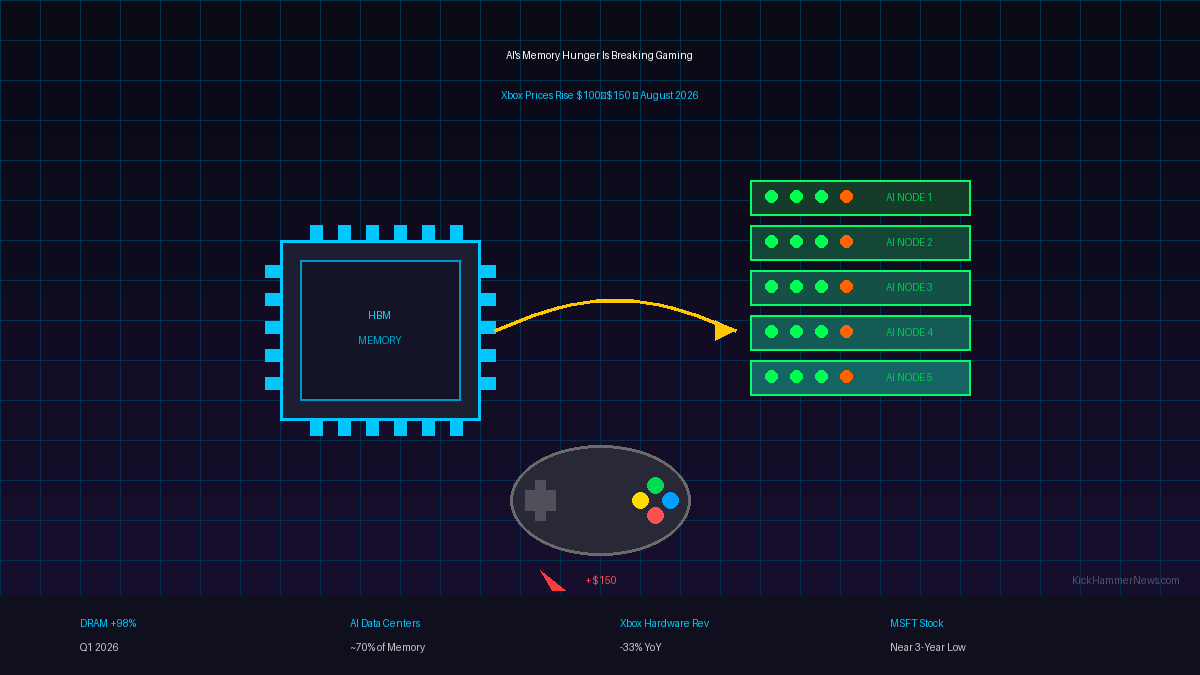
Microsoft’s gaming division has become an unlikely casualty of the artificial intelligence boom. On June 25, 2026, the company announced its third Xbox console price increase in just over a year, raising prices by $100 to $150 per unit effective August 1—a move that immediately rattled investors and sent MSFT stock tumbling to its lowest point in nearly three years.
The culprit isn’t a struggling product line or poor strategic decisions. It’s memory chips—the same components that AI data centers are hoovering up at a pace that has upended pricing across the entire consumer electronics industry.
The Numbers Behind the Hike
Starting August 1, the Xbox Series X 512 GB model will cost $100 more, while the 1 TB model will rise by $150. Microsoft is also quietly sunsetting its 2 TB configuration entirely—a signal that the economics of storage-heavy consumer hardware have become untenable. In raw terms, Xbox consoles are now 30 to 40 percent more expensive than they were just twelve months ago, with no ceiling in sight.
Microsoft has been unusually candid about the cause. Console storage and memory prices have increased by more than 2.5x since the start of 2025, the company acknowledged, and another doubling is expected by fall 2027. These are extraordinary figures for a market where hardware costs have historically trended downward over time, driven by manufacturing efficiencies and economies of scale.
AI’s Memory Monoculture Problem
The underlying dynamic is straightforward, even if its consequences are sprawling: the global AI infrastructure build-out has created an unprecedented concentration of demand for high-bandwidth memory (HBM), DRAM, and NAND flash storage. According to IDC, data centers are projected to consume roughly 70 percent of all memory chips produced worldwide in 2026—a staggering shift from the 20 to 30 percent share they held as recently as 2022.
Chip manufacturers, responding rationally to margin signals, have been retooling their production lines toward HBM and AI-grade memory at the expense of commodity DRAM and NAND. The result is a squeeze that is hitting every product that relies on affordable consumer-grade storage: smartphones, laptops, gaming consoles, and smart appliances alike.
The data tells the story clearly. DRAM prices rose as much as 98 percent in the first quarter of 2026 alone, according to industry tracker TrendForce, which projects a further jump of 58 to 63 percent in the current quarter. Microsoft is not absorbing these costs—they are passing them on—and at this rate, the company has little choice.
Xbox is not alone. Apple has moved in parallel, raising prices on Macs and iPads in response to the same memory cost environment. When two of the most cash-rich companies in the world decide they cannot absorb component inflation, it signals just how severe the structural shift has become.
A Market Structure Problem, Not a Cyclical Blip
What distinguishes this memory crisis from the boom-and-bust cycles that have historically characterized the semiconductor industry is its nature. Previous memory price spikes were driven by supply disruptions—factory fires, yield problems, geopolitical trade restrictions—that eventually resolved. This one is being driven by a structural reallocation of manufacturing capacity.
Chip foundries and integrated device manufacturers are making multi-year bets on AI infrastructure. Samsung, SK Hynix, and Micron have all announced aggressive pivots toward HBM production, with capital expenditure plans that prioritize AI-grade memory over commodity variants. These are not decisions that reverse quickly. The supply of consumer-grade DRAM and NAND will remain constrained relative to demand for years, not quarters.
TrendForce’s projections through 2027 reflect this reality. Even optimistic scenarios for the gaming hardware market involve sustained price pressure. Microsoft’s warning that console storage costs may double again by fall 2027 is not pessimism—it appears to be a straightforward reading of the supply chain.
The Fallout for Microsoft’s Gaming Business
The timing is painful for Xbox. The division had already been struggling with hardware revenue, which fell 33 percent year-over-year in the most recent quarter. Gaming revenue overall declined 7 percent. Now the company is forced into a position of making its hardware more expensive at exactly the moment it needs to compete more aggressively with PlayStation and attract new console buyers.
The price hike announcement knocked Microsoft stock down 3.8 percent on June 25 alone. MSFT, which had already entered bear market territory earlier in 2026—down more than 35 percent from its peak amid concerns about AI capital expenditures and a class-action lawsuit related to Copilot performance claims—briefly touched $382, its lowest level in nearly three years. The Xbox announcement served as a concrete illustration of how broadly the AI memory crisis is bleeding into Microsoft’s business lines.
For consumers, the calculus is equally uncomfortable. A platform’s appeal is partly a function of its price-to-value ratio. As Xbox units become materially more expensive, the competitive pressure on Microsoft’s gaming ecosystem intensifies. Game Pass subscriptions and software revenue may partially compensate, but the hardware moat matters—especially in markets where console pricing is particularly sensitive.
Who Benefits and What Comes Next
The obvious winners in this environment are memory chip manufacturers themselves, at least in the short term. Micron’s stock rallied on news of the Xbox price hike, as the announcement served as further confirmation of how robust demand for memory components remains across the industry.
For the gaming market broadly, the AI memory crisis raises serious questions about the console business model. Hardware manufacturers have historically been willing to sell consoles at thin margins or even losses, recouping value through software sales and ecosystem lock-in. That model becomes harder to sustain when component costs are rising faster than software revenue can offset.
Cloud gaming services stand to benefit if physical hardware becomes prohibitively expensive. Microsoft’s own Xbox Cloud Gaming platform could see renewed interest from consumers who balk at $600 or $700 box prices. Ironically, the company’s investments in cloud gaming infrastructure—itself a product of AI-era data center expansion—may provide a partial hedge against the hardware affordability crisis.
What seems clear is that the AI infrastructure boom has consequences that extend well beyond the server room. Gaming hardware, consumer electronics, and any product that relies on commodity memory are now collateral participants in a reallocation of global chip manufacturing capacity that will take years to fully stabilize. Microsoft’s third Xbox price hike in thirteen months is not an anomaly—it is a preview of how broadly the AI era will reshape the economics of computing hardware at every level of the market.
Related coverage: Xbox Console Price Update (Xbox Wire, June 25, 2026); Microsoft Lifts Price of Xbox Consoles Due to Soaring Component Costs (CNBC, June 25, 2026); Apple and Microsoft Raise Prices as AI-Driven Memory Chip Costs Quadruple (Euronews, June 26, 2026)