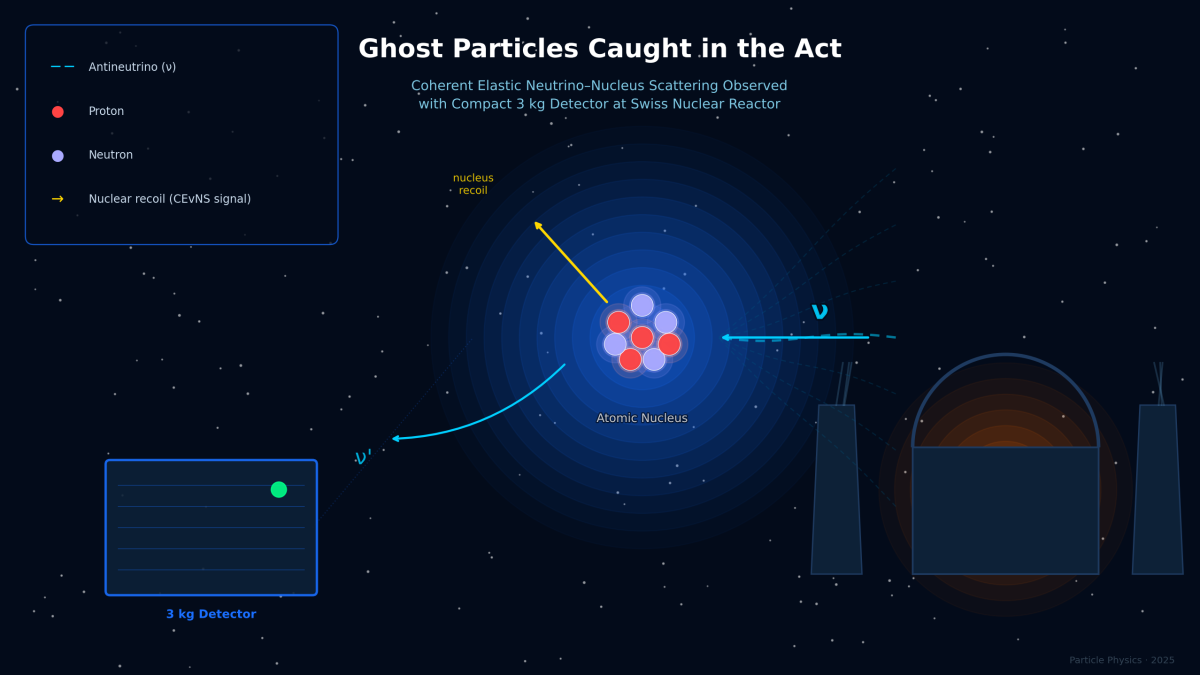
In a landmark achievement for particle physics, a team of researchers in Switzerland has successfully observed a rare phenomenon known as Coherent Elastic Neutrino-Nucleus Scattering (CEvNS) using a compact 3 kg detector at a nuclear reactor. This breakthrough, reported in early August 2025, confirms a long-predicted interaction in neutrino science and opens new avenues for exploring the fundamental building blocks of the universe.
What is CEvNS?
Neutrinos, often dubbed “ghost particles” due to their elusive nature, are among the most abundant particles in the universe. They pass through matter with minimal interaction, making them notoriously difficult to detect. Coherent Elastic Neutrino-Nucleus Scattering, first theorized in the 1970s, describes a process where a neutrino scatters off an entire atomic nucleus, rather than individual protons or neutrons, in a coherent manner. This interaction is extremely rare and requires precise conditions to observe, as the scattering process produces only a tiny recoil in the nucleus, leaving minimal detectable energy.
The CEvNS process is significant because it provides a unique window into the behavior of neutrinos and their interactions with matter. It also has implications for testing the Standard Model of particle physics, probing potential new physics, and improving our understanding of processes in extreme environments, such as supernovae and neutron stars.
The Experiment: A Compact Detector’s Triumph
The breakthrough occurred at a nuclear reactor in Switzerland, where researchers deployed a highly sensitive 3 kg detector designed specifically to capture CEvNS events. Nuclear reactors are ideal for studying neutrinos because they produce an intense flux of low-energy antineutrinos as a byproduct of nuclear fission. The compact size of the detector marks a significant technological advancement, as previous CEvNS observations, such as those by the COHERENT collaboration at Oak Ridge National Laboratory in 2017, required larger and more complex setups.
The Swiss team’s detector utilized advanced materials and ultra-low-noise electronics to measure the faint signals produced by neutrino-nucleus interactions. By placing the detector close to the reactor core, the team maximized the neutrino flux, increasing the likelihood of detecting the rare CEvNS events. After months of data collection and rigorous analysis, the researchers confirmed multiple CEvNS interactions, validating the theoretical predictions made decades earlier.
Why This Matters
The successful observation of CEvNS at a nuclear reactor with such a small detector has far-reaching implications for particle physics and beyond:
- Testing the Standard Model: CEvNS provides a sensitive probe for verifying predictions of the Standard Model, the framework that describes the fundamental particles and forces of the universe. Any deviations from expected CEvNS rates could hint at new physics, such as undiscovered particles or forces.
- Neutrino Applications: Understanding CEvNS could improve neutrino detection technologies, which have applications in nuclear nonproliferation, as neutrinos can reveal the presence of nuclear reactors remotely. This could enhance global efforts to monitor nuclear activity.
- Astrophysical Insights: CEvNS is a key process in extreme astrophysical environments, such as supernovae, where neutrinos play a critical role in energy transfer and element formation. Better understanding of CEvNS could refine models of stellar explosions and the origins of heavy elements.
- Technological Innovation: The development of a compact, highly sensitive detector demonstrates the potential for scalable, cost-effective neutrino detection systems. This could democratize neutrino research, enabling more facilities worldwide to conduct similar experiments.
Looking Ahead
The Swiss team’s achievement is a stepping stone toward deeper exploration of neutrino properties. Future experiments aim to refine CEvNS measurements, potentially using different detector materials or reactor types to study how the interaction varies across nuclei. Additionally, researchers hope to leverage CEvNS to search for signs of sterile neutrinos, a hypothetical particle that could explain mysteries like dark matter or the matter-antimatter asymmetry of the universe.
This breakthrough also underscores the importance of international collaboration in particle physics. The Swiss experiment builds on decades of theoretical and experimental work, including contributions from global research communities. As detectors become smaller and more efficient, the field of neutrino science is poised for rapid progress.