For decades, the Linux desktop has been haunted by a single, stubborn ghost: professional creative software. No matter how polished the desktop environment, how stable the kernel, or how enthusiastic the community, creative professionals who depended on Adobe Photoshop, Illustrator, or Premiere Pro faced a hard wall. You either kept a Windows machine around, or you stayed on Linux and made peace with GIMP. In early 2026, that wall finally cracked — and the implications could reshape the entire landscape of desktop computing.
The Wine Patch That Changed Everything
The breakthrough came from an unlikely source: a community developer known as “PhialsBasement,” who submitted a series of patches to the Wine compatibility layer that, for the first time, reliably allows Adobe Creative Cloud’s installer to run on Linux. Wine — which stands for “Wine Is Not an Emulator” — has long enabled Linux users to run Windows applications, but Adobe’s Creative Cloud suite had remained persistently out of reach due to deep incompatibilities in how the installer handled XML parsing, JavaScript execution, and Windows-specific system calls.
The technical root of the problem was deceptively mundane. Adobe’s Creative Cloud installer relied on MSXML3 and MSHTML components that behaved loosely by Windows standards but were incompatible with the stricter XML handling used by Linux libraries like libxml2. The patches wrapped problematic data in CDATA blocks to prevent XML parsing errors, forced an Internet Explorer 9-style environment that matched the installer’s expectations, and refined Wine’s internal ID-handling behavior. The result: the installer that had crashed or frozen on Linux for years finally ran to completion.
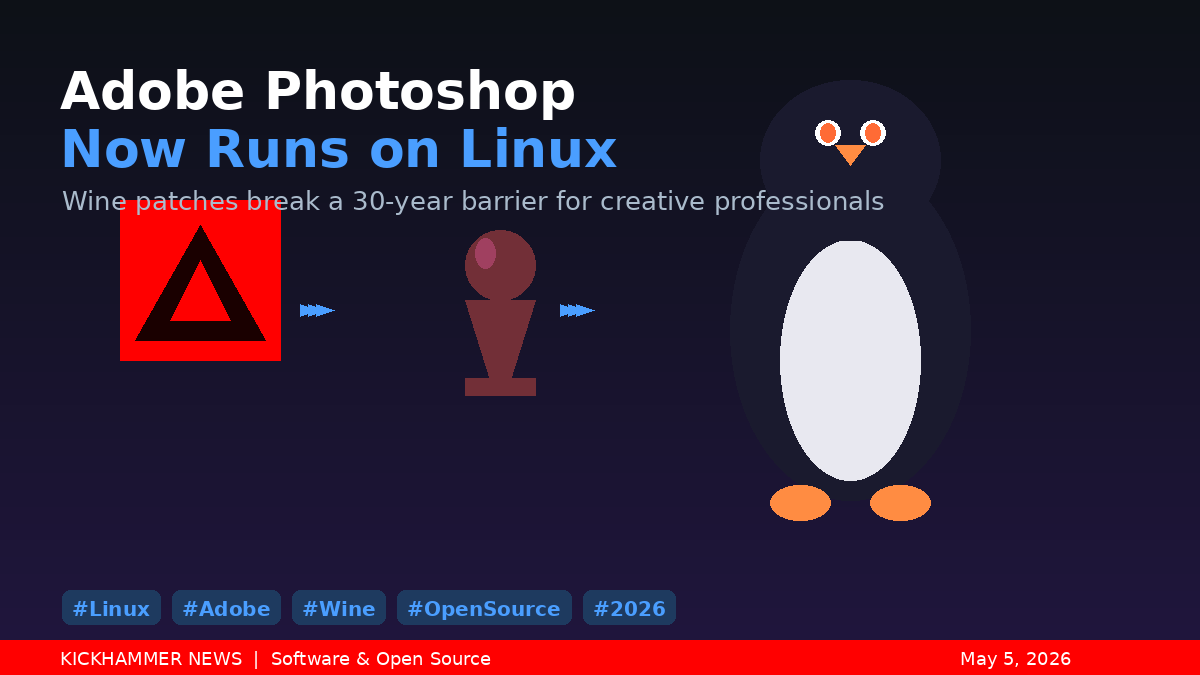
Photoshop 2021 reportedly runs “buttery smooth” under the patched Wine configuration. Photoshop 2025 is functional for many users, though results vary depending on GPU drivers, desktop environment, and font stack configurations. For the first time, a Linux user can install and launch Adobe Photoshop without having to copy files from a Windows virtual machine or follow a laborious multi-hour workaround.
Why This Matters Beyond the Technical Achievement
The significance of this development goes far beyond the technical community that will immediately benefit. It lands at a moment when Linux’s overall momentum has never been stronger.
Linux desktop market share has climbed to 4.7% in 2026 — the highest figure ever recorded — driven in part by Microsoft’s decision to end Windows 10 support in October 2025, which pushed millions of users on older hardware to seek alternatives. Germany’s Schleswig-Holstein state is mid-way through a migration of 30,000 government computers to Linux and LibreOffice. Valve’s Steam Deck has quietly normalized gaming on Linux. And now, Adobe’s most iconic application is running on a platform it has never officially supported.
The narrative around “the year of the Linux desktop” has been a running joke in tech circles for 25 years. But the joke is wearing thin. The convergence of Windows 10’s end-of-life, growing institutional Linux adoption, and now a path to running Adobe Creative Cloud represents the most credible case yet that mainstream Linux adoption isn’t a pipe dream — it’s already happening.
The Caveats Are Real
This isn’t a perfect story, and honest coverage demands acknowledging the limitations.
First, using Wine to run Adobe software on Linux is entirely unsupported by Adobe, and may violate the Creative Cloud Terms of Service in commercial contexts. Creative professionals working under client contracts or within regulated industries should consult legal counsel before adopting this workflow.
Second, even with the Wine patches applied, users must manually compile Wine from the developer’s patched source code — a process that requires comfort with the Linux terminal and a willingness to troubleshoot. Pre-packaged, one-click solutions don’t yet exist. The community is working on it, but it’s not there yet.
Third, critical professional workflows that depend on Adobe’s cloud sync, Camera Raw pipelines, color-critical print output, or third-party plugin ecosystems remain risky or broken. Photoshop opens. It edits. But a full production pipeline running through Creative Cloud on Linux still has sharp edges.
Finally, licensing validation — the periodic check-in that Creative Cloud performs to confirm subscription status — has been reported as intermittently failing, potentially locking users out of their software mid-project.
What Adobe Thinks (Hint: Nothing Official)
Adobe has made no statement about this development. The company has never officially supported Linux, and there is no indication that this will change. Adobe’s public roadmap mentions AI-powered features for Photoshop and Firefly integrations, but nothing about Linux compatibility.
The irony is rich: a community developer has done more to bring Adobe software to Linux in a few patches than Adobe itself has done in thirty years. Whether Adobe views this as a threat, an opportunity, or simply irrelevant to their business model remains to be seen. Given that Linux’s desktop share is still a fraction of Windows and macOS, the company has little business incentive to officially bless a Linux port.
But the technical precedent is set. The installer works. The application runs. The community knows how to do it.
The Broader Ecosystem Response
The Neowin headline that captured the story — “Linux closes the professional gap” — understated things slightly. What’s actually happening is that the gap is being closed from both directions simultaneously. On one side, Linux compatibility layers like Wine and Proton keep improving. On the other, Adobe’s applications have become increasingly web-dependent and less tied to Windows-specific internals, which paradoxically makes them more portable.
Meanwhile, open-source alternatives continue to mature. GIMP 3.0 landed in early 2025 with a dramatically improved interface. Krita has established itself as the professional choice for digital painting. Inkscape handles vector work capably. But these tools have always required users to change their workflows. What the Wine patches offer is something different: continuity. The ability to open the same PSD files, use the same tools, and deliver the same outputs — without switching software.
Looking Ahead
The Linux community is already building on the Wine patches. Projects like Bottles and Lutris — graphical front-ends for Wine that simplify Windows application installation — have opened issues tracking Adobe Creative Cloud compatibility. Within weeks or months, it’s plausible that installing Photoshop on Linux could become a guided, mostly-automated process rather than a manual compile-from-source exercise.
Adobe’s own trajectory is also worth watching. The company is investing heavily in AI features under its Firefly brand, and much of that infrastructure is cloud-based. An application that increasingly offloads processing to the cloud is, by definition, more platform-agnostic. Whether Adobe ever officially supports Linux is a business decision, not a technical one — and the technical barriers are eroding.
For now, the message to Linux users is this: Photoshop runs. It’s not perfect. It’s not supported. But it runs — and for a platform that has spent a quarter century being told it will never be ready for creative professionals, that is a milestone worth marking.
Sources: Neowin, OMG! Ubuntu, Phoronix, WindowsCentral, HowToGeek, XDA-Developers