May 5, 2026 | Technology | By Tech News
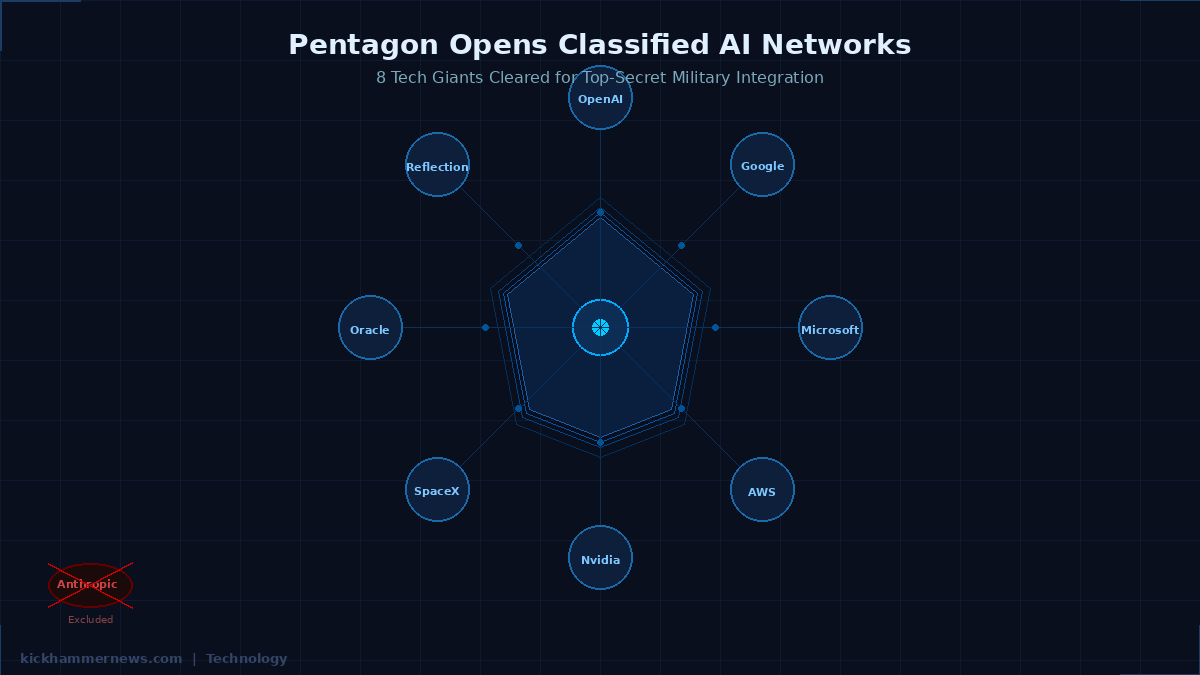
In a landmark move that signals the rapid militarization of artificial intelligence, the U.S. Department of Defense has formally struck agreements with eight of the world’s most powerful technology companies — SpaceX, OpenAI, Google, Microsoft, Amazon Web Services, Nvidia, Oracle, and a lesser-known firm called Reflection — to deploy their AI systems directly inside the Pentagon’s most sensitive classified networks. The announcement, which came at the start of May 2026, marks one of the most significant expansions of commercial AI into the national security apparatus in American history.
What the Deals Cover
The agreements authorize these eight companies to integrate their AI products into the DoD’s Impact Level 6 (IL6) and Impact Level 7 (IL7) network environments — the highest tiers of classification used by the U.S. military, reserved for information that is secret or top secret. At those levels, the data being processed can include operational intelligence, surveillance feeds, battlefield communications, and other information that, if compromised, could put lives and national security at risk.
According to the Pentagon, the goal is to use AI to “streamline data synthesis, elevate situational understanding, and augment warfighter decision-making in complex operational environments.” In plain terms: the military wants AI systems that can analyze enormous volumes of classified intelligence faster than any human analyst, surface patterns and threats in real time, and help commanders make better decisions under pressure.
The DoD framed the initiative as a deliberate effort to build an architecture that “prevents AI vendor lock and ensures long-term flexibility for the Joint Force.” Rather than becoming dependent on a single AI provider, the Pentagon is creating a multi-vendor ecosystem that can draw on the best capabilities from a diverse set of commercial platforms.
A Roster of AI Heavyweights
The eight companies selected span the full breadth of the modern AI industry. Microsoft and Google bring their frontier large language models — Azure AI and Gemini, respectively — along with deep enterprise integration experience. Amazon Web Services contributes its dominant cloud infrastructure and its own AI tooling through Bedrock. OpenAI brings GPT-class models that have already made their way into a range of government pilot programs in recent years.
Nvidia, while not primarily an AI software company, is included for its unmatched role as the hardware backbone of AI compute — its GPUs power virtually every major AI training and inference workload in existence. SpaceX’s inclusion is notable and reflects its growing role as a defense technology partner; the company’s Starlink satellite network and data capabilities have proven invaluable in recent conflict zones, and its AI ambitions have grown considerably under Elon Musk’s leadership. Oracle rounds out the roster with its cloud infrastructure and data management capabilities, while Reflection — a smaller, specialized AI firm — rounds out the group with niche capabilities the Pentagon apparently found compelling enough to include alongside the megacaps.
The Anthropic Exclusion — and Why It Matters
Perhaps the most striking aspect of the announcement is who was left out: Anthropic, the AI safety company founded in 2021 by former OpenAI researchers including Dario and Daniela Amodei.
The exclusion was not accidental. Earlier in 2026, the Pentagon designated Anthropic as a supply chain risk — an extraordinary and deeply unusual classification for one of the most prominent AI companies in the world. The designation stems from a fundamental disagreement between Anthropic and the DoD over usage terms. The military wanted what it described as unrestricted access to Anthropic’s AI models for national security purposes. Anthropic, whose corporate identity is built around AI safety principles, pushed back — insisting on contractual guardrails that would prevent its technology from being used for domestic mass surveillance or fully autonomous weapons systems that operate without meaningful human oversight.
That principled stand came at a steep commercial price. Being shut out of the Pentagon’s classified AI ecosystem is not merely a reputational setback; it represents billions of dollars in potential contracts and the kind of deep government integration that drives long-term enterprise revenue. Other major players — including OpenAI and Google, both of which have their own stated commitments to responsible AI — evidently found ways to satisfy the Pentagon’s requirements while staying in the deal.
Anthropic has not publicly commented in detail on the supply chain risk designation, but the situation has ignited a fierce debate in AI policy circles about the tensions between AI safety commitments and commercial imperatives when dealing with defense clients.
What This Means for the Future of AI in Warfare
The Pentagon’s move is part of a broader, accelerating global trend. China, Russia, and other geopolitical rivals are investing aggressively in military AI, and the U.S. government has concluded that falling behind in this domain is not an option. The integration of commercial AI into classified environments is seen as a way to rapidly close any capability gaps without waiting for purpose-built government systems to be developed from scratch — a process that has historically taken years or decades.
But the move also raises serious and unresolved questions. Autonomous weapons — systems capable of identifying and engaging targets without human input — remain one of the most ethically contested frontiers in modern warfare. International humanitarian law has not yet caught up with the pace of technological development, and there is no binding global agreement on where the line should be drawn between AI-assisted and AI-directed lethal force.
Critics of the Pentagon’s approach, including arms control experts and AI ethicists, worry that integrating powerful commercial AI into IL6/IL7 networks without robust, contractually binding safeguards creates the conditions for AI to creep into the kill chain with insufficient human oversight. The fact that the DoD explicitly rejected Anthropic’s demand for such guardrails suggests the military is more interested in operational flexibility than in pre-emptive restrictions.
Proponents counter that AI decision-support tools — systems that help analysts and commanders, rather than acting autonomously — are already saving lives by improving the speed and accuracy of threat assessment. They argue that the U.S. military operating with less AI capability than its adversaries is far more dangerous than the alternative.
Big Tech’s Defense Pivot
For the companies that signed on, the deals represent the formalization of a defense pivot that has been underway for several years. The era when large technology companies could credibly claim to be apolitical, pacifist entities focused purely on consumer and enterprise products is long over. Google, which famously canceled its Project Maven drone AI contract in 2018 after employee protests, has since re-entered the defense AI market under a different strategic calculus. Microsoft has been among the most aggressive in pursuing government and defense contracts, including a highly publicized $22 billion HoloLens contract with the U.S. Army.
The normalization of Big Tech’s role in national security infrastructure is happening faster than public discourse has been able to process it. Employee activism — the force that drove the earlier wave of corporate retreat from defense work — has quieted considerably in recent years, partly due to broader labor market conditions and partly due to a shift in the internal culture of these companies.
Looking Ahead
The Pentagon’s classified AI agreements are unlikely to be the last word. As AI capabilities continue to advance — with multimodal models, agentic systems, and real-time reasoning becoming increasingly powerful — the demand for AI integration at every level of the military will only grow. The architecture the DoD is building now, with its emphasis on multi-vendor flexibility, suggests the department is planning for a future in which the AI landscape continues to evolve rapidly and no single vendor can be relied upon as a permanent solution.
What remains to be seen is whether the guardrails that Anthropic demanded — and that the Pentagon rejected — will eventually be established through legislation, international agreement, or internal DoD policy. Until they are, the integration of commercial AI into the world’s most powerful military will continue to advance faster than the frameworks designed to govern it.
For now, the message from the Pentagon is clear: artificial intelligence is no longer a tool for the future of warfare. It is a tool for warfare today — and the classified networks of the United States military are open for business.
Sources: Nextgov/FCW, TechCrunch, Breaking Defense, CNN Business, Federal News Network, The Washington Post


