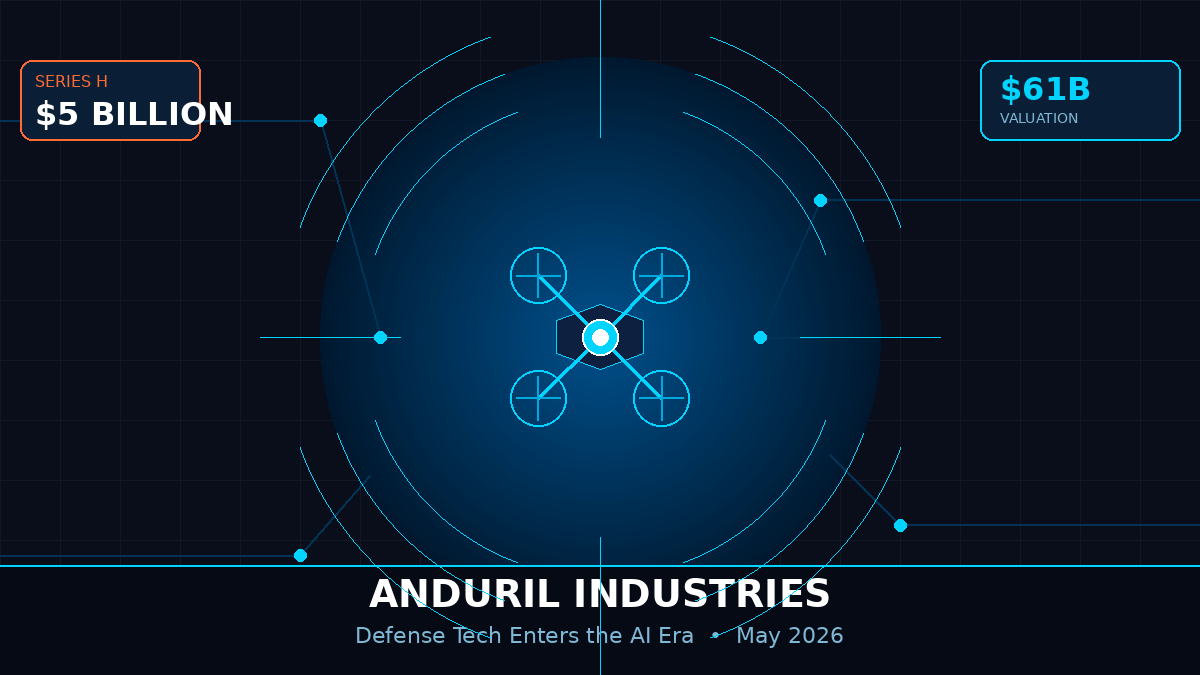
The era of the Silicon Valley defense startup has officially arrived. Anduril Industries, the autonomous weapons and military technology company founded by Palmer Luckey and CEO Brian Schimpf, has closed a $5 billion Series H funding round that more than doubles its valuation to $61 billion. Led by returning investors Thrive Capital and Andreessen Horowitz, the raise cements Anduril’s place as one of the most valuable private technology companies in the world — and signals that defense tech has become the most aggressive new frontier in venture capital.
The scale of this round is staggering. Less than a year ago, Anduril raised $2.5 billion at a $30.5 billion valuation, itself a record-breaking milestone led by Founders Fund — which wrote a $1 billion check, the largest in its history. Now, barely twelve months later, Anduril’s investors have doubled down at twice the price. The company has now raised more than $11 billion in total since its founding in 2017, a trajectory matched by virtually no other private tech company in modern history.
Revenue Growth That Justifies the Hype
The funding doesn’t exist in a vacuum. Anduril has the financial fundamentals to back its astronomical valuation. Revenue more than doubled in 2025, reaching $2.2 billion — a figure that puts it firmly in the category of a mature enterprise software company, not just a defense-adjacent startup chasing government contracts. That growth rate, sustained across the full year, is what convinced Thrive Capital and a16z to commit billions more despite an already elevated valuation.
“When we founded Anduril in 2017, defense was not a category that attracted significant venture investment,” CEO Brian Schimpf wrote in a blog post announcing the raise. “That has changed meaningfully over the last several years.” That may be the understatement of 2026.
What the $5 Billion Will Build
Schimpf has made clear that Anduril will invest “aggressively” in manufacturing capacity, research and development, and the physical infrastructure needed to bring its systems to scale. This isn’t a company sitting on a war chest waiting for an IPO — it’s in build mode, and it needs capital to keep up with the contracts that are flowing in.
Recent contract wins illustrate the breadth of Anduril’s ambitions. In May, the company was selected as part of a team to develop a space-based “Golden Dome” missile defense system — a protective shield designed to intercept ballistic and hypersonic threats before they reach the continental United States. The contract is part of the broader Trump administration push to reindustrialize the U.S. military with cutting-edge autonomous and AI-driven technology.
Anduril also secured a U.S. Army contract for its Lattice battle management software, which uses AI to fuse data from joint missile defense systems and give military commanders a real-time operational picture of the battlefield. A separate contract with the Dutch Ministry of Defense marks the company’s expansion beyond U.S. borders, laying the groundwork for a growing international business.
Meanwhile, in Seattle, Anduril is reportedly building out an autonomous warship operation — a facility focused on developing and potentially manufacturing unmanned naval systems, adding a maritime dimension to its already formidable land and air capabilities.
The Autonomous Fighter Jet at the Center of It All
Among Anduril’s most high-profile platforms is the “Fury” — an autonomous fighter jet designed to operate alongside piloted aircraft, providing AI-driven air support without putting human pilots at risk. In a notable development, the U.S. Air Force selected Shield AI’s autonomy software to operate aboard Fury, rather than awarding the entire software and hardware contract to a single vendor. It’s a sign that even as Anduril wins enormous contracts, the Department of Defense is deliberately cultivating a diverse ecosystem of defense tech providers rather than creating single-vendor dependency.
That nuance matters. The DoD’s strategy is to absorb the best capabilities from multiple startups, which means Anduril’s success doesn’t come at the expense of its rivals — and its rivals’ success doesn’t diminish Anduril’s standing. It’s a rising-tide dynamic that investors are increasingly betting on.
A Defense Tech Gold Rush
Anduril is not alone in attracting record capital. The broader defense tech sector has exploded in 2025 and into 2026, driven by geopolitical instability, the increasing integration of AI into military systems, and a generational shift in how the U.S. government procures defense technology.
Shield AI, which makes autonomy software for military drones and aircraft, raised $1.5 billion in a Series G round in March at a $12.7 billion valuation after its software was selected by the Air Force. Hermeus, the maker of hypersonic unmanned fighter jets, raised $350 million at over a $1 billion valuation in April, led by Khosla Ventures. European defense tech company Helsing, backed by Spotify co-founder Daniel Ek and Lightspeed Venture Partners, is reportedly closing in on a $1.2 billion raise at an $18 billion valuation — further evidence that the defense tech surge is a global phenomenon, not just an American one.
Collectively, the venture capital flowing into defense and autonomous weapons technology in 2026 has already surpassed what the entire sector attracted over the previous decade. The shift is structural. AI has matured to the point where it can meaningfully operate autonomous systems, and the geopolitical climate — from conflicts in Eastern Europe to heightened tensions in the Pacific — has created urgent demand for next-generation military capabilities.
The Ethics Debate Isn’t Going Away
Anduril’s rapid rise does not come without controversy. The company has navigated persistent criticism from some corners of the tech community about the ethics of building lethal autonomous weapons systems. Palmer Luckey, its founder, has been vocal in rejecting the idea that technologists should opt out of national defense — and the investment community has broadly sided with him, at least by the measure of capital flowing into the space.
The debate over autonomous weapons, AI decision-making in battlefield contexts, and the role of private technology companies in national security is likely to intensify as systems like Lattice and Fury move from prototype to operational deployment. For now, investors and the U.S. government appear united in their view that the risks of falling behind geopolitical rivals outweigh the ethical ambiguities of accelerating forward.
What Comes Next
The $61 billion valuation positions Anduril squarely in IPO territory. While no timeline has been announced, a public offering in 2026 or 2027 would allow Anduril to access the public capital markets at a moment when defense tech is arguably the most compelling sector narrative in technology investing.
For now, the company is focused on execution: delivering on its growing contract portfolio, scaling manufacturing, and continuing to push the frontiers of autonomous military systems. With $5 billion freshly in hand, a doubling revenue trajectory, and a contract pipeline that spans land, sea, air, and space, Anduril is doing everything it can to ensure that when the defense tech gold rush is written about in history books, its name appears at the top of the list.