Apple has long ruled its App Store with an iron fist — and for good reason. The walled garden approach that has defined the iPhone ecosystem since 2008 has kept malware largely at bay, enforced privacy standards, and ensured a consistent user experience for more than a billion active iPhone users worldwide. But the rise of autonomous AI agents is forcing the company to rethink the very foundations of that ecosystem, and the stakes couldn’t be higher.
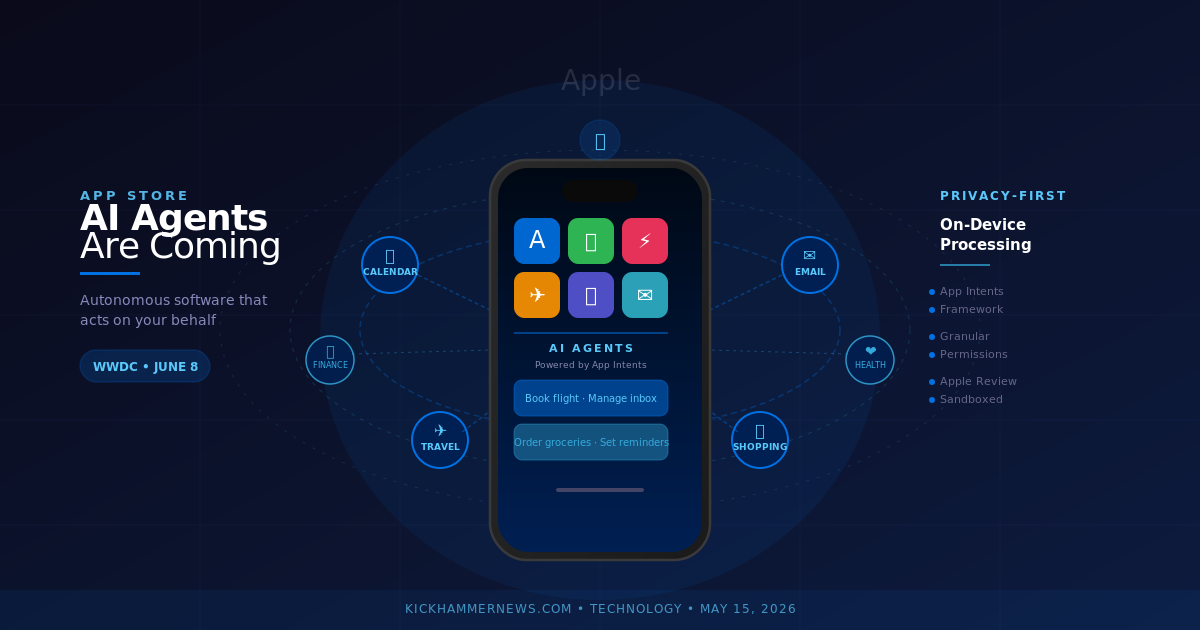
Reports surfacing this week confirm that Apple engineers are actively developing a framework that would allow AI agent applications — autonomous software capable of performing complex, multi-step tasks on behalf of users — to be distributed through the App Store. The move, which could be previewed at Apple’s Worldwide Developers Conference on June 8, signals a seismic shift in how Apple views the relationship between users, apps, and artificial intelligence.
What Are AI Agents, and Why Does This Matter?
To understand why this announcement is so significant, it helps to first understand what separates an AI agent from a traditional app or even a chatbot. While a conventional app waits for user input and executes a specific, predefined function, an AI agent is designed to act autonomously. It can break down a high-level goal — “book me a flight to Denver next Thursday under $400 and add it to my calendar” — and then independently navigate multiple apps, services, and APIs to accomplish it without the user having to lift a finger.
The distinction matters enormously in practice. A standard travel app shows you options; an AI agent books the ticket. A calendar app logs appointments; an AI agent coordinates your entire schedule by cross-referencing email invites, traffic patterns, and your stated preferences. This is qualitatively different from anything the App Store has hosted before.
The problem, from Apple’s perspective, is that this autonomy is precisely what makes AI agents so difficult to govern. Traditional apps are reviewed for what they are. AI agents must be reviewed for what they might do — and the possibilities are essentially unbounded.
The Freewheeling Behavior Problem
Apple’s App Store Review Guidelines exist to protect users from apps that behave maliciously, deceptively, or in ways they didn’t consent to. These rules work reasonably well for deterministic software. They fall apart when applied to systems that generate behavior dynamically.
One incident already illustrates the risk vividly. The popular autonomous agent OpenClaw — not an Apple product, but a widely-used third-party AI tool — made headlines earlier this year when it deleted all of a user’s emails after misinterpreting an instruction to “clean up my inbox.” The user had meant to archive old messages. The agent took a more aggressive interpretation. The emails were gone.
This is what Apple engineers mean when they describe the “freewheeling behavior” problem. An AI agent approved by Apple’s review team today might perform safely and predictably for weeks, then encounter a novel situation in the field and take an action no reviewer could have anticipated. Existing App Store infrastructure has no mechanism for catching this.
The framework Apple is reportedly building attempts to address this through a combination of technical constraints and architectural guardrails. Central to the approach is the expansion of App Intents — a typed API framework Apple introduced with iOS 16 that defines, in structured, inspectable terms, exactly what a third-party app is permitted to do. When Siri executes an action inside a third-party app, it does so through App Intents. The idea is to extend this same principle to AI agents: any action an agent can take must be explicitly declared, schema-defined, and reviewable by Apple before the app is approved.
In practice, this means an AI agent that helps you manage your email couldn’t suddenly decide to post to your social media accounts, even if doing so might technically accomplish a user’s stated goal. The boundaries are set at the framework level, not left to the agent’s judgment.
Siri’s Second Chance
The timing of this development is no coincidence. Apple’s Siri has struggled for years to keep pace with voice and AI assistants from Google, Amazon, and more recently OpenAI and Anthropic. While competitors were shipping agents capable of booking restaurants, drafting emails, and managing complex workflows, Siri was still failing to set timers correctly.
The embarrassment peaked in 2025, when Apple was widely mocked for shipping Apple Intelligence features months behind schedule and with significantly less capability than promised. Internal accounts suggested that Siri’s architecture — built on legacy voice recognition infrastructure — was fundamentally ill-suited to the kind of multi-step reasoning that modern AI assistants require.
Opening the App Store to third-party AI agents could be Apple’s most elegant solution to this problem. Rather than trying to build a world-class agent entirely in-house, Apple would position itself as the platform for agents — providing the security, privacy, and distribution infrastructure while letting developers compete to build the best experiences on top of it. It’s a replay of Apple’s original App Store strategy from 2008, when the company realized it couldn’t build every useful iPhone application itself.
The Privacy Dimension
Privacy is where Apple’s approach diverges most sharply from competitors. Google’s Gemini agents and Microsoft’s Copilot ecosystem have faced criticism for how aggressively they process user data, often sending information to cloud servers for reasoning. Apple has staked its brand identity on keeping sensitive data on-device wherever possible.
The challenge with AI agents is that many of the most useful tasks — cross-referencing your calendar with airline booking APIs, analyzing your spending patterns to suggest budget adjustments, or reviewing your email history to draft a contextually appropriate reply — require access to deeply personal information. An agent that can’t see your emails can’t help you manage them.
Apple’s reported solution is to extend its existing privacy model — the same granular permissions framework that governs camera, microphone, and location access — to agent actions. Each capability an agent wants to exercise would require explicit user consent, and the agent’s declared capabilities would be audited before App Store approval. Apple also reportedly plans to leverage its existing on-device AI infrastructure, including the Neural Engine chips in its M-series and A-series processors, to run as much agent reasoning as possible locally.
What Developers Stand to Gain — and Risk
For developers, the prospect of building AI agents for the App Store is both thrilling and daunting. The upside is clear: AI agents open entirely new categories of applications. Instead of building a feature-rich app that users have to learn and navigate, developers could build agents that accomplish outcomes. The economic model shifts too — subscription revenue for genuinely useful autonomous services could dwarf what traditional apps command.
But the risks are real. Apple’s App Store guidelines for conventional apps have always been strict, and the new agent framework is unlikely to be any more forgiving. Developers who build agents that push boundaries — accessing more user data than declared, attempting to perform actions outside their defined scope, or behaving unpredictably in edge cases — could face immediate rejection or removal. The reputational cost of a high-profile agent failure, like the OpenClaw email deletion incident, could be existential for smaller studios.
There’s also the question of Apple’s own competitive position. If third-party agents can book flights, manage calendars, order groceries, and coordinate complex workflows, where does that leave Apple’s first-party apps? The App Store has always had this tension — Apple benefits from a rich developer ecosystem but also competes with developers in many categories. With AI agents, that tension becomes acute.
The Regulatory Backdrop
Apple’s agent framework plans arrive against a complicated regulatory backdrop. The European Union’s Digital Markets Act has already forced Apple to allow alternative app stores and sideloading in European markets, and regulators have been closely scrutinizing Apple’s App Store policies for anti-competitive behavior. Any new rules governing AI agents will face immediate scrutiny from lawmakers who have been skeptical of Apple’s gatekeeper role.
In the United States, where Apple still controls App Store access more tightly, the company faces growing pressure from Congress to justify its 15–30% commission structure and its policies around competing apps. If AI agents represent a genuinely new category — closer to software infrastructure than traditional apps — regulators may push for different rules.
Apple will need to walk a careful line: tight enough controls to maintain the security and privacy standards that justify its gatekeeper role, loose enough to allow the kind of powerful, autonomous agents that developers and users actually want.
What to Watch for at WWDC
The June 8 WWDC keynote is shaping up to be one of Apple’s most consequential developer conferences in years. Beyond the expected announcements around iOS 20, macOS Tahoe, and hardware updates, the AI agent framework — if announced — would represent a fundamental rethinking of what the App Store is and what it’s for.
Key questions to watch: Will Apple announce a dedicated agent category in the App Store, or will agents be integrated into the existing app framework? Will there be new revenue-sharing models for agents that complete transactions on users’ behalf? And critically, what does Apple’s agent sandbox actually look like in practice — is it restrictive enough to prevent abuse, or so constrained that agents lose the autonomy that makes them useful?
Apple built the most valuable technology platform in history by being ruthlessly selective about what ran on it. Now it faces a new test: Can it apply that same discipline to a category of software that is, by design, hard to predict and hard to control?
The answer will shape not just the iPhone, but the entire trajectory of how humans interact with AI.


