By KickHammer News | June 11, 2026
Today is the day Wall Street has been dreading and anticipating in equal measure. SpaceX, Elon Musk’s rocket company turned AI-powered space conglomerate, is expected to price its initial public offering this evening, setting the stage for shares to begin trading on the Nasdaq on Friday. At a target valuation of $1.75 trillion, it would be the largest IPO in history — dwarfing even the Saudi Aramco offering of 2019 — and a definitive referendum on whether investors still believe in the AI boom or whether they’re starting to see the cracks.
The stakes could not be higher, and the timing could not be more fraught.
A Market Already on Edge
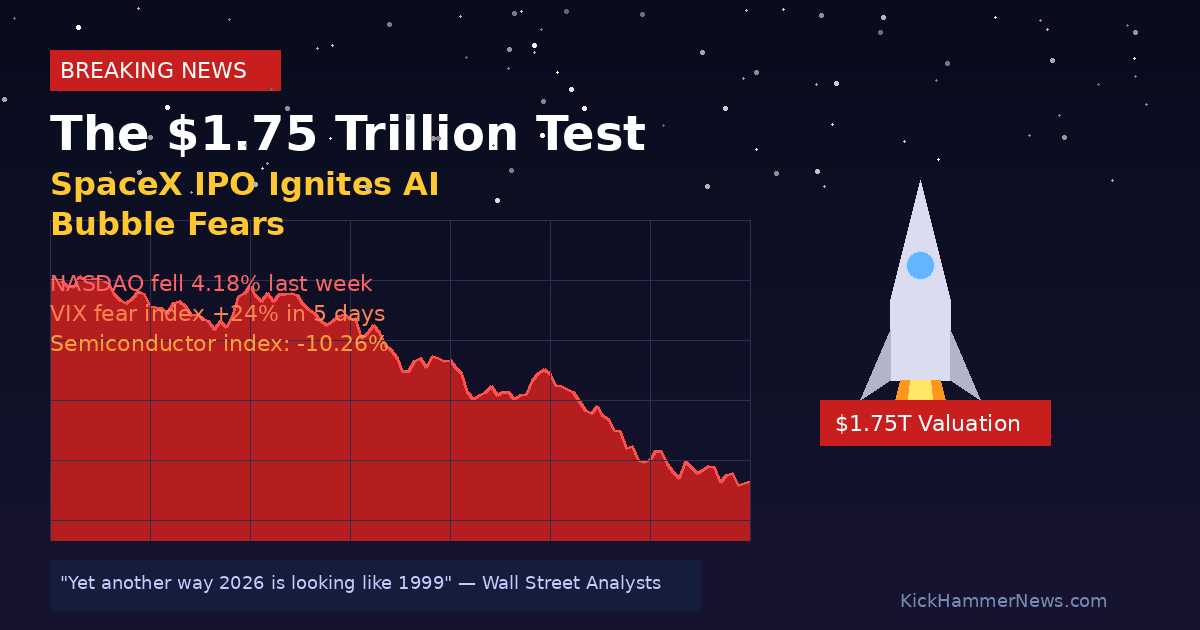
Before SpaceX’s IPO roadshow even concluded, markets began sending distress signals. Last week, the tech-heavy Nasdaq Composite fell 4.18% in a single session, its worst day in months. The Philadelphia Semiconductor Index collapsed more than 10% — a figure that would have felt catastrophic in any other era but has become the backdrop to one of the most extraordinary periods of AI investment in history. The VIX fear index, Wall Street’s standard gauge of investor anxiety, surged 24% over just five days.
“There seems to be no single cause, rather a general sense of increasing risk,” noted Paul Donovan, chief economist at UBS, in a client note last weekend.
The anxiety stems from a collision of pressures that have been building for months. Inflation sits at 3.8%, uncomfortably high. The U.S. unemployment rate is 4.3%. Those two numbers converging near each other has happened only six times since 1960 — in 1966, 1973, 1990, 2000, 2008, and 2021 — and not one of those episodes is remembered fondly on Wall Street. Analysts at Bank of America warned clients that if the pattern holds, it historically points toward Fed rate hikes and potential yield curve inversions, the latter being a widely cited recession indicator.
Add renewed conflict in the Middle East — Iran and Israel exchanged strikes last week, pushing Brent crude above $97 per barrel — and U.S. jobs data that came in far stronger than anyone expected (payrolls rose 172,000 in May, against a consensus forecast of 88,000), and you have a market that suddenly can’t agree on whether the economy is thriving or overheating.
The AI Circularity Problem
The deeper fear, and the one most relevant to the SpaceX IPO and the broader tech sector, is structural: virtually all of America’s current private investment growth is concentrated in AI.
Analysis from ING economist James Smith lays out the uncomfortable arithmetic. Strip away AI and the rest of U.S. private non-residential investment has been falling year-on-year for six consecutive quarters. The only thing holding up the chart is the extraordinary capital pouring into AI data centers, chips, and infrastructure. Goldman Sachs estimates that hyperscalers will spend $7.6 trillion on AI capital expenditure through 2031.
That’s an enormous number — and it has bred what Smith calls a “circularity problem.” The same handful of firms are raising money, buying chips, leasing compute, and booking revenues off one another. Google issued $85 billion in new stock last week. Meta is reportedly considering something similar. Oracle and Meta have already raised billions in private debt to fund AI buildouts. Bank of America’s Yuri Seliger reported that hyperscaler debt issuance had already reached $159 billion year-to-date, 91% of his full-year forecast, compared with roughly $121 billion for all of last year.
“The circularity is attracting more attention,” Smith wrote in a client note. “That may not spell disaster, but the fact remains that if you strip out AI, the rest of U.S. private non-residential investment has been falling year-on-year for six straight quarters.”
The SpaceX IPO is arriving at the apex of this dynamic. And it’s not alone.
The AI IPO Avalanche
SpaceX is pricing into what analysts are calling the most concentrated AI-adjacent IPO wave since the dot-com era. Within weeks of each other, three of the most valuable private companies in the world have begun their march toward public markets.
Anthropic — the AI safety company behind the Claude family of models and now valued at roughly $100 billion — disclosed a confidential S-1 filing at the start of June. Days later, OpenAI, the maker of ChatGPT and currently valued at $852 billion, announced it had also filed confidentially with the SEC. Sam Altman put the company’s approach in characteristically direct terms: “We expect it to leak so we’re just announcing it.” OpenAI has not committed to a timeline, noting that some things it wants to do are “likely easier as a private company,” but the S-1 filing gives it the option to go public as early as this fall.
Together, SpaceX, Anthropic, and OpenAI represent what Goldman Sachs projects could push 2026 IPO proceeds to $160 billion — a roughly fourfold increase from 2025 levels.
The challenge is where all that capital comes from. BNP Paribas has warned clients that retail investors, expected to be heavy buyers of the SpaceX offering, will need to raise cash by selling what they already own — which is heavily concentrated in semiconductor stocks and leveraged Nasdaq products. The very stocks that have driven the AI rally could face their sharpest test yet as capital rotates into SpaceX shares.
1999 Redux?
The historical analogy that keeps surfacing is 1999, the peak of the dot-com bubble. “Yet another way in which 2026 is looking like 1999,” wrote one Fortune analyst last week, citing the concentration of investor enthusiasm in a narrow band of technology companies and the willingness to look past near-term losses in favor of long-term narratives.
The parallels are imperfect but hard to dismiss entirely. OpenAI has reportedly told investors it doesn’t expect to reach profitability until 2030. Neither Anthropic nor SpaceX are currently profitable. Each is asking public market investors to fund losses today in exchange for what could be transformative returns tomorrow — the same basic proposition that animated the late 1990s technology boom.
What’s different this time, proponents argue, is that the underlying technology is genuinely delivering productivity gains. Enterprises are deploying AI at scale. Models are measurably improving. Microsoft, Google, and Amazon are all seeing meaningful revenue contributions from AI products. The economics, supporters say, are more grounded than the dot-com era’s eyeball-counting metrics.
Critics counter that the data center buildout has created a self-referential economy in which AI companies are primarily selling services to each other. Goldman Sachs research notes that roughly 3,500 announced data center projects have not yet broken ground — a “backlog” suggesting that announced commitments and actual investment may diverge.
What Happens Next
As SpaceX prices its offering today, the outcome will tell investors something important about the state of AI sentiment. A strong reception would likely signal that retail and institutional appetite for AI-adjacent assets remains intact, offering Anthropic and OpenAI a warm market for their own forthcoming offerings. A weak pricing — or worse, a pop followed by a sharp selloff — could rattle confidence across the entire sector.
South Korea’s KOSPI fell 8.29% last Monday. Japan’s Nikkei was down 3.85%. Global investors are watching the SpaceX IPO not just as a bet on rockets and satellites, but as a proxy vote on whether the AI story still holds.
The answer will come in a matter of hours. And Wall Street, for once, genuinely doesn’t know how to call it.
Sources: Fortune, eWeek, BNP Paribas client notes, Bank of America research, ING Economics, Goldman Sachs analysis.


