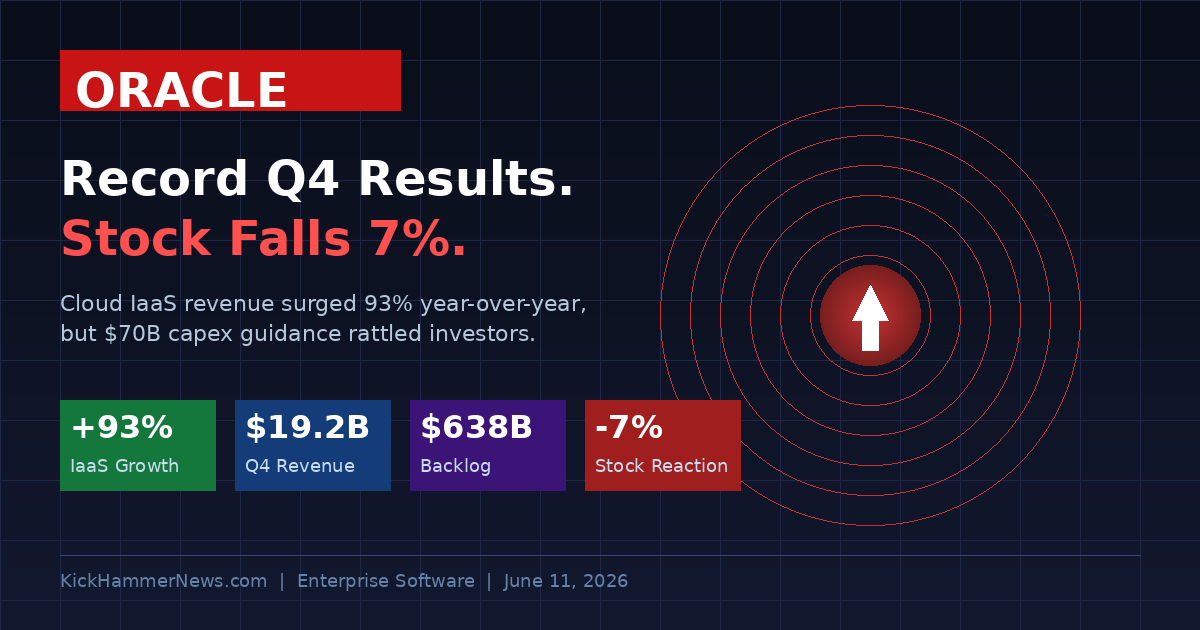
Oracle delivered what looked like a blockbuster fourth-quarter earnings report on Tuesday evening — record revenues, record cloud growth, record backlog — and the market punished the company’s stock by more than seven percent in after-hours trading. It was a vivid reminder that in the current era of AI infrastructure buildout, investors are not simply rewarding growth. They are scrutinizing the price tag.
The Numbers: Every Metric a Record
Oracle’s Q4 fiscal year 2026 results, announced after market close on June 10, were impressive by almost any traditional measure. Total revenues for the quarter reached $19.2 billion, up 21 percent year-over-year in U.S. dollars. Total cloud revenues hit $9.9 billion, a 47 percent increase that put Oracle squarely in the conversation as one of the fastest-growing hyperscale cloud providers on the planet.
The headline figure that caught the most attention was Oracle’s cloud infrastructure (IaaS) revenue, which surged 93 percent year-over-year to $5.8 billion. For a company that only began making serious inroads into the cloud infrastructure market several years after Amazon, Microsoft, and Google, that figure represents a remarkable trajectory. Cloud applications (SaaS) revenue grew a more modest but still healthy 10 percent, reaching $4.1 billion.
On the earnings front, Oracle posted non-GAAP earnings per share of $2.11, up 24 percent and comfortably ahead of analyst estimates of around $1.89. GAAP EPS came in at $1.45, a 21 percent gain. For the full fiscal year 2026, Oracle reported total revenues of $67.4 billion — up 17 percent — and total cloud revenues of $34.0 billion, up 39 percent. Operating cash flow for the year reached a record $32.0 billion, a 54 percent increase.
The company’s remaining performance obligations (RPO), a closely watched metric representing contracted future revenues not yet recognized, grew by $85 billion in the quarter alone, jumping from $553 billion to $638 billion. That backlog figure suggests Oracle’s near-term revenue pipeline is extraordinarily robust.
The Problem: Capital Spending Is Running Hot
So why did the stock fall? The answer lies almost entirely in capital expenditure.
Oracle spent $15.9 billion on capital expenditures in Q4 alone. For the full fiscal year, capex totaled $55.7 billion — a figure that significantly exceeded the company’s own previous guidance of roughly $50 billion. That overshoot rattled investors who were already watching AI infrastructure spending with some anxiety across the sector.
More troubling still was the forward guidance. Oracle said it expects to spend approximately $70 billion in “net cash outlay for capital expenditures” in fiscal year 2027. That is a substantial step-up, and it comes at a time when questions about the return on AI infrastructure investment are becoming louder across Wall Street.
The financing picture is equally eye-catching. In fiscal year 2026, Oracle raised $43 billion in debt financing and $5 billion in equity financing to fund its buildout. For fiscal 2027, the company expects to raise approximately $40 billion more through a combination of debt and equity, including a previously announced $20 billion at-the-market equity offering. That level of capital market activity is typically associated with capital-intensive industries like utilities or telecommunications — not software companies, even ones pivoting hard toward infrastructure.
The AI Infrastructure Thesis — and Its Risks
Oracle’s aggressive investment stance is driven by a specific strategic bet: that demand for AI compute — particularly large-scale AI training and inference workloads — will remain insatiable for years to come. Chairman Larry Ellison has been particularly vocal about Oracle’s multi-cloud AI partnerships, including its role in the U.S. government’s Stargate initiative and its growing relationships with hyperscaler customers who are essentially leasing Oracle GPU capacity.
A significant portion of Oracle’s $638 billion RPO backlog is tied to these large AI contracts. The company disclosed that prepaid and customer-supplied hardware portions of large AI contracts now total $75 billion — meaning many of the GPU clusters being built are either pre-paid by customers or involve customers supplying their own chips to Oracle for hosting. This is an unusual arrangement that somewhat de-risks the demand side of Oracle’s investment case, but it does not fully satisfy investors concerned about balance sheet leverage.
The dynamic echoes debates playing out across the hyperscaler landscape. Microsoft, Amazon, and Google have all faced similar investor scrutiny over their AI-driven capex ramp-ups in recent quarters. The question is whether the revenue being contracted today will generate returns sufficient to justify the interest expense and equity dilution required to fund the infrastructure.
A Tale of Two Narratives
Oracle’s situation is in some ways a microcosm of the broader enterprise software-to-infrastructure identity crisis that is reshaping the technology sector in 2026. The company that built its reputation on database software and business applications is increasingly being valued — and judged — on metrics more appropriate for a data center operator.
That shift has significant implications. Database and applications software historically generated high margins with modest capital requirements. Cloud infrastructure is a volume business requiring constant reinvestment. Oracle has been remarkably successful at transitioning its revenue mix toward cloud — and the 93 percent IaaS growth figure shows the strategy is working on the top line. But translating that growth into durable free cash flow per share, in the face of $70 billion annual capex commitments and rising interest costs on a ballooning debt load, is a much harder task.
What Analysts Are Watching
In the days following the earnings release, analysts are likely to focus on a handful of key questions: How quickly is Oracle converting its RPO backlog into recognized revenue? What margins can the IaaS business sustain at scale, and how do they compare to AWS, Azure, and Google Cloud? And critically, does the $638 billion backlog represent real, locked-in demand, or does it include significant optionality that customers might not fully exercise?
Oracle’s guidance for Q1 fiscal 2027 — expected to be released alongside the full earnings call transcript — will also be scrutinized for any signs that the revenue ramp is accelerating enough to absorb the capital deployment.
Bottom Line
Oracle’s Q4 and full-year fiscal 2026 results were genuinely impressive from a growth perspective. Cloud infrastructure revenues doubling in under two years, a backlog approaching $640 billion, and record operating cash flows are not the hallmarks of a company in distress. But the 7 percent after-hours stock decline reflects a straightforward investor calculus: record results are not enough when the cost of achieving them — and funding the next phase — is this large.
The market is asking Oracle to prove that its AI infrastructure gamble will ultimately generate returns commensurate with its extraordinary risk. For now, the jury is still deliberating.


