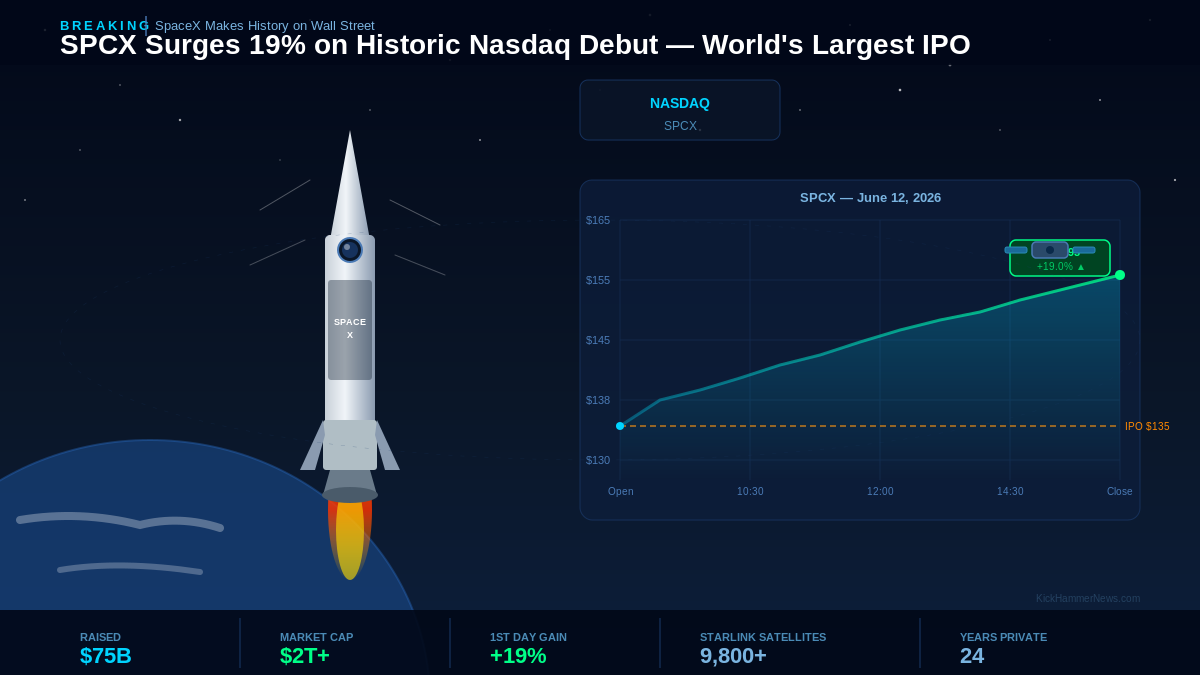
After 24 years as one of Silicon Valley’s most coveted private companies, SpaceX finally opened its doors to public investors on Friday — and the market answered with thunderous enthusiasm. Shares of the aerospace and technology giant closed at $160.95 on their first day of trading on the Nasdaq, a 19% leap above the IPO price of $135, capping what has already been certified as the largest initial public offering in stock market history.
The moment had been anticipated for years. Elon Musk’s rocket company, which first launched in 2002 with the audacious mission of making humanity multiplanetary, raised a staggering $75 billion by selling 555.56 million shares — a figure that dwarfs every IPO that came before it. At its closing price, SpaceX commanded an implied market capitalization north of $2 trillion, instantly placing it among the most valuable public companies on the planet.
A Historic Bell-Ringing
Trading opened at $150 per share — already 11% above the IPO price — as investors scrambled to get exposure to a company that has reshaped both the commercial space industry and, increasingly, the global technology landscape. Nasdaq’s screens in Times Square lit up with the SPCX ticker as SpaceX Chief Operating Officer Gwynne Shotwell rang the opening bell from the company’s Starbase facility in Boca Chica, Texas, flanked by engineers in SpaceX flight suits. The dual ceremony — simultaneously at Nasdaq MarketSite in New York and at Starbase — was itself a statement: SpaceX is not quite a Wall Street company, and it never will be.
Shotwell, who has run SpaceX’s day-to-day operations for nearly two decades while Musk focused on Tesla, xAI, and his other ventures, spoke briefly to the press before the open. “This is not an exit,” she said. “This is an accelerant.”
What SpaceX Is Worth — and Why
The $75 billion raised dwarfs the previous record holder, Saudi Aramco, which raised $29.4 billion in its 2019 IPO. The sheer scale reflects the transformation SpaceX has undergone since its early days of exploding Falcon 1 rockets. Today the company operates three distinct high-value businesses: the Falcon 9 and Falcon Heavy launch vehicles that dominate the global commercial launch market, the Starship super-heavy rocket now conducting operational flights, and Starlink — the satellite internet constellation that has become the company’s most lucrative and fastest-growing unit.
Starlink now operates more than 9,800 satellites in low Earth orbit, serving tens of millions of subscribers across more than 100 countries. Analysts estimate Starlink alone could be worth $800 billion to $1 trillion as a standalone business, given its near-monopoly on affordable broadband in rural, maritime, and aviation markets. The constellation has also become critical infrastructure for militaries and governments around the world, adding a geopolitical dimension to its valuation that traditional financial models struggle to capture.
SpaceX reported 2025 revenues of $18.5 billion, a figure that reflects both the strength of its launch manifest and the rapid growth of Starlink subscriptions. The company did post a net loss of approximately $5 billion for the year, a figure that raised some eyebrows on Wall Street — but which management attributed almost entirely to the integration costs following SpaceX’s acquisition of Elon Musk’s artificial intelligence company xAI in February 2026. That deal brought with it xAI’s Grok large language models, a massive GPU compute cluster, and a team of AI researchers, which SpaceX is now deploying to automate mission planning, satellite collision avoidance, and rocket manufacturing.
The xAI Factor
The xAI acquisition has added a speculative premium to the SpaceX story — and perhaps equally, a risk factor. Bulls argue that an AI-native space company with sovereign launch capability, global broadband infrastructure, and thousands of satellites collecting real-time Earth observation data is essentially a one-of-a-kind asset. Bears point out that SpaceX is now absorbing two extremely capital-intensive bets — reusable heavy-lift rockets and frontier AI — simultaneously, and that the $5 billion operating loss may be a preview rather than a one-time event.
Musk himself made no public appearance at the IPO, unusual for a founder of this stature. He posted a single message on X — the social media platform he owns — reading simply: “To the stars. 🚀” The post accumulated over 40 million views within hours.
Retail Investors Got In Early
One distinctive feature of the SpaceX offering was its unusually large retail allocation. Up to 30% of the IPO shares were made available to individual investors through a partnership with Robinhood and Fidelity, compared to the typical 5-10% in conventional large-cap IPOs. The company and its underwriters — Goldman Sachs, Morgan Stanley, and JPMorgan — reportedly made this decision intentionally, reasoning that SpaceX has a uniquely broad and passionate retail investor base that would provide long-term stability in the shareholder register.
The strategy appears to have worked. Trading volume on the first day was enormous, but the stock avoided the wild intraday swings that plagued some recent large-cap tech IPOs. SPCX opened, climbed steadily through the session, and closed near its intraday high — textbook behavior for a well-subscribed offering.
What Comes Next
The proceeds of the IPO will not go to Musk or to selling shareholders. SpaceX structured the offering as a primary raise, meaning the full $75 billion lands on the company’s balance sheet. Management has indicated the capital will accelerate Starship production toward a fleet capable of monthly Mars cargo missions, fund a second Starlink generation offering laser inter-satellite links for faster latency, and finance the buildout of xAI’s next-generation compute infrastructure.
For the broader technology market, the SPCX debut carries significance beyond one company’s stock price. It signals that the era of mega-cap private tech companies sheltering from public scrutiny may be drawing to a close. With Stripe, Databricks, and several large defense AI contractors rumored to be preparing their own S-1 filings in the back half of 2026, SpaceX’s successful debut could open the floodgates for a new wave of high-profile listings.
Friday, June 12, 2026 may well be remembered as the day that the space economy officially arrived on Wall Street — and Wall Street, for once, was ready for it.


