The numbers have always been staggering. But Goldman Sachs just made them concrete.
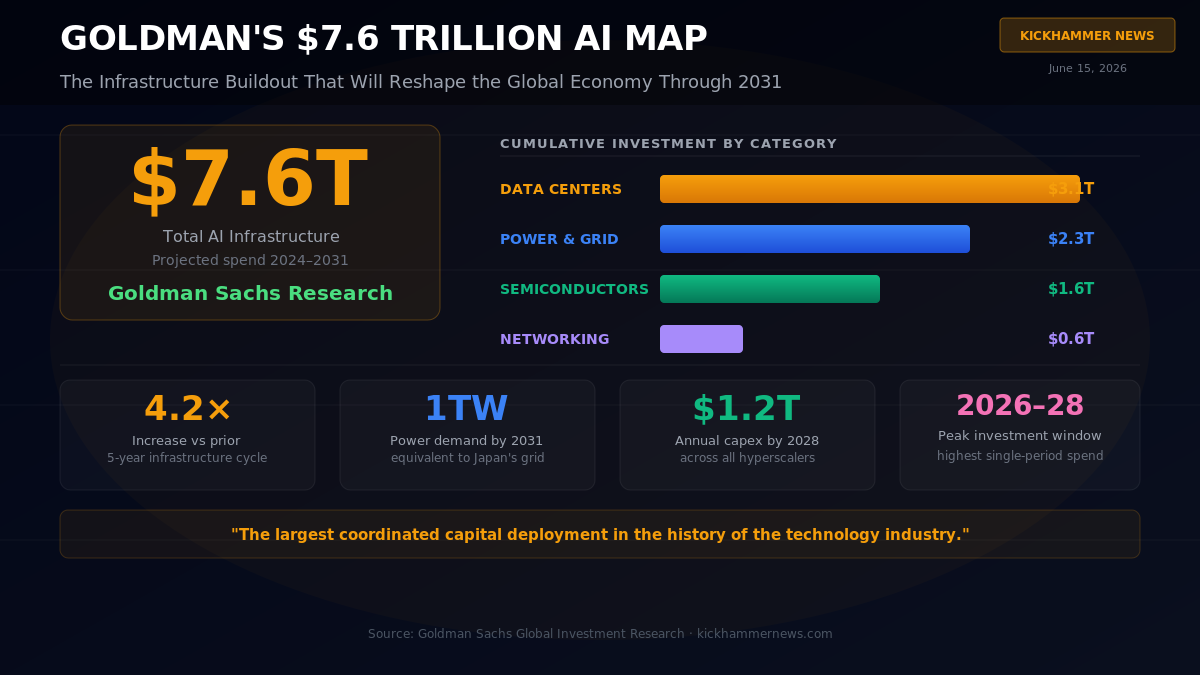
In a sweeping new infrastructure forecast, the investment bank projects that the global artificial intelligence buildout will consume $7.6 trillion in cumulative capital expenditure between 2026 and 2031 — a figure so large it eclipses the annual GDP of every country on Earth except the United States and China. Goldman’s analysts broke the spending into three layers: $5.1 trillion for compute hardware, $2.1 trillion for data centers, and $358 billion for power infrastructure. Annual AI capital spending is expected to reach $1.6 trillion by 2031, more than doubling from $765 billion this year alone.
This is not just an investment thesis. It is a reordering of the global technology economy, and its consequences will ripple outward in ways that most people are only beginning to understand.
The Compute Layer: Nvidia’s Triumphal March
At the center of Goldman’s forecast sits a single company: Nvidia. The bank projects that Nvidia will capture approximately 75 percent of the entire $5.1 trillion compute layer over the six-year period — roughly $3.8 trillion in cumulative revenue from its AI accelerators and systems. The baseline unit underpinning much of this projection is the Rubin VR200 chip, priced at approximately $80,500 per GPU.
This concentration is, in one sense, a testament to Nvidia’s extraordinary technical lead. No current GPU alternative delivers comparable performance at scale. Even the hyperscalers — Meta, Microsoft, Amazon, and Alphabet — who are pouring billions into developing their own custom silicon (Google’s TPUs, Amazon’s Trainium, Microsoft’s Maia) continue to purchase Nvidia hardware in parallel, because nothing else trains frontier AI models at the speed and efficiency the market demands.
Nvidia’s data center GPU gross margins, sitting at a remarkable 75 percent, are the envy of the semiconductor industry. This is also exactly why every major cloud company is developing alternatives. But the performance gap remains wide enough that the custom silicon projects serve as competitive hedges rather than replacements.
Goldman separately projects combined AI capex of $5.3 trillion from the four largest hyperscalers — Meta, Microsoft, Amazon, and Alphabet — between fiscal year 2025 and fiscal year 2030. That figure alone exceeds the current annual GDP of Japan.
Data Centers: From Megawatts to Gigawatts
The data center layer tells a story of physical transformation that is barely visible to the outside world but is reshaping real estate markets, supply chains, and electricity grids across every continent.
Standard enterprise cloud infrastructure operates at five to fifteen kilowatts per rack. That was the paradigm for decades of internet infrastructure. The Blackwell generation of AI facilities pushed this to 130 to 200 kilowatts per rack — already a tenfold increase that forced major redesigns in cooling and power distribution. But the next generation of AI factories, running Nvidia’s Rubin and Feynman chips, will require more than 500 kilowatts per rack. Liquid cooling is no longer optional; it is the only thermal solution that works at this density.
Construction costs are escalating accordingly. Traditional hyperscale data centers cost roughly $10 million per megawatt to build. Next-generation AI facilities are being designed and contracted at $15 to $20 million per megawatt — a 50 to 100 percent premium driven entirely by the cooling and power infrastructure requirements of high-density AI compute.
Vertiv, the data center infrastructure company, sits directly in the path of this upgrade wave. Every rack transitioning from 40 kilowatts to 500-plus kilowatts requires new liquid cooling systems, new power distribution equipment, and new thermal management infrastructure that existing facilities were simply not built to handle. Goldman’s analysts project the liquid cooling market will grow from $5.5 billion today to $15.75 billion by 2030 — a near tripling in less than five years, driven almost entirely by AI compute density requirements.
Power: The Real Bottleneck
The power segment of Goldman’s forecast — at $358 billion — is the smallest by dollar amount but, paradoxically, the most consequential constraint on the entire buildout.
Amazon CEO Andy Jassy captured the situation plainly when he said: “Our single biggest constraint is power.” The numbers bear him out. Grid connection timelines for large data centers now extend into years, not months. Utilities have waiting lists. Transmission infrastructure is creaking under load that was never anticipated. In several U.S. states, data center developers are being told that new large-scale facilities cannot receive utility power until 2028 or 2029 at the earliest.
The response from the industry has been aggressive and revealing. Vistra, the nuclear power company, locked in a 20-year power purchase agreement with Meta covering over 2,600 megawatts of nuclear energy — enough to power roughly two million homes, now dedicated to AI training. The company struck a separate deal with AWS. Goldman Sachs and Jefferies both upgraded Vistra following the Meta announcement, recognizing that nuclear energy has suddenly become one of the most strategically valuable assets in the AI economy.
The broader pattern is unmistakable: the AI industry is becoming a patron of nuclear energy in ways that would have seemed unlikely just three years ago. Reliability, carbon-free generation, and the ability to contract long-term capacity are all characteristics that AI data centers desperately need and that nuclear uniquely provides.
The Wild Card: Silicon Depreciation
Goldman’s model contains one variable that, more than any other, determines the financial outcomes of the entire buildout. It concerns how long AI chips remain economically useful before being replaced.
At a three-year chip replacement cycle, cumulative compute depreciation reaches $3.99 trillion over the forecast period. At a seven-year cycle, that figure falls to $2.23 trillion — a difference of $1.76 trillion driven by a single assumption about useful life. This is not a trivial uncertainty. AI chips are improving so rapidly that hardware obsolescence may force accelerated replacement cycles that no traditional depreciation model was designed to handle. On the other hand, the sheer capital cost of leading-edge chips may push operators to extend their useful lives well beyond what historical precedent would suggest.
The answer to this question — which no one currently knows with confidence — will determine whether the $7.6 trillion forecast proves conservative or extravagant.
Geopolitical Dimensions
The Goldman forecast, rigorous as it is, says relatively little about the geopolitical factors that may accelerate or disrupt the buildout it describes. U.S. export controls on advanced AI chips have already reshaped trade flows, forcing Chinese tech companies to scramble for domestic alternatives while pushing Nvidia to find creative workarounds — most recently by opening orders for its Vera CPU line into China, which faces fewer restrictions than its GPU products.
Meanwhile, China’s government has announced a $295 billion AI infrastructure investment program of its own, a figure that represents a meaningful addition to Goldman’s $7.6 trillion global total. Europe is also ramping up, with the EU announcing several large-scale AI industrial programs and SoftBank reportedly pursuing a $52 billion data center investment program across the continent.
The infrastructure race, in other words, is not merely a corporate competition. It has become a dimension of national strategy, with governments treating AI compute capacity the way previous generations treated oil refineries or steel mills: as fundamental to economic and military power.
What It Means
There is a temptation to treat numbers this large as abstractions. Seven point six trillion dollars. One point six trillion annually by 2031. Three point eight trillion to Nvidia alone. The mind slides off them.
But the physical reality these numbers describe is tangible and ongoing. Tens of thousands of construction workers are building data centers across America, Europe, and Asia. Power engineers are rerouting grid infrastructure. Cooling system manufacturers are running plants at full capacity. Chip fabs in Taiwan, South Korea, and the United States are operating around the clock.
The Goldman Sachs forecast is not a prediction so much as a map of something that has already begun. The concrete is being poured. The power lines are being strung. The chips are being fabbed. The question is not whether this buildout will happen — it is already happening — but who will benefit from it, who will pay for it, and what the world looks like on the other side of the largest capital investment cycle in the history of technology.
The answer to that last question will define the next decade.


