The global race to dominate artificial intelligence has always been framed as a contest of algorithms and talent. But quietly, decisively, and with the full weight of the Chinese state behind it, Beijing is redefining the battleground. The real competition, it turns out, is over concrete, fiber, silicon, and electricity—the physical infrastructure that determines who can run AI at scale and who cannot.
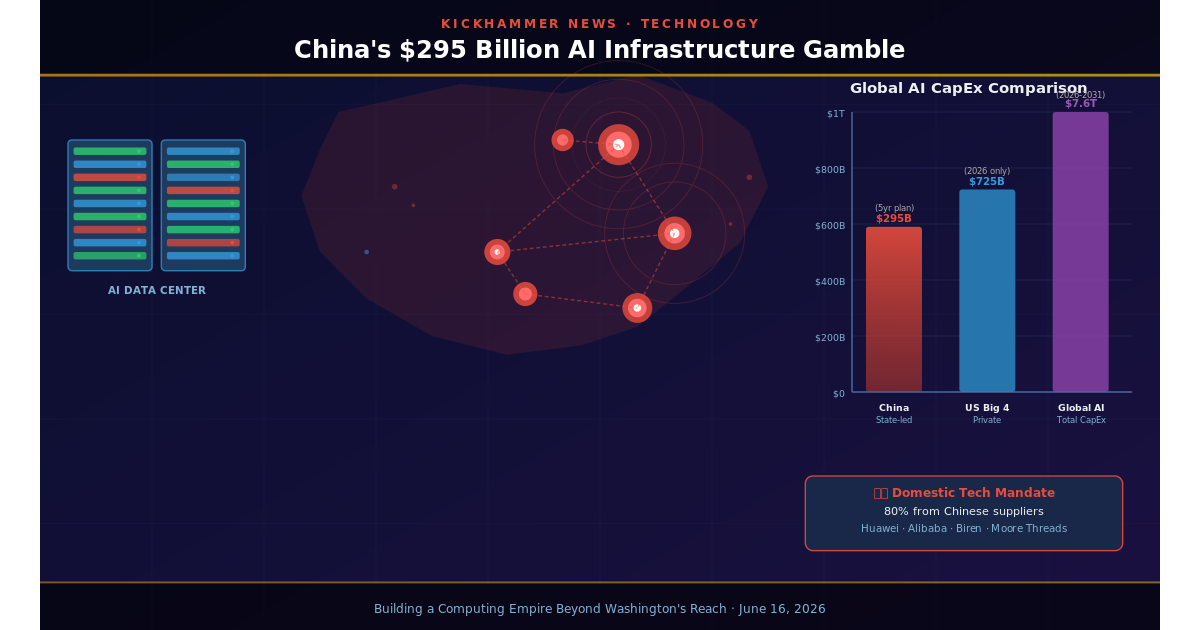
China is preparing to spend approximately 2 trillion yuan—roughly $295 billion—over the next five years to construct a nationwide network of interconnected AI data centers. The scale is staggering. The ambition is even larger. And the geopolitical implications may reshape the technology landscape for decades.
A Plan Taking Shape at the Highest Levels
According to reporting by Bloomberg, key government agencies including the National Development and Reform Commission (NDRC) are actively drafting the blueprint. China’s two largest state-owned telecom operators—China Mobile and China Telecom—are expected to serve as the backbone, operating the bulk of the data center facilities and ensuring high-speed interconnectivity between regional computing hubs.
This is not a speculative investment roadmap or a private equity wish list. It is a state-directed national infrastructure program, the kind China has executed before in highways, high-speed rail, 5G networks, and solar panel manufacturing—industries where Beijing chose to lead globally through sheer force of industrial policy and patient capital.
The difference this time is that the stakes involve intelligence itself.
Cutting Out American Chips
Perhaps the most consequential aspect of the plan is its hardware mandate. Officials reportedly want at least 80% of the technology deployed across the network—AI processors, servers, networking equipment—to come from Chinese domestic suppliers. That requirement is an explicit signal to Nvidia, AMD, and their U.S. allies: you are not invited.
In their place, Huawei’s Ascend line of AI chips is expected to play a central role. In May 2026, Chinese authorities approved nine categories of domestically produced AI chips from Huawei, Alibaba, Biren Technology, and Moore Threads for use across government and security-sensitive sectors. Those approvals cleared a path that had long been blocked by both regulatory uncertainty and concerns about performance gaps with Western alternatives.
The export restrictions that the United States imposed on advanced chips—including the A100, H100, and later H200—were designed to slow China’s AI progress. The effect may have been the opposite: by cutting off access to foreign supply chains, Washington accelerated Beijing’s determination to build its own. Huawei’s Ascend 910B and 910C processors have emerged as credible, if not equivalent, alternatives. With hundreds of billions of dollars now flowing into deployments, Chinese chip vendors will have the scale to iterate rapidly.
How $295 Billion Compares
Context matters here. The $295 billion figure covers five years and represents state-backed and state-directed spending. It is not the totality of China’s AI infrastructure investment—private sector giants like Alibaba, Tencent, and ByteDance are investing separately.
For comparison, Goldman Sachs published research in June 2026 estimating that cumulative global AI capital expenditure will reach $7.6 trillion between 2026 and 2031. The four largest U.S. hyperscalers—Meta, Microsoft, Amazon, and Alphabet—are expected to spend a combined $5.3 trillion through 2030 alone.
The sheer scale of U.S. private-sector spending dwarfs Beijing’s plan on paper. But China’s approach has a different structural logic. State-coordinated infrastructure spending is aimed at achieving baseline national capability—a floor of computing capacity that exists outside the market’s boom-and-bust cycles and beyond the reach of foreign policy decisions. Where U.S. investment follows profitability signals, China’s investment follows strategic necessity.
The Architecture of Independence
The plan builds on earlier programs that have already laid partial foundations. China’s “Eastern Data, Western Computing” initiative, launched in 2022, aimed to redistribute computing workloads from data-hungry eastern coastal cities to energy-rich western provinces. The National Integrated Computing Network has been trying to knit together disparate regional data centers into a more cohesive national resource.
The new $295 billion program represents a significant acceleration and formalization of those efforts. The goal is not just more data centers, but a genuinely integrated national computing fabric—one where AI workloads can flow between facilities, energy sources can be optimized across regions, and no single point of failure (or foreign sanction) can take the system down.
Funding is expected to come from multiple sources: special-purpose sovereign bonds, state-backed investment vehicles, policy bank financing, and likely contributions from China’s major technology platforms. That diversified funding structure insulates the program from the kind of market volatility that can derail private-sector infrastructure projects.
Energy, Environment, and the Grid
A project of this scale cannot avoid hard questions about energy. AI data centers are among the most electricity-intensive facilities ever built. Training large models and serving inference requests at population scale requires continuous, high-density power that most electrical grids struggle to sustain.
China’s plan is likely to concentrate new facilities in provinces with abundant power generation capacity—including regions served by large hydroelectric installations and, in some areas, coal-fired plants. Western provinces like Guizhou, Inner Mongolia, and Xinjiang have already been targeted under earlier programs for their relatively cheap energy and available land.
The environmental implications are significant. China has committed to peaking carbon emissions before 2030 and achieving carbon neutrality by 2060. A massive surge in data center power consumption creates tension with those pledges, particularly when facilities rely on fossil fuel generation. How the government resolves that tension—through renewable buildout, nuclear expansion, or carbon offsets—remains to be seen.
What This Means for the Technology Industry
For Nvidia and AMD, the message is clear. One of the world’s largest technology markets is accelerating its departure from Western semiconductor dependency. The long-term revenue implications are substantial, not merely from China’s government procurement but from the private-sector ecosystem that will orbit the state-funded infrastructure.
For global cloud providers—Amazon Web Services, Microsoft Azure, Google Cloud—the emerging reality is bifurcation. A world where Chinese AI infrastructure runs primarily on Chinese chips, Chinese software, and Chinese networks is a world where interoperability becomes harder and where the assumptions embedded in global cloud architectures need revisiting.
For startups and AI developers operating internationally, the bifurcation creates a strategic crossroads. Products built on U.S. cloud infrastructure and Western AI stacks may face increasing friction in markets where Chinese platforms dominate. Conversely, the scale of China’s investment could create new openings for developers willing to build within that ecosystem.
The Longer Game
What Beijing is building is not just computing capacity. It is autonomy.
The $295 billion plan is explicitly designed to ensure that China’s AI sector can continue advancing regardless of what happens in Washington, in Taiwan, or in the global semiconductor supply chain. It is a hedge against every scenario that Beijing views as a strategic threat: chip embargoes, economic decoupling, military conflict, or simply being outcompeted by a faster-moving adversary.
The United States has responded to China’s AI ambitions primarily through export controls and investment restrictions. Those tools have had measurable effects—but they have also sharpened China’s resolve to eliminate the dependencies that make those tools effective.
The AI infrastructure race is no longer a contest that can be won purely by having the best models or the most talented researchers. It is becoming a contest over who controls the computing substrate that underlies everything else. China has decided, with unmistakable clarity, that it intends to control its own.
Sources: Bloomberg, Tech Startups, Goldman Sachs Global Research, China Money Network


