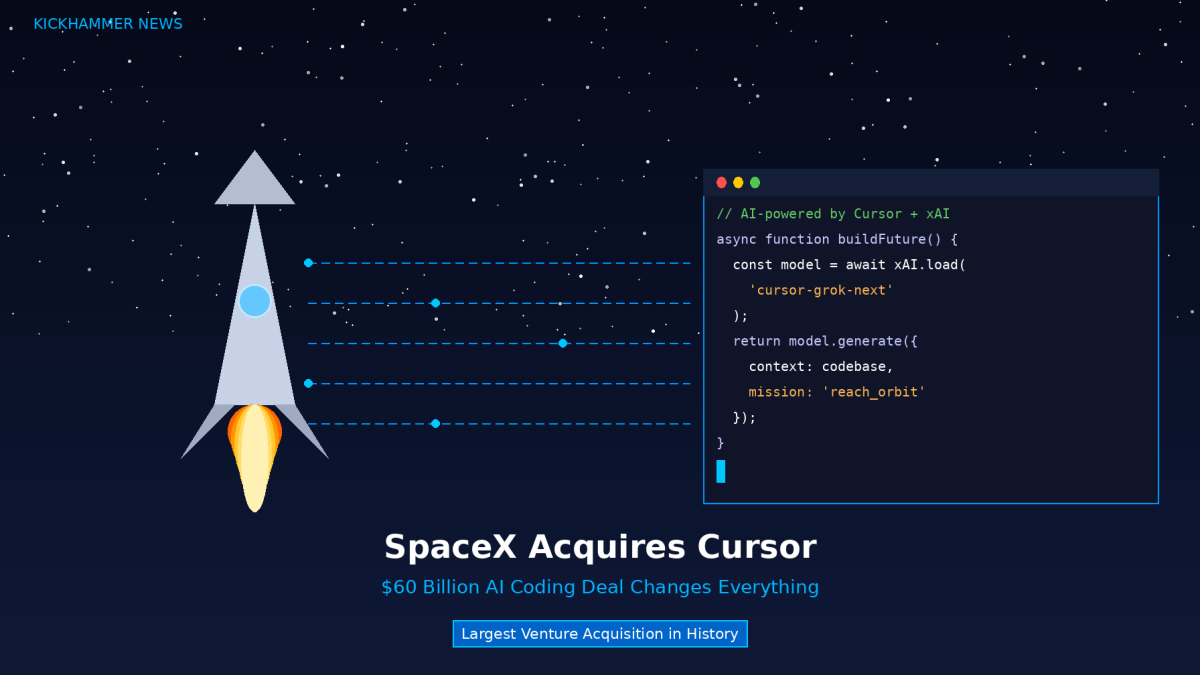
When SpaceX rang the opening bell at Nasdaq on June 12, 2026, raising $75 billion in the largest IPO in history, many expected the company to pivot toward ambitious space programs or doubled-down satellite infrastructure. What few anticipated was that just four days later, SpaceX would announce an even more audacious move: a $60 billion all-stock acquisition of Anysphere, the startup behind Cursor — the AI-powered code editor that has reshaped how millions of developers write software.
The deal, now one week old and expected to close in Q3 2026, is already being called the largest acquisition of a venture-backed startup in history. It is also the clearest signal yet that the war for AI dominance isn’t just being fought in chatbots and cloud services — it’s being fought inside the code editor sitting open on every developer’s screen.
What Is Cursor, and Why Does It Matter?
If you haven’t heard of Cursor, you almost certainly know a developer who has switched to it. Built by Anysphere, Cursor is an AI-native code editor that doesn’t just auto-complete lines — it understands entire codebases, rewrites functions, generates tests, and debugs errors with the fluency of a senior engineer. By February 2026, Cursor had reached $2 billion in annual recurring revenue, a milestone that made it the fastest-growing business software company ever recorded, according to multiple reports.
The company counts roughly 50,000 enterprise customers, ranging from scrappy startups to Fortune 500 engineering teams. At its peak in mid-2025, Cursor commanded roughly 41% of the AI coding assistant market. That share has eroded somewhat — to about 26% by May 2026 — as Anthropic’s Claude Code surged to control nearly half the category. But the revenue trajectory and customer depth remained extraordinary.
Before SpaceX came calling, Anysphere was on track to close a $2 billion funding round backed by Andreessen Horowitz, Thrive Capital, and Nvidia at a $50 billion valuation. SpaceX preempted that fundraise in April with a uniquely structured deal: an option agreement giving Musk’s company the right to acquire Anysphere outright at $60 billion, or walk away by paying a roughly $10 billion combined breakup and deferred-services fee. On June 16, SpaceX exercised that option.
A $26 Trillion Bet on AI
The strategic logic behind the deal is rooted in what SpaceX told investors during its IPO roadshow. The company described a $26 trillion addressable market for AI products — a figure roughly equivalent to the entire U.S. GDP. That ambition requires more than rockets and satellites; it requires AI infrastructure that touches developers directly.
SpaceX’s AI division, built around xAI — Elon Musk’s AI company, which merged with SpaceX earlier this year — has faced a turbulent stretch. Despite launching Grok as a capable large language model and Grok Build as an AI-powered development environment, xAI struggled with controversies around content moderation, including allegations that its models permitted the generation of non-consensual imagery. The division was still in the midst of a restructuring when the Cursor deal was announced.
Acquiring Cursor gives xAI immediate credibility in the developer tools market. More importantly, it brings a proven product, a massive enterprise install base, and a team that has been quietly co-training a new AI model alongside SpaceX engineers for months. That joint model is expected to debut inside both Cursor and Grok Build, potentially leapfrogging the current generation of AI coding assistants.
The Competitive Stakes
The acquisition reshapes a competitive landscape that was already undergoing rapid consolidation. Microsoft remains the most formidable player through its ownership of GitHub Copilot, the pioneering AI coding tool, combined with its deep integration of models from OpenAI. Google competes through Gemini Code, which benefits from the same 2-million-token context window planned for the forthcoming Gemini 3.5 Pro. Anthropic, meanwhile, has built Claude Code into a developer favorite — one that now holds roughly 50% of the AI coding market after gaining ground that Cursor lost.
SpaceX’s entry into this category with a $60 billion acquisition isn’t just a competitive move — it’s a statement that AI-native development platforms have crossed from indie productivity tools to strategic infrastructure worth betting entire company balance sheets on. The AI-native development platform market is projected to reach $9.8 billion by the end of 2026, growing at approximately 38% annually.
For Microsoft and Anthropic, the SpaceX-Cursor deal raises an uncomfortable question: if a company whose primary business is building rockets and satellites is willing to spend $60 billion on a code editor, what does that say about the stakes involved?
What Happens to Cursor Now?
SpaceX has said the deal is expected to close in Q3 2026, subject to regulatory approval. Once it does, Cursor will become a wholly owned SpaceX subsidiary — one with significant independence expected to continue building for developers who have nothing to do with space or xAI’s broader AI agenda.
In the short term, the most concrete change is likely to be the debut of the co-developed model, which analysts expect will offer deeper reasoning capabilities and tighter integration with SpaceX’s own engineering workflows. The company has stated that embedding AI-native software development capabilities into its operations at scale will accelerate development across Starship, Starlink, and other programs — effectively using its own acquisition as internal tooling.
For Cursor’s enterprise customers, the near-term disruption should be minimal. Anysphere’s leadership team is expected to remain in place, and the product will continue operating on its existing pricing model. The longer-term question — whether xAI’s models will gradually displace the third-party AI providers that currently power much of Cursor’s capabilities — remains unanswered.
The Bigger Picture
What the SpaceX-Cursor deal illustrates above all else is the degree to which AI coding tools have become a proxy for AI supremacy itself. The premise is simple: whoever controls how developers write code controls how the next generation of software gets built. And the next generation of software, by virtually every estimate, is being built on and for AI.
Elon Musk understood this early — Grok Build was an attempt to position xAI as a developer’s AI platform before SpaceX had the capital to make a splashy acquisition. Now, with fresh IPO currency and a $2.7 trillion market cap, SpaceX has simply done what powerful companies do: it bought its way to the front of the market.
Whether Cursor can maintain its edge against Claude Code and GitHub Copilot while integrating into the SpaceX machine remains the defining question. But there’s no doubting the scale of the wager. At $60 billion for a code editor — even one generating $2 billion in annual revenue — SpaceX is pricing in a future where the developer is the center of gravity for the entire AI industry.
In that future, the company that builds the best AI coding tool doesn’t just win a market. It writes the code that everything else runs on.
Sources: TechCrunch, CBS News, Tech Funding News, DevOps.com, Digital Applied, TechRepublic


