The departure of four elite researchers from Google DeepMind in a single week sent shockwaves through Wall Street — and raised deeper questions about whether the world’s most-funded AI lab can hold onto the minds that built it.
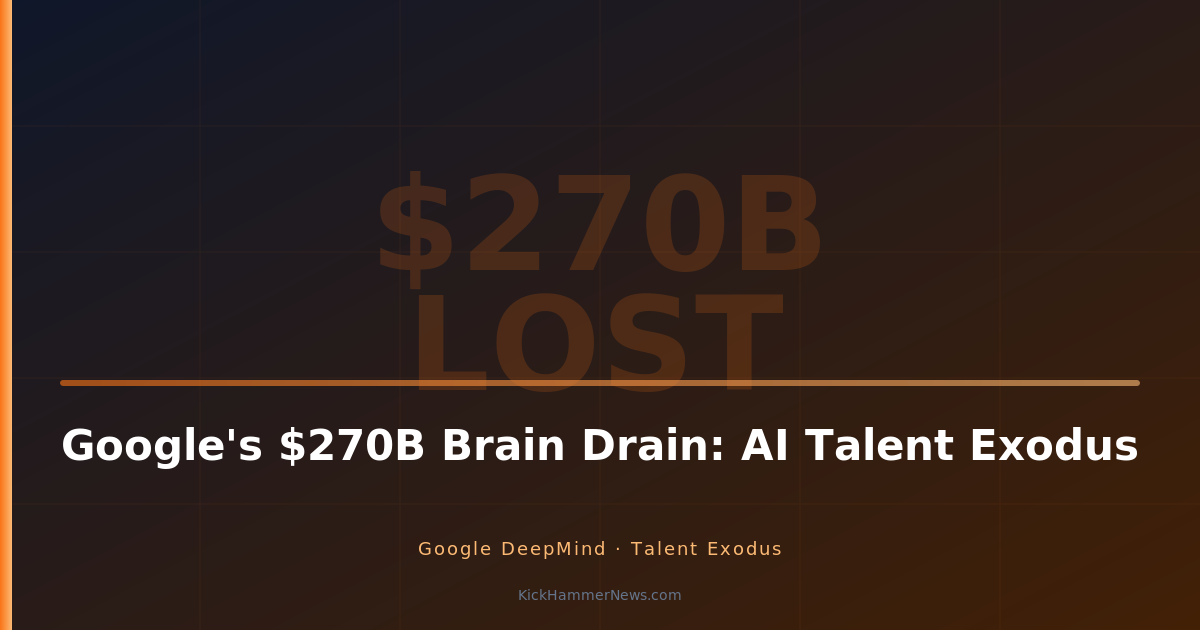
In the world of artificial intelligence, a breakthrough idea can be worth more than a data center. That lesson hit Alphabet shareholders hard in the third week of June 2026, when a cascade of high-profile departures from Google DeepMind and the Gemini team erased roughly $270 billion in market capitalization — one of the largest non-earnings-related market cap destructions in tech history.
The exodus began on June 18, when Noam Shazeer, Google’s vice president of engineering and a co-lead of its flagship Gemini AI models, announced he was leaving to join OpenAI. Shazeer’s defection was particularly stinging: he had returned to Google less than two years earlier, in August 2024, as part of the company’s acquisition deal with Character.AI — the very startup he had co-founded after originally departing Google in 2021. Google paid to bring him back. OpenAI apparently offered something Google could not match.
Two days later, on June 19, John Jumper followed. DeepMind’s vice president and engineering fellow announced he was leaving after nine years to join Anthropic. Jumper is no ordinary engineer. In 2024, he shared the Nobel Prize in Chemistry alongside DeepMind CEO Demis Hassabis for their work on AlphaFold, the AI system that predicted the 3D structures of more than 200 million proteins — a scientific achievement many consider among the most consequential applications of AI in human history. Losing a Nobel laureate to a rival is not a routine personnel matter.
The week did not end there. Within days, two more leading Gemini researchers — Jonas Adler and Alexander Pritzel — announced their own departures for Anthropic, adding to what analysts quickly labeled a talent drain from the core team responsible for Google’s most advanced AI systems.
The Market Verdict
Alphabet’s stock reacted with unusual severity. On June 22, shares dropped more than 7% intraday before closing down approximately 5% — the steepest single-day percentage decline in over a year and the company’s largest single-day market-cap loss on record. By some estimates, the total erosion across multiple sessions between June 18 and June 24 reached $269 billion to $270 billion.
The magnitude of the sell-off surprised even seasoned observers. Alphabet is not a company without resources: in early June, it announced plans to raise $80 billion through equity offerings to fund AI capital expenditures, with total AI spending projected between $180 billion and $190 billion for 2026 alone. The market clearly believed the problem was not money.
As one analyst put it: you can build the most expensive gym in the world, but if the best athletes sign with someone else, the equipment does not matter.
Why Now? The Talent Wars Intensify
The departures reflect a broader structural tension in the AI industry: the companies with the most resources are not always the ones with the most compelling missions — or the most competitive compensation structures for elite researchers.
OpenAI and Anthropic have both accelerated their talent acquisition strategies in 2026, offering equity packages in companies now valued in the hundreds of billions. For a researcher like Shazeer, who helped invent the transformer attention mechanisms that underpin virtually every modern large language model, the appeal of joining a focused organization rather than a division of a $2 trillion conglomerate can be significant.
Anthropic’s recruitment of Jumper, Adler, and Pritzel is especially notable. Anthropic has consistently emphasized its safety-focused research culture, and the appeal to DeepMind veterans — many from academic backgrounds with strong ethical commitments — may be partly ideological. DeepMind was founded with the explicit mission of solving intelligence for the benefit of humanity; Anthropic’s pitch to researchers concerned about AI risk follows a similar thread.
Google’s Position: Still Formidable, But Rattled
To be clear, Google DeepMind is not on the verge of collapse. The organization still employs thousands of researchers, maintains massive compute infrastructure, and has produced transformative work across protein structure prediction, robotics, and reinforcement learning. The Gemini family of models remains highly competitive.
But the question investors were pricing in is a subtler one: whether the specific combination of minds that enabled Google’s most critical AI advances can be reconstituted after such departures. The particular teams and collaborative networks that produced AlphaFold and the Gemini architecture took years to build.
History suggests reconstitution is genuinely difficult. Research breakthroughs in AI tend to cluster around specific people and their collaborators. When Ilya Sutskever left OpenAI in 2024, the market watched carefully. When key members of Google Brain left to join competing labs, the ripple effects on research output were eventually felt. Human capital in frontier AI is concentrated, non-fungible, and increasingly mobile.
The Structural Implications
The June 2026 talent crisis at Alphabet highlights several dynamics that will define the AI industry’s next chapter.
First, equity incentives at AI startups and scale-ups now rival or exceed those at established tech giants. When a company like Anthropic carries a valuation north of $900 billion, its equity packages are not consolation prizes.
Second, mission alignment is becoming a genuine competitive differentiator in recruiting. Elite AI researchers have real choices, and company culture and research direction increasingly factor into those choices alongside compensation.
Third, the concentration of AI talent makes individual departures disproportionately impactful. Unlike in software engineering, where large teams ship incremental improvements, frontier AI research is often driven by small groups with exceptionally high output variance. Losing a Nobel laureate and three co-architects of your flagship model in one week is not equivalent to losing four mid-level engineers.
What Comes Next
Alphabet continues to recruit aggressively and has resources few institutions can match. Its compute infrastructure, distribution advantages through Google Search and Android, and enterprise customer relationships give it structural moats that pure research labs lack.
But the message from markets was unambiguous: in the age of AI, the people inside the building matter as much as the building itself. And right now, some of the most important people in AI are choosing different buildings.
For Alphabet shareholders, the week of June 18, 2026, will be remembered not just as one of the most expensive weeks in company history — but as a signal that the war for AI talent has entered a new and more consequential phase. The scoreboard is not just model benchmarks. It is about who has the minds to build the next generation of models entirely.