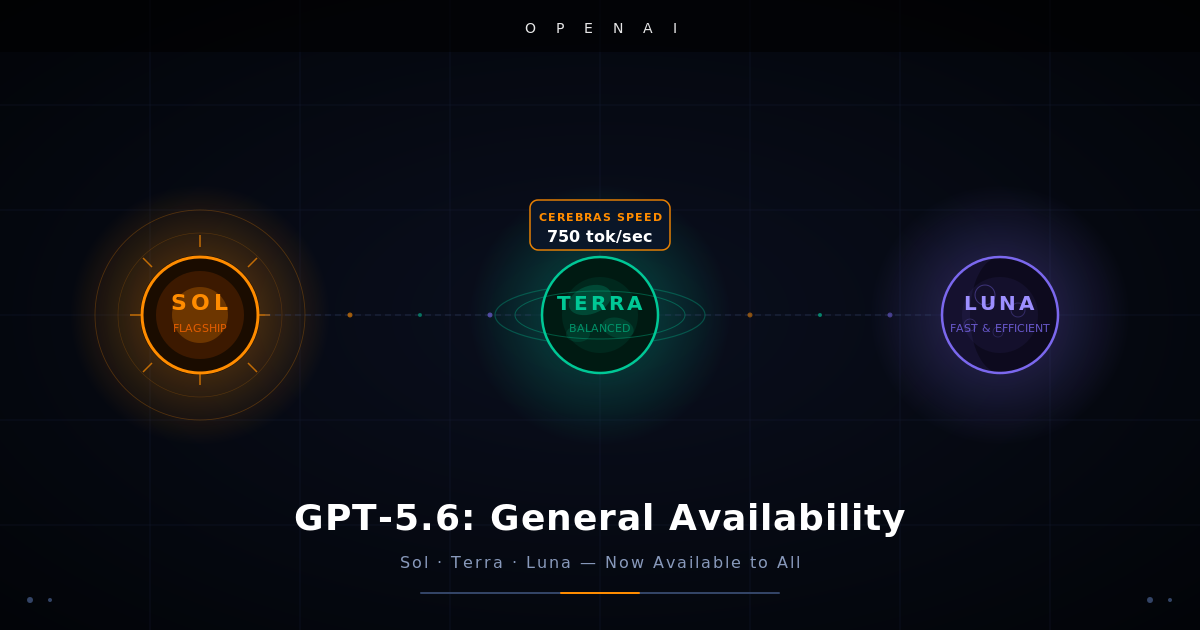
After weeks of closely guarded previews, limited partner access, and careful coordination with the U.S. government, OpenAI has officially opened its GPT-5.6 family of models to the general public. The trio — codenamed Sol, Terra, and Luna — represents the company’s most ambitious model release to date, bringing frontier AI intelligence to developers, enterprises, and everyday users at a scale and speed that would have seemed impossible just eighteen months ago.
Three Models, One Vision
The GPT-5.6 launch isn’t a single model drop — it’s a fully tiered ecosystem designed to match the right intelligence to the right task. OpenAI has learned from the sprawl of its earlier lineups, and this release reflects that maturity.
GPT-5.6 Sol is the flagship. The most capable model OpenAI has ever shipped, Sol is built for the tasks that demand deep reasoning, long-horizon planning, and maximum accuracy. Sol introduces a new “max reasoning effort” setting that gives the model additional time to think through complex problems before responding — an approach that pays dividends in domains like advanced scientific research, multi-step legal analysis, and sophisticated software engineering. Sol also introduces an “ultra mode” that coordinates multiple subagents working in parallel to accelerate complex workflows that previously would have taken hours of sequential processing.
GPT-5.6 Terra sits in the middle tier — a balanced model that trades some of Sol’s raw horsepower for faster responses and lower cost. Terra is designed for enterprise production workloads where intelligence matters but real-time performance can’t be sacrificed. Think customer-facing applications, document processing pipelines, and enterprise copilots where Sol would be overkill but GPT-5.5 is starting to show its age.
GPT-5.6 Luna is the lightweight speed demon of the family. Luna is fast, affordable, and optimized for high-volume tasks where efficiency is paramount — chatbots, classification, summarization, and the kind of inference-at-scale that requires thousands of API calls per second without a runaway compute bill. Luna may be the most important model of the three for the majority of developers building real products.
Benchmarks That Back the Hype
OpenAI is known for carefully curated benchmark releases, and the GPT-5.6 Sol numbers are impressive in the areas the company chose to highlight.
On Terminal-Bench 2.1, a test designed to evaluate command-line workflows requiring planning, iteration, and tool coordination, Sol sets a new state of the art. This benchmark is significant because it reflects real-world agentic coding tasks — not just toy examples, but the kind of multi-step, error-correcting terminal work that developers actually do. The improvement over GPT-5.5 is substantial.
On GeneBench v1, which evaluates long-horizon genomics and quantitative-biology analyses, Sol outperforms its predecessor while using meaningfully fewer tokens — a rare combination of better performance and lower cost in a domain that has historically strained AI models. Researchers in computational biology are already noting the implications for protein structure prediction, drug target identification, and multi-omics data analysis.
Security researchers received particular attention in the release notes. GPT-5.6 Sol is described as “the most capable model yet for cybersecurity,” shifting what OpenAI calls the “performance-efficiency frontier” for long-horizon security tasks including vulnerability research. This comes paired with what the company describes as its most robust safety stack to date, with strengthened protections against sensitive cyber requests and repeated misuse attempts.
The Speed Story: Cerebras Changes Everything
Perhaps the most surprising element of the GPT-5.6 launch is what’s happening on the infrastructure side. Sol is launching on Cerebras hardware at up to 750 tokens per second — a throughput figure that fundamentally changes the user experience for real-time applications.
To put that in perspective: typical GPT-4-era models ran at roughly 30–50 tokens per second on standard infrastructure. The leap to 750 tokens per second isn’t just a quantitative improvement — it’s a qualitative shift that makes frontier AI feel instantaneous in a way that wasn’t possible before. For applications like live coding assistance, real-time document drafting, and interactive research tools, that difference will be felt immediately.
The partnership with Cerebras — which has positioned itself as an alternative inference provider to NVIDIA-dominated infrastructure — signals that OpenAI is serious about breaking the compute bottleneck that has limited how its most capable models can be deployed at scale.
The U.S. Government Chapter
The GPT-5.6 launch didn’t happen in a vacuum. OpenAI shared its models and release plans with the U.S. government before making them available to partners, and the initial rollout was restricted to approximately 20 organizations while regulatory review was underway.
This deliberate approach reflects the new reality of frontier AI governance. Export controls, national security reviews, and concerns about advanced AI capabilities reaching adversarial actors have become a standard part of the release pipeline for the most powerful models. The restricted initial launch — followed by today’s broader rollout — is a template the industry is likely to follow for future releases at this capability tier.
The U.S. government’s involvement also underscores just how seriously policymakers now treat the deployment of frontier AI. GPT-5.6 Sol’s advanced cybersecurity capabilities in particular required careful review — powerful tools for vulnerability research and exploitation can serve both defenders and attackers, and the balance between enabling legitimate security work and preventing misuse is a genuinely difficult policy problem.
What This Means for the Market
The GPT-5.6 launch arrives at an inflection point in the AI market. ChatGPT’s share of AI assistant traffic recently slipped below 50% for the first time, as competitors including Google’s Gemini family, Anthropic’s Claude Fable, and a growing roster of open-weight models from Mistral and others have eaten into OpenAI’s dominance.
In that context, GPT-5.6 is as much a market statement as it is a technical milestone. Sol, Terra, and Luna together cover the full spectrum of enterprise and developer needs in a way that makes OpenAI’s ecosystem difficult to displace in a single move. A startup considering migrating off of OpenAI’s platform — as some have done in pursuit of cost savings — now faces a more compelling reason to stay.
The company’s S-1 filing with the SEC and anticipated IPO later this year add another dimension. A strong model launch the same summer as an IPO is no coincidence. OpenAI is demonstrating to prospective investors that its technical lead is real, that it can manage complex government relationships, and that its product roadmap continues to produce models that set the pace for the entire industry.
The Road Ahead
OpenAI’s release notes hint at more to come. The “ultra mode” subagent orchestration in Sol suggests the company is doubling down on agentic AI — systems that plan, use tools, and execute multi-step tasks without constant human guidance. The introduction of that capability in a production model, rather than a research preview, is a signal of where the next year of AI development is headed.
For developers, the immediate opportunity is clear: GPT-5.6 Sol offers capabilities for long-horizon reasoning and agentic workflows that weren’t commercially available at this performance level even six months ago. For enterprises, Terra provides a practical path to upgrading production systems without the cost and complexity of running Sol at scale. For everyone building with AI, Luna ensures that speed and affordability don’t have to be sacrificed at the altar of intelligence.
The GPT-5.6 family is available now through OpenAI’s API. Pricing details and full benchmark documentation are available at openai.com.