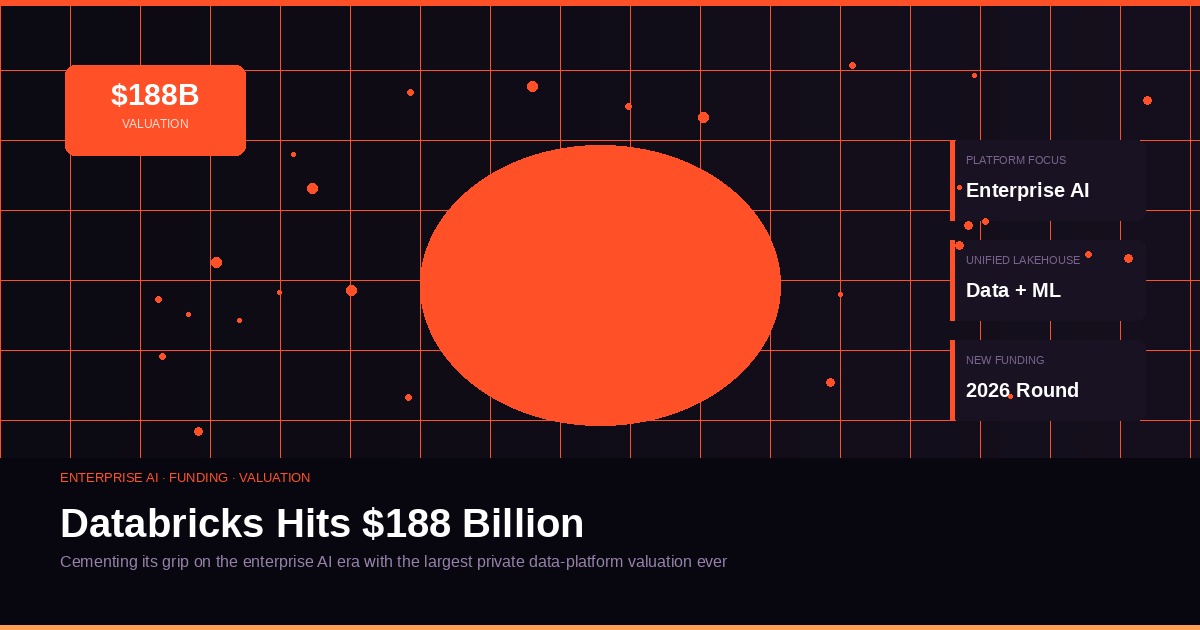
In a funding landscape that has become accustomed to eye-watering numbers, Databricks still managed to turn heads this week. The enterprise AI and data platform company announced it is raising a new strategic round of funding at a $188 billion valuation — a figure that places it among the most valuable private technology companies in history.
The round, which the company expects to close later this summer, is led by existing investor Coatue and is expected to bring in roughly $3 billion in new capital. For context: Databricks was valued at $134 billion as recently as February 2026. Before that, in December 2024, it raised $10 billion at a $62 billion valuation — itself a record at the time. The company has tripled its valuation in roughly eighteen months, a trajectory that speaks less to startup hype and more to the extraordinary appetite enterprises have developed for AI infrastructure.
From Data Lakes to the Center of the AI Universe
Databricks was founded in 2013 by a group of researchers from UC Berkeley who created Apache Spark, one of the foundational technologies for large-scale data processing. For years, the company was known primarily as a data engineering tool — an unglamorous but essential piece of the enterprise data stack. It helped companies process massive datasets, unify data warehouses and data lakes into a lakehouse architecture, and run analytics at scale.
Then AI happened. Or more precisely, the AI boom made the unglamorous essential and the essential extremely valuable.
Enterprise AI does not run on vibes. It runs on data — vast amounts of it, carefully curated, governed, and made accessible to the AI systems consuming it. Databricks, with its deep roots in data management and its sprawling enterprise customer base, found itself perfectly positioned at the intersection of data and AI at exactly the right moment.
What the New Capital Is For
According to Databricks CEO Ali Ghodsi, the new funding will accelerate three key product bets that reflect where enterprise AI is heading in the second half of 2026.
The first is Unity AI Gateway, a multi-AI governance solution designed to help enterprises manage and control costs across the sprawling ecosystem of AI models they are now deploying. As organizations find themselves running dozens — sometimes hundreds — of AI agents and models simultaneously, governance has become one of the thorniest problems in enterprise technology.
The second is Genie, described as an AI coworker that turns business data into trusted answers and actions. Rather than requiring data analysts to write complex queries, Genie allows business users to ask questions in plain language and receive reliable, data-grounded responses. The emphasis on trusted is deliberate: one of the persistent problems with enterprise AI adoption has been hallucination and unreliable outputs, especially when AI systems are asked to reason over company-specific data.
The third is Lakebase, a serverless Postgres-compatible database built specifically for AI agents. As agentic AI systems proliferate, they need persistent storage, memory, and structured data access. Traditional databases were not designed for the read/write patterns that autonomous AI agents create. Lakebase is built from the ground up to serve as the persistence layer for the agentic AI era.
The IPO Question
Perhaps the most striking aspect of the Databricks story at this valuation is the consistent absence of IPO plans. When the company raised at $62 billion in late 2024, analysts and observers assumed a public offering was imminent. When it raised at $134 billion earlier this year, the same assumption held. Now, at $188 billion, the company remains conspicuously private.
This is partly by design. Databricks has access to essentially unlimited private capital at favorable terms, allowing it to invest aggressively in product development without the quarterly scrutiny of public markets. It also reflects a broader trend among elite private AI companies: OpenAI has floated IPO timelines repeatedly but remains private; Anthropic has no clear path to the public markets; and Databricks appears content to continue its run as the enterprise AI darling of the private funding world.
The question, of course, is for how long. At $188 billion, the company is approaching the valuation territory where late-stage investors need liquidity. Secondary markets for Databricks shares exist but are illiquid by comparison. At some point — most analysts put it at 12 to 24 months — the pressure to go public or seek an acquisition will become difficult to resist.
The Competitive Landscape
Databricks’ success has not gone unnoticed by its competitors. Snowflake, once considered the Databricks rival most likely to dominate enterprise data, has struggled to keep pace with the AI pivot. AWS, Google Cloud, and Microsoft Azure all offer competing data and AI platforms, but none have replicated the developer affinity and neutral, multi-cloud positioning that Databricks has cultivated. Microsoft’s Fabric platform represents perhaps the most serious competitive threat, but its deep integration with the broader Microsoft ecosystem can feel like a constraint for enterprises that span multiple clouds.
The company’s largest customers — including some of the world’s biggest financial institutions, healthcare systems, and technology companies — have become increasingly locked into the Databricks ecosystem through data gravity. Once your organization’s most sensitive and valuable data is managed, governed, and served through a single platform, switching costs become existential.
What This Means for Enterprise AI
The Databricks valuation milestone is more than a headline about a single company’s fundraising. It is a signal about where enterprise technology investment is flowing in 2026 and who is winning the infrastructure layer of the AI economy.
The companies capturing the most value are not, by and large, the frontier model developers building the largest language models. They are the companies that control the data those models run on, the governance systems that make AI deployment legally and operationally defensible, and the infrastructure that keeps AI systems reliable and cost-effective at scale.
Databricks has built exactly that infrastructure. And at $188 billion, the market is saying, loudly and clearly, that it is not done growing.