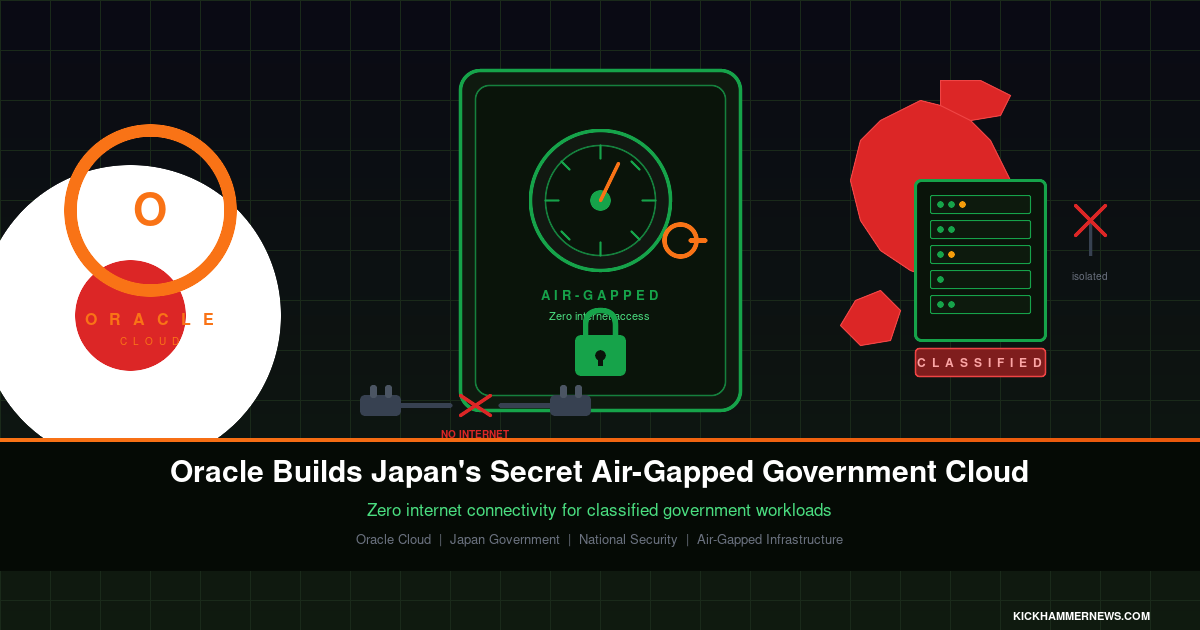
Oracle has emerged as the front-runner to construct Japan’s most sensitive piece of digital infrastructure — an air-gapped sovereign cloud cut off entirely from the public internet. According to a Financial Times report, Larry Ellison’s company has pulled decisively ahead of Amazon Web Services, Microsoft, and Google in talks with Tokyo, setting the stage for one of the most consequential cloud contracts in the Indo-Pacific this decade.
The contract is not yet signed. Japan has not made a final decision, and the FT notes that Tokyo could still split the work across multiple vendors. But Oracle’s early lead signals a significant shift in how governments are thinking about cloud security — and where the technology industry’s most politically connected companies stand to benefit.
Why Japan Needs an Air-Gapped Cloud
An air-gapped system is exactly what it sounds like: a network physically and logically severed from the open internet. Data inside the vault cannot be exfiltrated via the web because there is no web path to exploit. Access occurs only through classified networks, connected via encrypted, hardware-authenticated links.
For Japan, the urgency is China. Washington has spent years pressing Tokyo to harden its cyber defenses against Chinese state-sponsored hacking groups that have repeatedly targeted Japanese defense contractors, government ministries, and critical infrastructure. The concern has only grown as the US and Japan deepen their cooperation on advanced weapons systems, including the joint development of a next-generation fighter aircraft.
At a March 19, 2026 White House summit, President Donald Trump and Japanese Prime Minister Sanae Takaichi jointly announced that Japan would develop a secure, sovereign cloud platform for government data — explicitly to “enhance bilateral information sharing, planning, and coordination.” That diplomatic commitment accelerated timelines and created an opening that Oracle was well-positioned to fill.
Oracle’s Winning Pitch: Security First, Commercial Cloud Second
The key differentiator in Oracle’s pitch was its willingness to commit, early and clearly, to delivering a fully air-gapped system. Microsoft and AWS reportedly argued that their existing commercial cloud infrastructure could be hardened sufficiently to handle Japan’s classified data. Oracle went further, signaling it would build the vault from the ground up.
That commitment aligns with Oracle’s broader enterprise positioning. For years, Ellison and his executives have argued that Oracle’s advantage in the cloud is not raw compute scale — it’s the architecture, which was designed with isolation and data sovereignty in mind from the outset. Oracle Cloud Infrastructure (OCI) uses a network design that separates customer data more aggressively than older hyperscaler architectures. For a customer whose threat model includes a nation-state adversary, that design philosophy matters.
There is also the political dimension. Ellison’s close relationship with President Trump — well documented since the early days of the administration — has reportedly given Oracle early access to discussions about the US-Japan security cloud framework. That kind of back-channel advantage is difficult to quantify but impossible to ignore.
SoftBank and the Oracle Alloy Foundation
The cloud would not be built by Oracle alone. The technical backbone is Oracle Alloy, Oracle’s platform that allows partners and operators to deploy full OCI services inside their own data centers, under their own governance. In Japan, the primary partner is SoftBank, which announced in October 2025 that it would offer cloud services to Japanese enterprises using Oracle Alloy under the brand “Cloud PF Type A.”
Under that arrangement, SoftBank operates the infrastructure inside its eastern and western Japan data centers, giving customers access to more than 200 Oracle Cloud Infrastructure services — AI, databases, analytics, networking — while keeping all data physically within Japanese borders. The eastern Japan site was scheduled to go live in April 2026; the western Japan site follows in October 2026.
The classified government cloud would extend that foundation into a more restricted tier: air-gapped, military-grade, and designed to carry data that cannot be allowed to touch any path connected to the internet. It is a logical escalation of the SoftBank-Oracle Alloy work, but in a different threat environment entirely.
The Sovereign Cloud Trend Reshaping Enterprise Software
Oracle’s Japan bid is part of a much larger wave. Governments worldwide are demanding that their most sensitive data not only stay onshore, but stay off the open internet. Britain recently declared US cloud providers critical to its financial system — a recognition of dependency that comes with calls for greater transparency and contractual assurances. European defense labs are building military-grade sovereign AI systems that individual states can own and operate without relying on commercial vendors.
The pattern reflects a hard lesson learned from a decade of cloud migration: concentration creates vulnerability. When a government’s most sensitive workloads run on shared commercial infrastructure, the attack surface is defined by the hyperscaler’s own security posture, not the government’s. An air-gapped architecture removes that dependency at the cost of complexity and connection. For classified intelligence data, governments are increasingly willing to pay that cost.
For Oracle, this trend is a strategic gift. The company spent much of the past decade as the underdog in cloud computing, fighting for market share against AWS, Azure, and Google. Its government cloud business — including contracts with the US intelligence community via OCI Dedicated Region — has become a genuine differentiator, a market segment where Oracle’s early architectural decisions pay dividends that newer entrants cannot easily replicate.
What’s at Stake
The strategic prize here extends well beyond the contract value. If Oracle wins the classified cloud contract, Japan becomes a closer, more capable member of the allied intelligence-sharing architecture that includes the Five Eyes (the US, UK, Canada, Australia, and New Zealand). Japan is not a Five Eyes member, but Washington has wanted to deepen intelligence cooperation with Tokyo, particularly on China, for years. A certified, air-gapped cloud that meets allied standards is one of the preconditions for that deeper sharing.
For Oracle, a marquee sovereign cloud win in Japan would also accelerate conversations with other allies — South Korea, the Philippines, Australia, and NATO members in Eastern Europe — that face analogous pressure to harden their digital infrastructure against adversary intrusion.
The cloud wars, it turns out, are increasingly won not in data centers selling AI inference at scale, but in classified vaults where no one is watching. Oracle has quietly been building toward this moment for years. Japan may be where that strategy pays off.
Sources: Financial Times, The Next Web, Oracle/SoftBank press releases, AI Weekly