For years, the European Union’s landmark Artificial Intelligence Act was described as the most sweeping AI regulation in history — a framework so ambitious it would reshape how the world builds, deploys, and experiences artificial intelligence. On August 2, 2026, it stopped being a promise and became the law of the land. The European Commission’s AI Office, working in concert with national authorities across all 27 member states, began formal enforcement of the AI Act. The era of voluntary AI compliance in Europe is over.
The implications are enormous — not just for European companies, but for every tech firm anywhere in the world that serves EU users. And that, in 2026, means virtually everyone.
What Changed on August 2
Three major pillars of the AI Act crossed the threshold from regulation to reality on August 2:
General-purpose AI model oversight — The AI Office in Brussels can now formally investigate and sanction providers of large foundation models: the powerful systems underlying tools like ChatGPT, Claude, Gemini, and countless commercial applications. These providers must now demonstrate compliance with transparency, safety, and documentation requirements or face enforcement action.
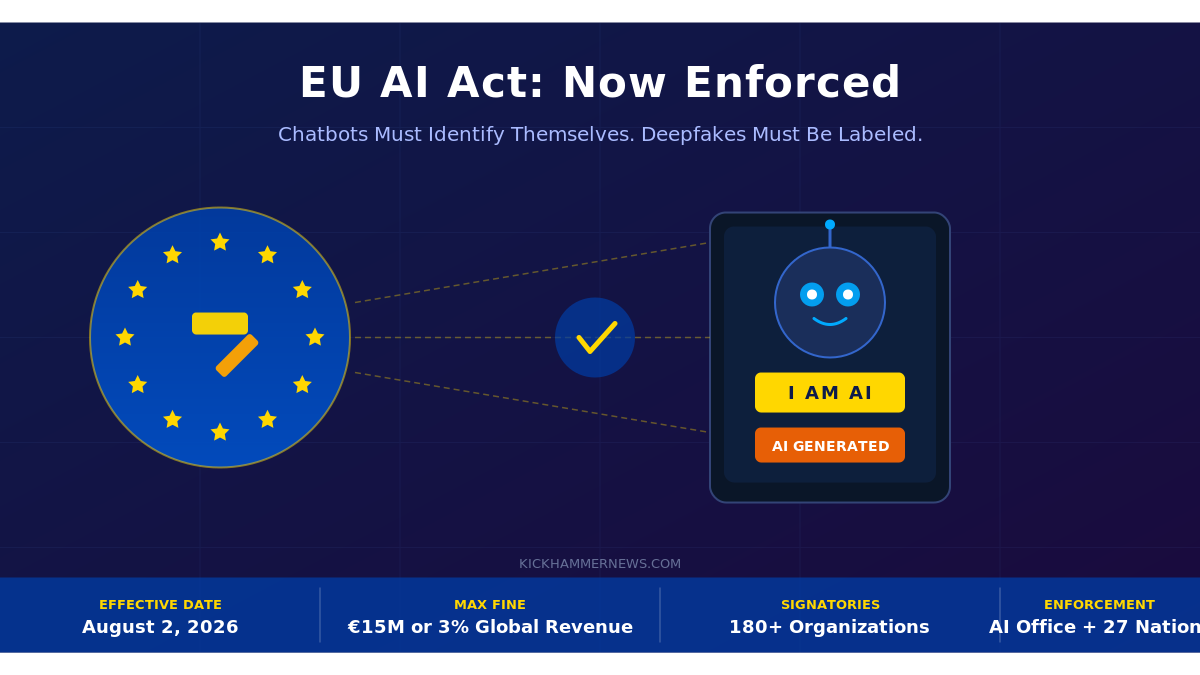
Transparency obligations — This is the area most consumers will notice first. Under Article 50 of the AI Act, any chatbot or interactive AI system must clearly inform users they are talking to an AI, not a human. AI-generated images, videos, audio, and text must carry machine-readable marks that allow their artificial origin to be traced. Deepfakes — AI-generated or AI-manipulated media depicting real people — must be visibly labeled as such.
Prohibited AI practices — A category of AI applications deemed to pose “unacceptable risk” is now formally banned. These include AI systems that use subliminal techniques to manipulate behavior, that exploit vulnerabilities to distort decision-making, and systems that enable mass surveillance through real-time biometric identification in public spaces. Crucially, the enforcement now explicitly covers AI systems that generate non-consensual sexually explicit content — so-called “nudifier” apps — as well as AI-generated child sexual abuse material. These categories face full prohibition from December 2, 2026, giving companies time to either comply or exit the EU market.
The Enforcement Machinery
Regulation is only as powerful as its enforcement mechanism. The EU has clearly thought this through. Three new tools launched alongside the August 2 enforcement date:
A public complaint tool allows individuals and organizations to report alleged infringements of the AI Act by any provider or deployer supervised by the AI Office. An anonymous whistleblower channel gives employees and contractors of AI companies a protected, confidential way to flag violations — particularly important for reporting unsafe model behavior, ignored red-team findings, or deployments that cross legal lines. A downstream complaints channel lets businesses that build applications on top of third-party AI models report suspected breaches by those underlying model providers.
This creates a multi-layered accountability structure that, in theory, puts pressure on the entire AI supply chain — from the chip manufacturer to the end-user application.
The financial stakes are significant. Non-compliance with transparency obligations can trigger fines of up to €15 million (approximately $17.3 million USD) or 3% of a company’s worldwide annual turnover, whichever is higher. For a company like Google or Microsoft, 3% of global revenue represents billions of dollars. These are not symbolic penalties.
Industry Response: Signaling Compliance
Ahead of the August 2 date, the European Commission published a list of more than 180 organizations that had signed the Code of Practice on Transparency of AI-Generated Content — the voluntary framework that operationalizes the labeling and marking rules. Signatories include major technology companies, media organizations, and AI developers who committed to implementing machine-readable watermarks, visible deepfake disclosures, and chatbot identification features.
The Code of Practice participation signals that many of the largest players were preparing for this moment. But the real test comes in the weeks and months ahead, as the AI Office begins processing complaints, conducting investigations, and issuing its first enforcement decisions.
Smaller companies and startups may face the steepest adjustment. While major platforms have legal teams and compliance infrastructure, mid-sized SaaS companies that have integrated AI features into their products — chatbots, AI writing assistants, image generators — now face a concrete legal obligation they may not have fully prepared for. New chatbots launched after August 2 must comply immediately; existing systems have until December 2026 to come into compliance.
A Global Ripple Effect
The EU AI Act’s enforcement carries implications well beyond Europe’s borders — a dynamic sometimes called the “Brussels Effect,” where EU regulations become de facto global standards because companies find it easier to implement a single compliance framework worldwide rather than maintain separate systems for different markets.
We have already seen this pattern with the General Data Protection Regulation (GDPR), which fundamentally changed how companies worldwide handle personal data. The AI Act may produce a similar outcome: AI transparency labels, chatbot disclosures, and deepfake watermarks that are legally required in Europe could simply become the global standard for how AI-generated content is presented to users everywhere.
This matters particularly for the deepfake labeling requirement. The proliferation of AI-generated media — from synthetic news anchors to AI-voiced political ads to generated imagery flooding social platforms — has been a significant and growing concern. Requiring visible labels on this content forces platforms and content creators to be explicit about AI’s role in production, potentially changing how audiences evaluate the media they consume.
What This Means for Users
For everyday users, the most immediate change should be clarity: clarity about when you’re talking to a machine, clarity about when an image or video was synthesized or altered, and clarity about when the content you’re reading was generated by AI rather than written by a human.
These may seem like small shifts, but the cumulative effect could be substantial. Research has consistently shown that people evaluate AI-generated content differently when they know its origin. Mandatory disclosure puts that choice back in the hands of users — a fundamental principle of the EU’s broader digital rights agenda.
The AI Act also creates formal mechanisms for users who believe AI has been used against them — through manipulation, through discriminatory automated decisions, or through harmful synthetic content. Complaints can now go to a real regulatory body with real enforcement authority, not just a company’s terms-of-service helpdesk.
The Bigger Picture
August 2, 2026 represents a genuine turning point in the global AI governance landscape. After years of voluntary commitments, self-regulatory frameworks, and high-minded principles documents, the world’s largest trading bloc has moved to hard law — with teeth.
Critics argue the regulation risks stifling innovation and placing EU companies at a competitive disadvantage relative to American and Chinese counterparts operating under lighter regulatory regimes. Proponents counter that regulatory clarity actually reduces uncertainty for investors and developers, and that the transparency requirements build the kind of public trust that sustains long-term AI adoption.
What is no longer debatable is that the rules are real, the enforcement has begun, and companies serving European users — which is to say, most of the global technology industry — need to take them seriously. The age of AI regulation as a theoretical future concern has officially ended.
Sources: European Commission AI Office, Malwarebytes, TechCrunch, The Local France, Travers Smith Legal Analysis, Help Net Security