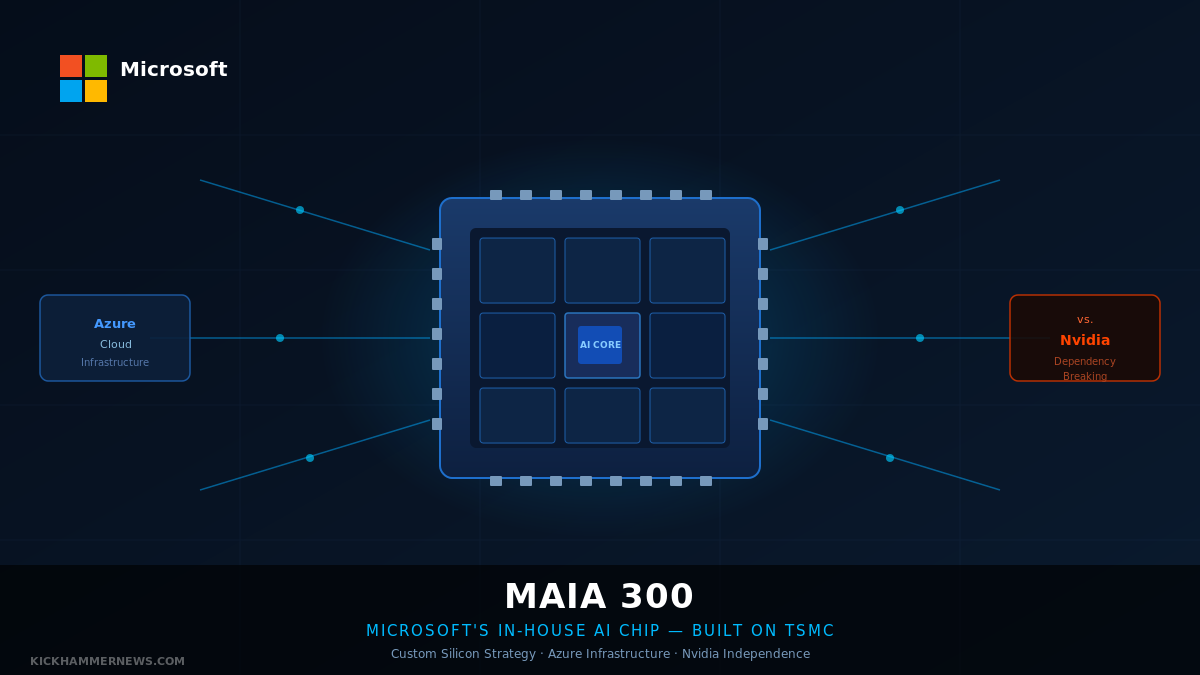
Microsoft is preparing to reveal its next-generation Maia 300 AI chip as early as this September, and the company is quietly lining up one of the most aggressive silicon production campaigns in its history. New reporting from The Information reveals that Microsoft has entered talks with TSMC to secure manufacturing capacity for more than 300,000 Maia 300 units for delivery in 2027 — with an ultimate target of over one million chips. The move signals that Redmond is serious about reducing its deep dependence on Nvidia and, for the first time, competing seriously in the custom silicon race it has so far largely ceded to Google and Amazon.
From Side Project to Strategic Priority
Microsoft introduced its first Maia chip in November 2023, but the project struggled to gain momentum. While Google had already proven out its TPU architecture at massive scale and Amazon’s Trainium and Inferentia chips were generating real revenue, Microsoft’s in-house silicon effort remained more of a roadmap promise than a shipping product. That changed in January 2026, when the company formally launched the Maia 200.
The Maia 200 is no modest iteration. Built on TSMC’s 3-nanometer process, the chip packs more than 140 billion transistors into a design that delivers over 10 petaFLOPS of compute at 4-bit precision — the precision level typically used for large-language-model inference. It ships with 216 gigabytes of HBM3e memory and 272 megabytes of on-chip SRAM, and operates within a 750-watt thermal envelope. Microsoft designed Maia 200 explicitly for inference workloads, not training, reflecting where the company sees its near-term opportunity: serving AI responses at cloud scale for Copilot, Azure AI Foundry, and the thousands of enterprise customers building on OpenAI’s models.
The Maia 300, by all accounts, is a significant leap forward from even that. Microsoft has not officially disclosed specifications, but the production ambitions alone — starting at 300,000 units and targeting one million — suggest a chip intended to become a load-bearing pillar of Azure’s AI infrastructure, not a showcase product.
The Nvidia Problem
The urgency behind Maia 300 is impossible to separate from Microsoft’s relationship with Nvidia. The two companies are deeply intertwined: Microsoft is one of Nvidia’s largest customers, and Azure’s AI product lineup is substantially built on H100 and B200 GPU clusters. But Nvidia’s pricing power is formidable, and every dollar spent on Nvidia silicon is a dollar that is not flowing to Microsoft’s own infrastructure margin.
According to sources cited by The Information, Microsoft believes its Maia chips can run both its own models and OpenAI’s models at a 30 to 40 percent cost advantage over equivalent Nvidia hardware. If that figure holds at scale, the economic case for Maia is compelling: at the volumes Azure operates, even a modest cost-per-inference improvement translates into billions of dollars in annual savings.
CEO Satya Nadella has made no secret of this calculus. Reducing reliance on Nvidia is a stated strategic priority, and the Maia line is central to that effort. The question has always been whether Microsoft could execute at the scale and reliability that cloud customers demand. The Maia 300 production push suggests the company believes it finally can.
Anthropic: Customer, Competitor, and Bellwether
Perhaps the most consequential subplot in the Maia 300 story is Anthropic. Microsoft is actively courting the AI startup — maker of the Claude models — as an early external customer for the new chip. That pitch is complicated by timing: Anthropic recently confirmed it is building an internal semiconductor team to design custom chips for its own Claude inference stack, making the company simultaneously a prospective Maia customer and an emerging long-term competitor in the silicon business.
Whether Anthropic adopts Maia 300 will be closely watched. The startup has its own relationship with Amazon Web Services, which has invested heavily in Anthropic and whose Trainium chips are another potential fit. For Microsoft to win Anthropic’s workloads — even partially — would be a significant market signal that Maia is genuinely competitive, not just a cost-reduction play for captive Azure workloads.
Winning external customers matters because it changes the economics and the narrative. It means Maia becomes a platform, not just an internal cost center, and it gives Microsoft leverage in conversations with every other AI company that currently routes its inference through Nvidia-powered clouds.
Production Constraints and the TSMC Factor
Ambition is one thing; execution is another. The Information’s reporting notes that Microsoft’s target of one million Maia 300 units faces real constraints — both in component supplies and in ongoing capacity negotiations with TSMC. TSMC’s most advanced nodes are heavily contested. Nvidia, Apple, AMD, and a growing roster of hyperscaler custom-chip programs are all competing for the same leading-edge wafer starts. Securing 300,000 units is a meaningful commitment, but scaling from there to seven figures will require sustained prioritization from TSMC and a supply chain that can keep pace.
This is precisely why the September reveal matters strategically. By unveiling Maia 300 publicly, Microsoft signals commitment to the market, to potential customers, and to TSMC. Public announcements create their own momentum; they make it harder to quietly deprioritize a program when the next quarterly earnings cycle creates pressure to cut costs.
The Broader Context: Cloud’s Custom Silicon Moment
Microsoft’s Maia push is part of a sweeping industry realignment. Every major hyperscaler is now designing at least some of its own silicon. Google’s TPUs power its AI services and have become a commercial product. Amazon’s Trainium 2 is being adopted by a growing list of customers. Meta designs its own training accelerators. Apple designs its own inference chips for on-device AI.
The common thread is the recognition that AI workloads have characteristics — massive parallelism, memory bandwidth requirements, inference-specific precision needs — that general-purpose GPU architectures are not optimally suited to address. Custom chips allow hyperscalers to co-design hardware and software stacks, optimize for specific model architectures, and capture margin that would otherwise flow to chip vendors.
For Microsoft, Maia 300 represents more than a cost play. It is a statement that Azure intends to compete as a full-stack AI platform — one where the hardware, the orchestration layer, the model runtime, and the developer tools are all aligned under one roof. If the chip ships at scale and performs as promised, it could meaningfully shift the competitive dynamics of the cloud AI market in 2027 and beyond.
What Comes Next
Microsoft is expected to formally unveil the Maia 300 this fall, with September as the most likely window. Exact specifications, pricing, and availability timelines will follow. The bigger test, though, will come in 2027, when the first major production batches ship and enterprises and AI developers can measure performance and cost against the Nvidia alternatives they already know.
What is already clear is that Microsoft is no longer treating custom silicon as an optional experiment. The Maia 300 program — with its TSMC negotiations, its Anthropic courtship, and its million-chip ambitions — is a genuine strategic bet on the idea that the next phase of the AI infrastructure race will be won at the level of the chip, not just the software.
Sources: The Information, Techzine Global, Bloomberg, CryptoBriefing, Digitimes