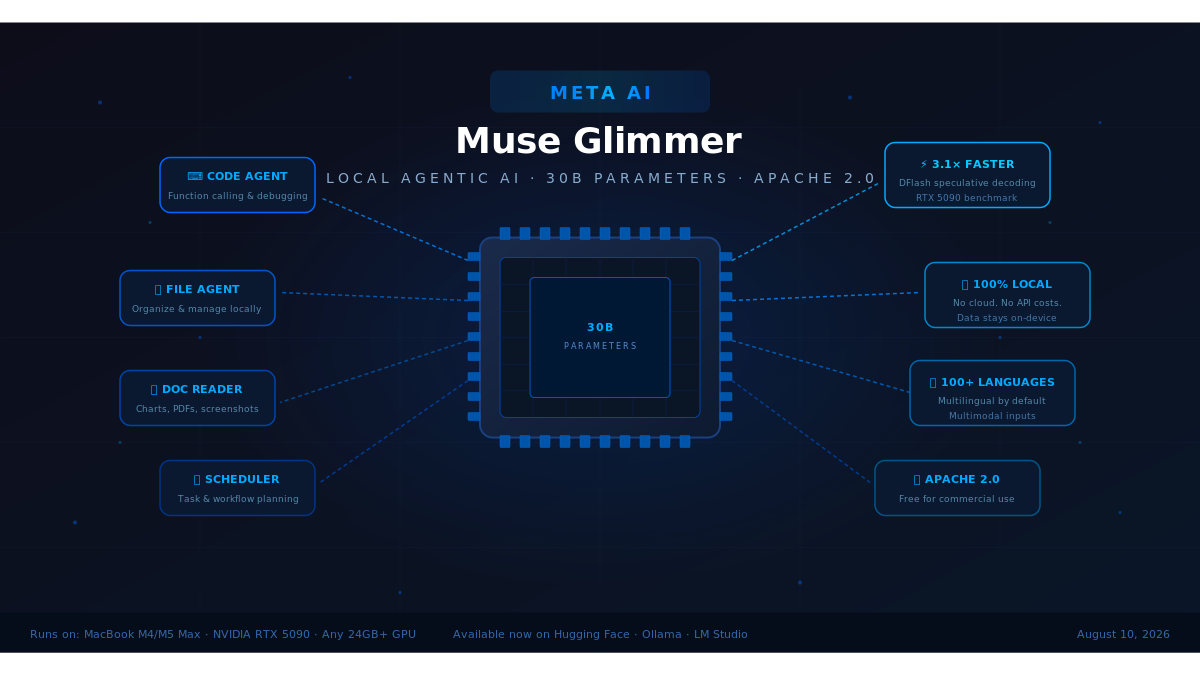
Meta has released Muse Glimmer, a 30-billion-parameter open-weight AI model that can run entirely on a single consumer GPU—no cloud subscription, no API key, no internet required. The release marks one of the most significant moments yet in the push to bring genuine agentic AI capabilities out of hyperscale data centers and onto everyday hardware.
What Is Muse Glimmer?
Muse Glimmer is a compact, highly capable language model distilled from Meta’s larger Muse Spark architecture, which Meta Superintelligence Labs introduced in April 2026. Where Muse Spark requires sprawling server infrastructure, Muse Glimmer was engineered from the ground up to operate on consumer-grade hardware—a MacBook, a gaming PC, or any device with a modern GPU.
The model ships under the Apache 2.0 license, meaning individuals, startups, and enterprises can use, modify, and redistribute it freely, including for commercial purposes. Weights are available now on Hugging Face, with optimized builds for llama.cpp, MLX, and ExecuTorch following in the coming days. Inference runtimes including Ollama, LM Studio, Unsloth, Together AI, Fireworks AI, and OpenRouter are already supported.
The Engineering Behind the Efficiency
Running a 30-billion-parameter model on consumer hardware is not a trivial feat. At full floating-point precision, such a model would consume more than 55 GB of GPU memory—far exceeding even high-end consumer GPUs. Meta solves this through aggressive quantization, compressing the model to approximately 4-bit precision and reducing the memory footprint to under 20 GB. That leaves room on a 24 or 32 GB GPU for the KV cache, the perception encoder, and the speculative decoding drafter.
That drafter, based on Meta’s DFlash technology, proposes entire blocks of tokens at once, which the main model then verifies in parallel. The result is substantially faster inference than sequential token generation: Meta reports a 3.1× speedup on NVIDIA’s RTX 5090, 1.8× on Apple’s M5 Max chip, and 1.5× on the M4 Max. For practical use—asking an agent to rewrite a function, summarize a document, or organize a folder—those multipliers translate into responses that feel genuinely interactive rather than laboriously slow.
Built for Agents, Not Just Answers
Most language models, even large and capable ones, were originally designed to answer questions. Muse Glimmer was designed differently. Its training pipeline passed through three distinct phases: logit distillation from the larger Muse Spark model, extended mid-training on longer context windows and agentic task data, and finally a combined phase of supervised fine-tuning and reinforcement learning optimized for autonomous workflows.
The result is a model that handles multi-step reasoning, reliable tool use, and failure recovery in ways that conventional conversational models do not. When a tool call fails—an API returns an error, a file path is wrong, a function throws an exception—Muse Glimmer is trained to diagnose what went wrong and retry intelligently rather than halt or produce a confused response. This capability is essential for agents that must execute complex sequences of actions across real systems.
Meta describes Muse Glimmer’s core use cases as “always-on” local agent workflows: automated coding assistance, function calling against local APIs, schedule management, file organization, multi-step document reasoning, and LLM-as-a-judge evaluations for local model testing pipelines. These are not demo scenarios—they are the practical workloads that developers and power users have wanted from local AI for years.
Multimodal and Multilingual by Default
Muse Glimmer is not limited to text. A dedicated perception encoder allows the model to interpret multimodal inputs, alternating between text and image processing within a single reasoning chain. This means an agent can read a screenshot of a user interface, analyze a chart embedded in a PDF, or examine a scanned document and incorporate what it sees into a task.
The model was also trained on data spanning more than a hundred languages, and users can adjust its reasoning intensity—trading speed for depth depending on the complexity of the task at hand. For simple function calls, the model can respond quickly. For complex multi-step problems requiring careful planning, it can engage longer chains of thought before acting.
Zuckerberg’s Broader Argument
The release of Muse Glimmer is not purely a technical milestone—it arrives as part of a deliberate strategic posture. Alongside the model launch, Meta CEO Mark Zuckerberg publicly urged U.S. policymakers to remove regulatory barriers to open-source AI, arguing that open-weight models are essential for American competitiveness and that restrictions on sharing model weights would benefit closed-model developers at the expense of broader innovation.
Zuckerberg also directly criticized the distillation debate that has circulated in AI policy discussions—the question of whether training a smaller model on the outputs of a larger one constitutes problematic knowledge transfer. Meta’s position is that distillation is a standard and necessary engineering technique, not an appropriation of proprietary capability, and that restricting it would chill legitimate research and product development.
The political context matters: as Washington continues to debate how to regulate frontier AI, the open versus closed model question has become a proxy for larger arguments about market concentration, national security, and who gets to benefit from AI progress.
Competition With Chinese Open Models
Muse Glimmer enters a crowded field. Chinese AI labs, particularly DeepSeek, have released a series of highly capable open-weight models that have commanded significant attention on global benchmarks. DeepSeek’s V4 Flash, released in early August 2026, demonstrated strong performance on agentic evaluation benchmarks—setting a high bar for efficiency-focused open models.
Meta’s advantage is its hardware partnerships. AMD, Arm, Dell, Intel, and NVIDIA are all collaborating on device-specific optimizations for Muse Glimmer, meaning the model will become faster and more efficient on a widening range of consumer and enterprise hardware as those integrations land. The Apache 2.0 license also removes friction for adoption in commercial products, which may accelerate ecosystem growth faster than more restrictive alternatives.
Crucially, Muse Glimmer was evaluated under Meta’s Advanced AI Scaling Framework before release—a signal that Meta is attempting to balance rapid release with at least a structured safety evaluation process, even as the company advocates for fewer regulatory constraints on open-weight development.
What This Means for Developers and Enterprises
For developers, Muse Glimmer removes one of the most significant barriers to building agentic AI products: ongoing API costs and cloud dependency. An agent built on Muse Glimmer runs entirely locally, which eliminates per-token pricing, reduces latency, and keeps sensitive data off third-party servers. For enterprise applications involving confidential documents or internal tools, local execution is not just economically attractive—it may be legally or operationally required.
For individual users and power users, the implications are more personal. A capable agentic model that runs offline, responds at interactive speeds on consumer hardware, and handles multi-step reasoning across files, code, and documents represents a genuine shift in what personal computing can do. The dream of an AI system that actually manages your files, debugs your code, and interprets your documents—without routing everything through a distant data center—is now running on a MacBook near you.
For the broader AI industry, Meta’s move intensifies pressure on every lab competing in the open-weight space. Muse Glimmer sets a new benchmark for what a locally runnable model can do, and its release at Apache 2.0 means the ecosystem it seeds is impossible to re-close.
Getting Started
Muse Glimmer is available now at Hugging Face. Users with an NVIDIA RTX GPU (24GB or higher) or Apple Silicon Mac (M4 Max or M5 Max recommended) can run the model locally through Ollama or LM Studio. Enterprise and cloud deployments are supported through vLLM and SGLang for high-throughput scenarios.
Meta has published technical documentation and quick-start guides on the Meta AI Research blog, including configuration recommendations for different hardware profiles and integration guides for connecting Muse Glimmer to local tool ecosystems.
Sources: Meta AI Research, Techzine Global, The Next Web, Phoronix, TechStartups


