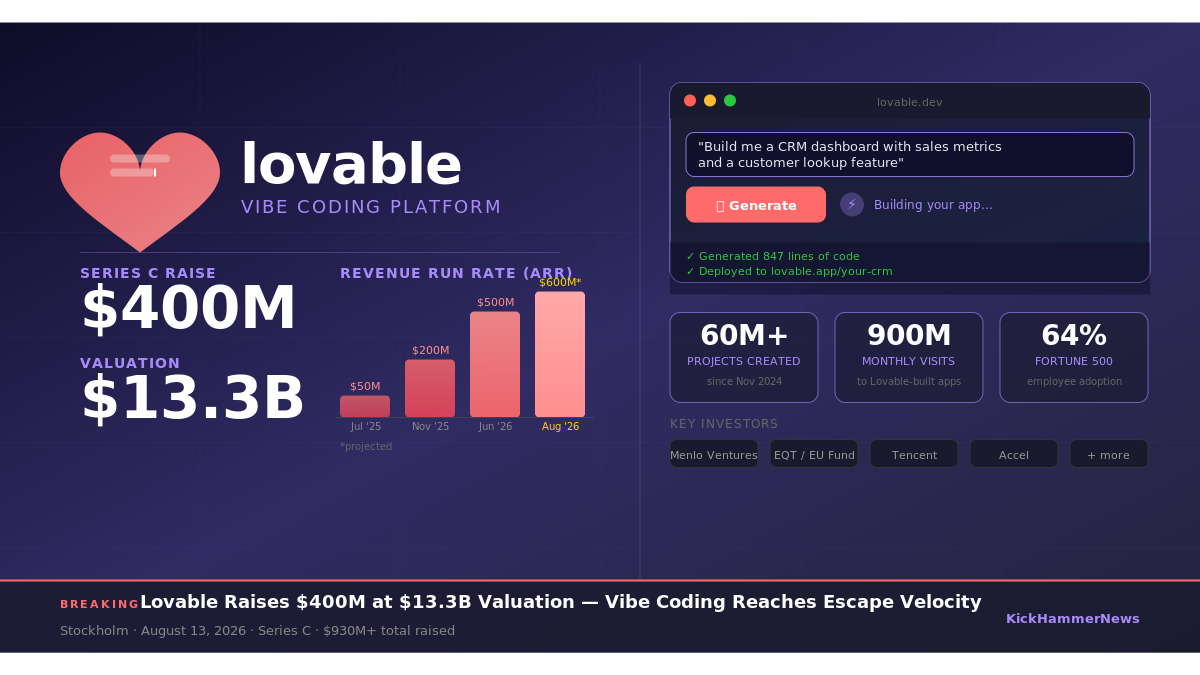
The Stockholm-based AI startup has turned natural-language app creation into a $930M+ venture, tripling its revenue run rate in less than a year and planting flags in two-thirds of the Fortune 500.
In the spring of 2025, the idea of “vibe coding” — writing software by describing what you want in plain English and letting an AI figure out the rest — seemed like a novelty, a party trick for tech enthusiasts who wanted a landing page without touching CSS. By August 2026, it has become one of the most hotly funded categories in enterprise software. And Lovable, the Swedish startup that helped coin the phrase, just put an exclamation point on that transformation with a $400 million Series C round that values the company at $13.3 billion — double what it was worth just eight months ago.
The round was co-led by Menlo Ventures and the Scaleup Europe Fund, a European Commission-backed investment vehicle managed by Swedish private equity firm EQT AB. New investors include Balderton Capital, Carmignac, Tencent Holdings, Kaszek Ventures, LTS Growth, World Innovation Lab, and Regent. Returning backers — Accel, CapitalG, DST Global, HubSpot Ventures, and Salesforce Ventures — also participated. All told, Lovable has now raised more than $930 million since its founding in 2023.
From Prompt to Product in Seconds
The premise of Lovable is disarmingly simple: you describe what you want to build, and the platform builds it. A marketing manager who has never written a line of code can spin up a lead-capture form, a custom dashboard for tracking campaign metrics, or a lightweight CRM in the time it takes to draft an email. Hosting is bundled in. No GitHub repo, no deployment pipeline, no DevOps team required.
Chief Executive Anton Osika and co-founder Fabian Hedin started Lovable in 2023 with a conviction that the biggest bottleneck in software creation wasn’t talent — it was the friction between an idea and a working product. The public launch came in November 2024, and the numbers since then have been difficult to argue with: more than 60 million projects created on the platform, with apps built on Lovable now drawing 900 million visits per month.
“This funding lets us move faster on the product, infrastructure, and team needed to make Lovable the best place to build and run a business,” Osika said in the company’s announcement.
Revenue Growth That Defies Gravity
Lovable’s financials are the kind that make venture capitalists reach for their checkbooks. In November 2025, the company disclosed annualized revenue of roughly $200 million. By June 2026 — just seven months later — that figure had hit $500 million. The company expects to end August at a $600 million run rate, suggesting a near-tripling in less than a year.
That trajectory was enough to push Lovable’s valuation from $6.6 billion in December 2025 to $13.3 billion today, a jump that reflects both the company’s own momentum and investors’ broader conviction that AI-powered software creation is approaching a tipping point. Matt Murphy, a partner at Menlo Ventures who co-led both the Series B and this round, called Lovable “one of the most generational companies of the AI era.”
For context, the previous December round — a $330 million Series B — had itself been remarkable, implying a valuation nearly four times the $1.8 billion Accel had assigned to the company when it led the Series A in July 2025. The compounding pace of these re-ratings tells a story about how quickly the market’s perception of vibe coding has shifted: from curiosity to category-defining platform.
Enterprise Is the Next Frontier
The bulk of Lovable’s revenue still comes from individual developers and small teams paying monthly subscriptions, but the enterprise story is beginning to take shape. Employees at nearly two-thirds of the Fortune 500 now use the platform, up from about half at the start of the year. Named enterprise customers include Nvidia, Adidas, Hearst Communications, and Zendesk.
Enterprise contracts account for only about $20 million of annualized revenue today — a small slice of the total, but one the company is actively working to grow. The new funding will go toward deeper enterprise integrations, governance and permissions controls that IT and legal teams require, and continued training of Lovable’s in-house AI models. The company is also aiming to expand its workforce to roughly 450 employees by the end of 2026, an increase of about 50%, with most new hires concentrated in machine learning, product, infrastructure, and security.
Geographically, Lovable is filling out a global footprint alongside its Stockholm headquarters, with new offices planned or opening in London, Boston, San Francisco, and New York. The international investor syndicate — European institutions, a Latin American VC, Tencent from Asia — mirrors the company’s ambitions for global reach.
Why Vibe Coding Has Staying Power
Skeptics of vibe coding often argue that AI-generated software is fine for prototypes but breaks down at production scale — that serious applications require serious engineering. That criticism is becoming harder to sustain.
Lovable says nearly 80% of its users are building something they intend to monetize, and that more than a third of those are already earning revenue. Those aren’t hobby projects. They’re small businesses, independent software vendors, and internal tools that companies are using to streamline operations — applications that, a few years ago, would have required hiring a developer or paying an agency.
The platform’s evolution from a prompt-to-webpage toy into a full-fledged application development environment tracks a broader pattern in AI: initial capabilities that seem limited quickly compound, and what starts as a convenience feature becomes load-bearing infrastructure. Lovable is betting that the next wave of business software won’t be built by traditional developers following agile sprints — it will be built by the people who actually understand the problem, typing prompts into an interface that handles the engineering.
That thesis is getting more credible by the month. OpenAI, Anthropic, Google, and a raft of well-funded competitors are all pushing coding models that improve with each generation. The underlying technology Lovable relies on is getting faster, cheaper, and more capable. Rather than threatening the business, those improvements tend to expand what Lovable can do — and by extension, what its users can build.
A European Unicorn With Global Ambitions
It’s worth noting where Lovable is from. Stockholm has produced a remarkable number of globally significant technology companies — Spotify, Klarna, King, Mojang — and Lovable is shaping up to be the city’s most valuable AI export yet. The involvement of the EU-backed Scaleup Europe Fund is a signal that European institutions see Lovable not just as a commercial success story but as a strategic asset: proof that world-class AI companies can be built outside the Bay Area.
The company’s rapid ascent also arrives at a moment when European policymakers are debating how to foster AI innovation while maintaining the continent’s emphasis on data privacy and algorithmic accountability. Lovable’s model — building on top of frontier AI rather than training from scratch — means it operates closer to the application layer, where regulatory questions around user data and output responsibility are different, and in many respects more tractable, than those facing foundation model developers.
What Comes Next
With $930 million raised, a $13.3 billion valuation, and revenue approaching $600 million annualized, Lovable is no longer a startup that needs to prove its model works. The questions ahead are about scale, defensibility, and enterprise penetration.
Can the company convert its Fortune 500 footprint from departmental experiments into organization-wide contracts? Can its in-house models keep pace with the rapid improvements coming from OpenAI, Anthropic, and Google? And can it maintain the simplicity that made it compelling as it adds the enterprise features — role-based access, audit logs, compliance controls — that larger customers require?
The funding suggests investors believe the answers are yes. But the real test will come as Lovable moves from being the platform people use when they want something built quickly to the platform enterprises trust when they want something built right.
Sources: SiliconANGLE, Bloomberg, EU-Startups, Lovable Series C Announcement


