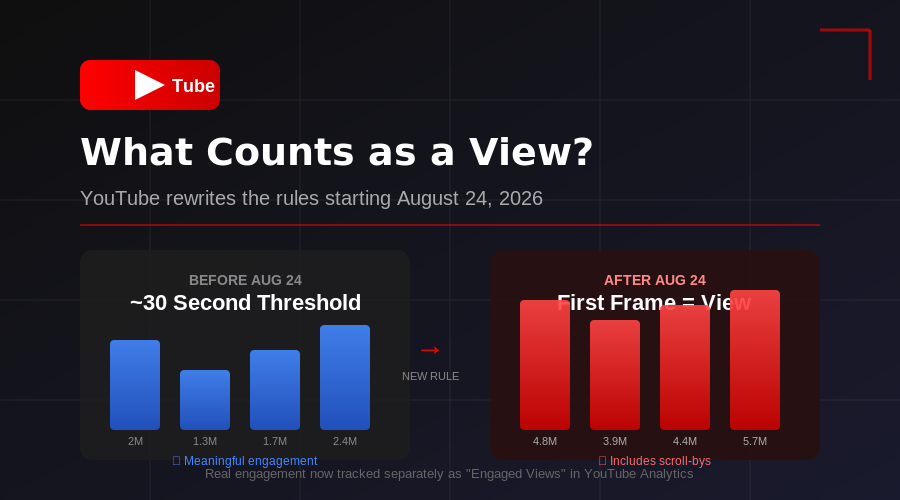
Starting August 24, 2026, YouTube will count a view the moment a video begins playing. For two billion users and millions of creators, nothing will look the same.
For nearly two decades, a YouTube view meant something specific: a human being chose to watch your video, stuck around long enough to matter, and walked away having genuinely engaged with your content. That definition — never officially written down, but widely understood to require roughly 30 seconds of watch time — is about to be retired. Beginning August 24, 2026, YouTube will count a view the moment a video begins playing, matching the approach already used by TikTok, Instagram Reels, and YouTube Shorts. The change sounds administrative. Its implications are anything but.
The End of an Unofficial Standard
YouTube’s old view-counting system was a quiet contract between the platform and its creators. Holding the threshold at approximately 30 seconds filtered out accidental plays, algorithmic pre-loads, and the endless scroll behavior that has come to define short-form consumption. A video with 10 million views under the old system meant 10 million people chose to spend meaningful time with that content. It was an imperfect proxy for quality, but it worked well enough to anchor an entire industry of creator analytics, brand partnerships, and advertising deals.
Google never published the exact rules. But the creative economy built around them was very real. Sponsorship rates, merchandise deals, record label interest, and viral credibility all flowed from public view counts that implicitly carried a quality filter. That filter is now gone.
The company explained the reasoning in a YouTube Community post: “Historically, we’ve used multiple view counting systems across different formats. However, we’ve heard that creators want to eliminate this metric confusion and accurately understand their true exposure.”
The logic is defensible. YouTube has long juggled different counting rules for long-form videos, Shorts, and live broadcasts. Unifying them under a single first-frame standard creates consistency and aligns YouTube’s surface-level metrics with what competitors already report. Creators managing content across platforms can now compare numbers without adjusting for platform-specific counting quirks. That clarity has real value.
What “Engaged Views” Actually Tells You
To soften the blow, YouTube is preserving the old metric under a new name: “Engaged Views.” Starting August 24, creators will find this figure in YouTube Analytics, representing the count of viewers who watched beyond the threshold that previously defined a public view. Monetization eligibility, ad revenue calculations, and YouTube Partner Program qualification will all continue to be tied to Engaged Views rather than the new public count.
This means creators effectively now have two view numbers to track: a larger, inflated public count for social currency and first impressions, and a smaller, more honest Engaged Views figure for understanding actual audience behavior and earning potential.
The split creates new complexities. A video with 5 million views might have 800,000 Engaged Views — an 84% bounce rate that tells a very different story about content quality. Advertisers sophisticated enough to ask for Engaged Views data will have access to a more sobering picture. Creators may need to educate their audiences, sponsors, and collaborators about which number actually matters. And platforms that surface YouTube analytics — from influencer marketing tools to music label dashboards — will need to update their data pipelines to track the right metric.
The Monetization Squeeze
The view count change arrives at a fraught moment for the creator community. Earlier this month, YouTube announced that it is doubling the watch hours required to enter the YouTube Partner Program, raising the threshold from 4,000 to 8,000 qualified watch hours over the past year. Shorts creators face a similarly steep jump, needing 20 million qualified views in 90 days instead of 10 million.
The timing has sparked significant backlash. Critics argue YouTube is simultaneously inflating the public metric that generates buzz while raising the internal bar required to earn money from that buzz. A creator can now rack up millions of “views” — by the new definition — while seeing fewer qualified watch hours in Analytics and finding themselves further from monetization than ever.
YouTube frames these as unrelated policy changes, and technically they are. But for the hundreds of thousands of mid-tier creators trying to build sustainable channels, the message feels contradictory: your numbers will look bigger, but the work required to get paid just got harder.
What This Means for Viewers
For most people who watch YouTube, the change will be invisible. Videos will accumulate views faster. Viral tags will hit milestones like 1 million views more quickly. A clip that would have reached 500,000 views under the old rules might hit several million under the new standard, simply by capturing the first frame of a broader pool of autoplay passes and quick scrollers.
Whether that changes how viewers perceive popularity is an open question. View counts have always served partly as social proof — they signal that a video is worth watching. If those signals inflate significantly, viewers may start to discount them, leaning more heavily on ratings, comments, or other engagement signals to assess quality. The attention economy runs on trust. When a metric loses meaning, something has to fill its place.
Live streams receive the same treatment. Every time a viewer joins a broadcast, that entry counts as a view immediately, rather than after they have spent time with the content. For streamers whose community metrics hinge on concurrent viewers and session counts, this could reshape how channels are perceived and marketed.
A Platform Following Its Competitors
The deeper story behind this change is competitive alignment. TikTok and Instagram have always counted views from the first frame. As YouTube has pushed Shorts — its answer to short-form competition — it already adopted the same rule for that format a year ago. Extending it to all video formats is a logical next step that lets YouTube report headline numbers that don’t look embarrassingly small next to TikTok’s.
There’s also an advertiser dimension. Brands buying YouTube inventory care about reach, impressions, and attention signals. The new view count is closer to an impression — the moment content enters a viewer’s awareness — than to a confirmed engagement. Platforms generally want their reach numbers to look large. A unified first-frame count achieves that.
The Creator Calculus
Savvy creators will adapt. Those who have built engaged communities know their audience and understand what Engaged Views actually tells them about content performance. Analytics-literate channels will use the new dual metric system to their advantage, pointing sponsors to Engaged Views to demonstrate genuine audience depth while using the public count for negotiating brand awareness campaigns.
Smaller creators and newcomers will face steeper learning curves. Building a channel on YouTube has always required understanding a complex system of algorithms, analytics, and policy thresholds. The post-August 24 landscape adds one more variable to manage — and underscores that the most important number on YouTube is rarely the one displayed to the public.
For brands that sponsor creators, auditing partners’ analytics will become even more important than it already is. An influencer with 10 million views and 600,000 Engaged Views is a very different proposition than one whose view counts are genuine reflections of audience investment. Due diligence in the creator economy just got more complicated.
What Happens Next
YouTube’s view count change takes effect on August 24 and applies globally, across all formats and regions. The company has signaled no plans to revisit the decision. Creators who want to download historical Analytics data before the transition should do so now, since legacy Engaged View breakdowns may eventually be harder to access.
The broader question this change raises is about transparency. YouTube built its creator economy on a view count that creators and advertisers loosely trusted to mean something. By severing that implicit meaning and relabeling the “real” metric as Engaged Views buried in a dashboard, the platform is trading a small piece of trust for larger headline numbers. Whether that trade serves the long-term health of the creator economy — or just YouTube’s competitive positioning — remains to be seen.
What’s certain is that the number you see on a YouTube video after August 24 will mean something different than it did before. In a media landscape already full of inflated metrics and attention proxies, that distinction matters more than YouTube’s announcement might suggest.


