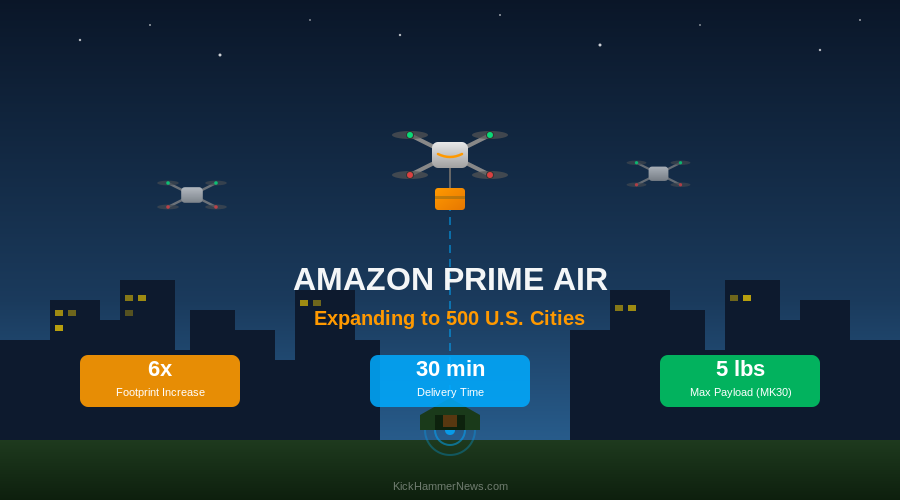
Amazon has announced its most aggressive expansion of Prime Air to date, with plans to bring drone delivery to nearly 500 U.S. cities and towns by the end of 2026 — a sixfold increase over its current footprint.
For years, autonomous drone delivery felt like a perpetual “just around the corner” promise. Prototypes buzzed over test fields. Regulatory hurdles stacked up. A few thousand deliveries trickled out to select zip codes in sunbelt suburbs. But the announcement on August 19 signals something different: Prime Air is no longer a pilot program. It is becoming infrastructure.
From Pilot to Platform
Amazon's drone delivery program currently serves customers across seven states — Arizona, Florida, Kansas, Louisiana, Michigan, Nebraska, and Texas. The expansion announced this week adds eleven new launch locations almost immediately: Tolleson, Arizona; Ruskin, Florida; Kansas City, Kansas; Papillion, Nebraska; Baton Rouge, Louisiana; Hazel Park and Pontiac, Michigan; and Richmond, San Antonio, Richardson, and Waco, Texas.
Beyond those near-term additions, Amazon says launches in Georgia, Ohio, Illinois, Idaho, and New York are coming soon — a signal that the program is finally moving out of the southern Sun Belt and into new regional and northeastern markets. The target of nearly 500 cities by year's end represents a massive logistical undertaking that would require Amazon to stand up new drone delivery hubs, secure FAA airspace authorizations, and integrate with its existing fulfillment network across hundreds of new geographies.
“Customers already turn to Amazon for fast Same- and Next-Day Delivery, and Prime Air provides them an even speedier option when they need it, with deliveries in as fast as 30 minutes,” said David Carbon, vice president of Amazon Prime Air.
The MK30 Drone: Built for the Real World
Central to the expansion is Amazon's MK30 drone, which the company has been quietly deploying and iterating on since its introduction. The MK30 can carry packages up to five pounds, a threshold that covers roughly 60 percent of items frequently purchased on Amazon — think phone chargers, over-the-counter medications, small kitchen gadgets, cosmetics, snacks, and similar everyday items.
Amazon has made a point of emphasizing the drone's real-world robustness. Unlike early consumer drone technology that struggled in wind, rain, or temperature extremes, the MK30 is engineered to operate in light precipitation and across a wide range of environmental conditions. For customers who have grown accustomed to weather delays affecting traditional delivery, that reliability matters.
Navigation and safety rely on a combination of onboard cameras and sensors that handle obstacle detection and landing zone assessment. The company's “industry-leading Detect-and-Avoid system” continuously monitors airspace and the drone's immediate surroundings during flight, a feature Amazon has leaned into heavily following scrutiny after several earlier incidents.
Safety Remains the Headline Underneath the Headline
The return of Prime Air to Tolleson, Arizona — one of the eleven newly announced launch sites — carries some baggage. In October 2025, two Amazon drones collided with the boom of a crane in Tolleson, an incident that temporarily paused operations and drew FAA attention. Other incidents over the past year included a drone clipping an internet cable in Texas, a crash into a garden, and a collision with an apartment building wall.
Amazon's decision to prominently feature safety messaging in this announcement — and to specifically return to Tolleson as a demonstration of restored confidence — reflects the company's awareness that public trust is as much a limiting factor as regulatory approval. The program operates under FAA Part 135 certification, the same framework applied to commercial air carriers, a designation that requires rigorous operational standards, pilot training equivalents, and ongoing compliance reporting.
“Prime Air has already delivered hundreds of thousands of packages to customers by drone this year,” Carbon added — a number that, while impressive for an emerging technology, remains a fraction of Amazon's billions of annual package deliveries.
Pricing and the Prime Flywheel
Amazon is using Prime Air to reinforce the value of its Prime membership, structuring pricing in a way that rewards subscribers while remaining accessible to non-members. Prime members receive free drone delivery on eligible orders of $50 or more. Orders under the $50 threshold cost Prime members $2.99. Non-Prime customers pay a flat $4.99 delivery fee.
The 30-minute delivery promise, if consistently delivered, could fundamentally alter shopping behavior. Urgent purchases — a forgotten birthday gift, a medication, a replacement cable — that previously required a car trip could instead arrive via drone before the consumer finishes deliberating. At scale, this could shift meaningful purchase volume away from brick-and-mortar retail toward Amazon's ecosystem.
Competition in the Sky
Amazon is not alone in building out drone delivery. Alphabet's Wing division has partnered with Walmart to operate what the companies describe as the largest drone delivery network in the United States. In June, Wing and Walmart added seven new markets to their network, including Phoenix, Philadelphia, and the San Francisco Bay Area. That expansion, combined with Wing's existing presence, positions Alphabet as the most direct competitor to Amazon in the consumer drone delivery space.
The race is less about who gets there first and more about who builds the operational moats — the fulfillment integrations, regulatory relationships, public trust, and geographic density — that make the service genuinely useful to ordinary consumers rather than a novelty for early adopters.
What 500 Cities Actually Means
It's worth pausing on what “nearly 500 cities” actually represents for the United States. A network covering 500 cities would bring Prime Air within reach of a substantial portion of the American population — though coverage within a city is not the same as coverage across it, and Amazon has not specified delivery radius parameters for all markets.
The practical impact will vary enormously by location. A Prime Air hub deployed in a dense urban environment faces different airspace challenges than one operating in a Sun Belt suburb with wide-open flight corridors and compliant zoning. Amazon's expansion into states like New York and Illinois will test the program's adaptability in ways that Texas suburbs simply have not.
The Bigger Picture
Amazon's Prime Air announcement lands at a moment when drone technology is transitioning from proof-of-concept to genuine commercial infrastructure. The FAA's regulatory posture toward commercial drones has become meaningfully more accommodating over the past two years, as the agency has accumulated data from real-world operations and refined its Part 135 framework.
For consumers, the timeline is straightforward: if Amazon's plans hold, drone delivery could become a routine option for a significant portion of American households before the new year. For competitors, the message is equally clear — the window to establish drone delivery infrastructure before Amazon cements its lead is closing.
For anyone who has watched the “future of delivery” promised repeatedly over the past decade, 2026 may finally be the year the skies over American suburbs start to look meaningfully different.


