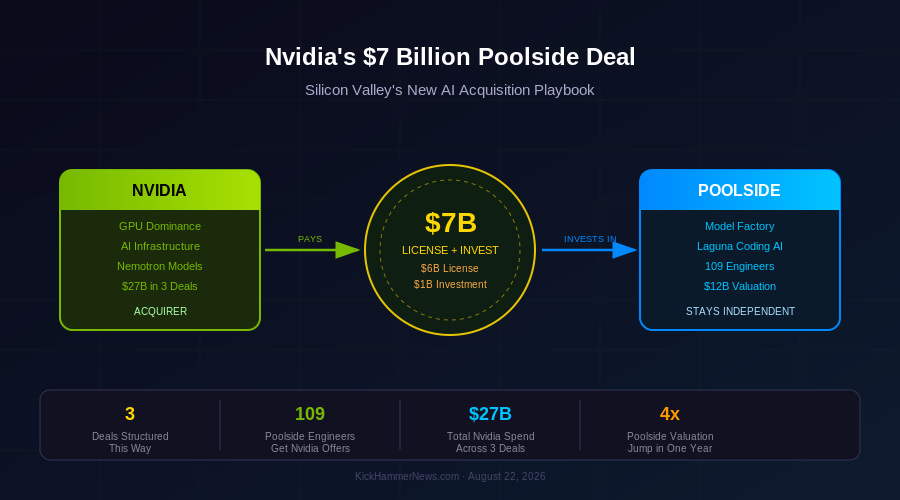
Nvidia has agreed to pay AI startup Poolside $6 billion to license the software it used to build cutting-edge AI coding models, while simultaneously investing $1 billion in what remains of the company at a $12 billion pre-money valuation. The arrangement, first reported by Newcomer and confirmed through an investor letter, also includes Nvidia extending job offers to 109 of Poolside’s employees. The three co-founders, however, are staying put.
The deal is “not an acquisition and it is not an acquihire,” the letter to investors states plainly. And yet, the combined $7 billion commitment — which brings Nvidia’s total spending across three such arrangements to roughly $27 billion — signals something profound about how the most powerful company in AI infrastructure is reshaping its competitive position.
The Model Factory Is the Prize
At the center of the deal is a system Poolside calls the Model Factory — the pipeline the startup used to build its Laguna family of open-weight coding models. Poolside started out as a developer of an AI coding agent before pivoting toward data center infrastructure, eventually releasing Laguna as what its team pitched as the Western world’s answer to DeepSeek and Qwen. It was trained entirely on Nvidia server chips.
Poolside CEO Eiso Kant described the scale of the effort last month on the Latent Space podcast. “Less than 70 people built this model,” he said. “Less than 115 between engineering and researchers, like, together did this effort.” Now Nvidia is paying $6 billion for the system those people built — and making offers to 109 of them.
The license is non-exclusive, meaning Poolside can still offer it to others. The $6 billion fee is expected to be distributed to Poolside’s investors by the end of 2027, representing a fourfold jump from the company’s $3 billion valuation just last year.
Nvidia’s New Template
What makes this deal particularly significant is that it isn’t new — it’s the third time Nvidia has structured an arrangement exactly this way. The playbook: license key intellectual property, hire away core talent, take a minority stake, let the company continue operating independently. No full acquisition. No regulatory review triggered by an outright purchase.
In May, TNW reported that Nvidia paid inference chip startup Groq $20 billion under a similar arrangement — securing Groq’s inference technology and its top engineers while Groq raised $650 million as a continuing entity. By August, Groq had closed a $350 million round at a $3.5 billion valuation, with Nvidia participating as an investor there too.
Before Groq, Nvidia struck a comparable deal with hardware startup Enfabrica for approximately $900 million.
Across all three deals, Nvidia has deployed roughly $27 billion without technically acquiring a single company.
Why This Structure?
The logic is layered. Full acquisitions of this scale invite antitrust scrutiny — a meaningful concern for a company that already commands the AI chip market with a dominance few companies in any sector have ever achieved. By licensing IP and hiring individuals rather than purchasing firms outright, Nvidia secures the capabilities it wants while sidestepping regulatory risk.
There is also a talent dimension. These are some of the most sought-after engineers in the world — researchers who have spent years building the specific systems Nvidia now wants inside its walls. A licensing deal is a way of paying for their output while the recruitment process unfolds. By the time Nvidia extends job offers to 109 Poolside engineers, it already knows exactly what they can do.
The arrangement also preserves optionality. The Poolside founders remain in place with a $1 billion war chest and a non-exclusive license that lets them continue building. The letter notes that Poolside Infrastructure Company, a spinout launched in January 2026, is developing a 1.2-gigawatt data center in Texas. A new CEO and CFO were appointed in the weeks before the deal was announced.
The Letter’s Candor About Frontier AI
The investor letter that surfaced this deal is unusually candid about what the frontier AI race actually looks like from inside a well-funded startup. “For the last 3½ years we’ve been directionally correct in a race where capital requirements went vertical,” it reads. The specific breaking point: “At the end of last year, we had a 6-week window in which to raise $2 billion dollars to pay for a 40,000 GB300 cluster coming online in January. We didn’t close it in time, and we lost the cluster.”
Poolside believed 10,000 to 20,000 of those chips would have been sufficient to build a frontier-rivaling model. Next year’s frontier, the letter argues, will require “far more than an order of magnitude larger cluster” — and the constraint isn’t just capital anymore. It’s physical data center space and pre-contracted compute.
This is a remarkable admission: even a company with strong technology, experienced founders, and Nvidia as an existing investor couldn’t move fast enough when the compute window opened and closed in six weeks.
What Nvidia Gets
Nvidia is not simply buying insurance against a competitor. The company is building its own open model line — the Nemotron family — and is reportedly working toward a trillion-parameter open-weight model. Poolside’s Laguna was built on the same Nvidia chips and by the same team that Nvidia is now absorbing. The Model Factory is the industrial process for building models at that level.
It’s worth noting that Nvidia has also halved a prior $250 billion commitment to OpenAI, signaling a willingness to reorient relationships with even its largest partners when the strategic logic shifts.
Nvidia has not commented publicly on the Poolside deal. The company’s silence is consistent with its previous handling of the Groq and Enfabrica arrangements.
The Bigger Picture
The Poolside deal crystallizes a structural reality in AI that 2026 has made hard to ignore: the frontier is no longer defined by who has the best ideas. It is defined by who controls compute at scale. Poolside had both the ideas and the people. What it lacked was the ability to secure a 40,000-chip cluster in six weeks.
Nvidia, with its hardware monopoly on GPU clusters and now an expanding portfolio of licensed AI model technology, is positioning itself at every layer of that stack simultaneously. By the time the Model Factory’s capabilities show up in Nvidia’s products — whether under the Nemotron name or another label — the three founders of Poolside will still be running a company. It just won’t be the same company it was when the letter was written.
Across three deals and $27 billion in commitments, Nvidia is acquiring the AI industry one license at a time.


