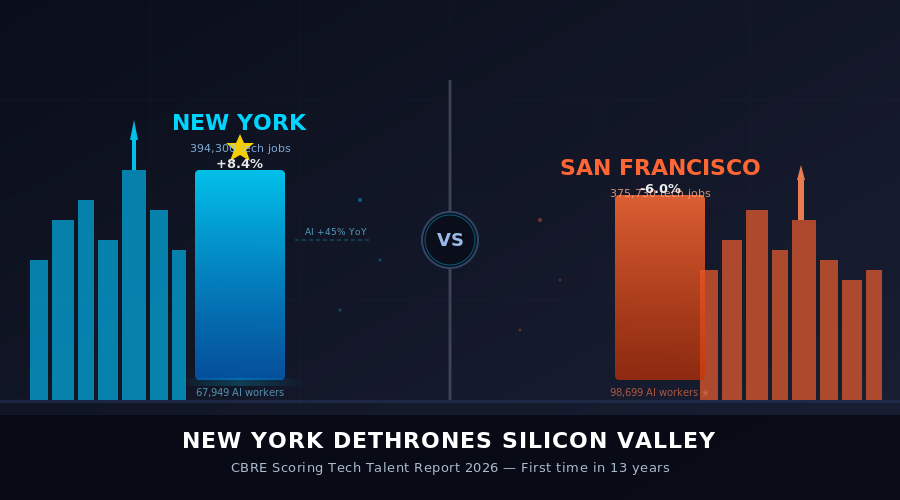
For thirteen years, the answer to “where do America’s best tech workers live?” was never in doubt. San Francisco. Always San Francisco. That era ended this week, when commercial real estate giant CBRE released its 13th annual Scoring Tech Talent report and confirmed what many in the industry had quietly suspected: New York City has overtaken the Bay Area as the largest tech talent market in the United States.
The numbers are stark. New York now claims 394,300 tech talent jobs, edging past San Francisco’s 375,730. It is a gap of roughly 19,000 workers — not a landslide, but a threshold crossed for the first time in a decade and a half of analysis. And the forces driving it are anything but subtle.
A Tale of Two Cities in the Age of AI
The story of this shift is really two stories happening at once, pulling in opposite directions. In the Bay Area, waves of tech layoffs that began in 2022 and continued through 2024 carved away tens of thousands of software engineers, product managers, and technical roles that did not survive the post-pandemic correction. From 2022 through 2025, the Bay Area shed a net 23,900 tech workers — a 6 percent decline that would have seemed unthinkable at the height of the pandemic-era hiring frenzy.
New York, meanwhile, was building. The city added 30,640 tech talent workers over that same three-year period, an 8.4 percent increase fueled by something the rest of the country has been slower to replicate: the convergence of Wall Street capital and artificial intelligence hiring. Banks, asset managers, hedge funds, and financial services firms — industries where New York has always dominated — began aggressively recruiting AI engineers, machine learning specialists, and data scientists at a pace that matched and eventually outpaced what was happening on the West Coast.
Colin Yasukochi, executive director of CBRE’s Tech Insights Center, put it plainly: layoffs in the Bay Area created a contraction, while New York’s finance sector dramatically increased its appetite for AI talent. The result is the map we have now.
The AI Layer: Where Both Cities Are Racing
None of this means Silicon Valley is becoming a backwater. Far from it. In the most important emerging category — AI-specific jobs — San Francisco still holds the crown. The Bay Area counts 98,699 AI workers within its metro footprint. New York trails with 67,949. When CBRE’s broader scoring methodology is applied (which factors in talent pipelines, university output, cost of labor, and other criteria), San Francisco still leads the overall ranking. The headcount victory belongs to New York; the AI density title remains in California.
What is striking is how fast both cities are growing in this dimension simultaneously. AI-specific roles across the U.S. and Canada surged by 45 percent in just the past year. Both San Francisco and New York each added more than 20,000 AI jobs since mid-2025 alone. Across both countries, there are now approximately 751,000 workers in AI-related roles — nearly one-third of all active tech job listings. The demand is not slowing down.
In San Francisco, the AI boom has reshaped the commercial real estate market in ways that were supposed to be impossible after the remote-work revolution. AI companies accounted for 58 percent of all office leasing in the first half of 2026, absorbing roughly 10 million square feet since 2023. The offices that went dark when pandemic-era tech giants retreated are being refilled, but by a different kind of company.
Why AI Brought People Back to the Office
One of the quietly significant details in CBRE’s findings is what AI work is doing to office culture. For years after 2020, the dominant assumption was that tech workers had permanently migrated to hybrid or fully remote arrangements, and that demand for office space in tech hubs would never fully recover. AI is complicating that story.
Yasukochi noted that AI roles typically require workers to be present in the office four to six days a week. This is not a management diktat being imposed against worker preferences — it reflects the collaborative, fast-iteration nature of building AI systems, where model evaluation, safety testing, and rapid prototyping benefit enormously from in-person proximity. The kinds of breakthroughs that come from whiteboard sessions and hallway conversations are not easily replicated on Zoom.
This dynamic is one reason why fears that AI would hollow out the need for office space have so far proven premature. Yasukochi was measured on this point: AI tends to transform jobs rather than eliminate them outright, at least in the near term. Within finance — New York’s core industry — new AI-adjacent roles are emerging alongside existing positions rather than replacing them wholesale. The city is not losing bankers; it is gaining AI engineers who work alongside bankers.
Canada’s Emerging Role
The report also highlights a development worth watching north of the border. Canada’s AI talent cluster is maturing rapidly, and it is geographically concentrated in ways that mirror the density of San Francisco and New York. Sixty percent of Canada’s AI workers are located in just three metros: Toronto, Montreal, and Vancouver. These cities are benefiting from strong university research programs, immigration-friendly policies, and the deliberate decisions of major AI labs to establish Canadian outposts partly as a hedge against U.S. visa uncertainty. Toronto in particular has emerged as a genuine global AI hub, not merely a regional one.
What It Means for Tech Geography
The CBRE report is a data snapshot, not a verdict. San Francisco is not losing its identity as the spiritual home of the technology industry. The density of AI talent, venture capital infrastructure, and institutional knowledge concentrated in the Bay Area is not replicated anywhere else. The culture of risk-taking and the networks built over decades of startup activity do not migrate easily.
But New York’s ascent is real, and it signals something important: the AI era is broadening the geography of tech in ways the previous decade did not. Finance, media, healthcare, and retail — industries deeply embedded in New York’s economy — are all becoming technology industries. The talent they are hiring to make that transformation is now, for the first time, more concentrated in Manhattan and Brooklyn than in Soma and the South Bay.
For the first time in thirteen years, when someone asks where America’s tech talent lives, the honest answer is: New York. At least by the numbers.
Sources: CBRE Scoring Tech Talent 2026 report; Dataconomy; Quartz