August 24, 2026
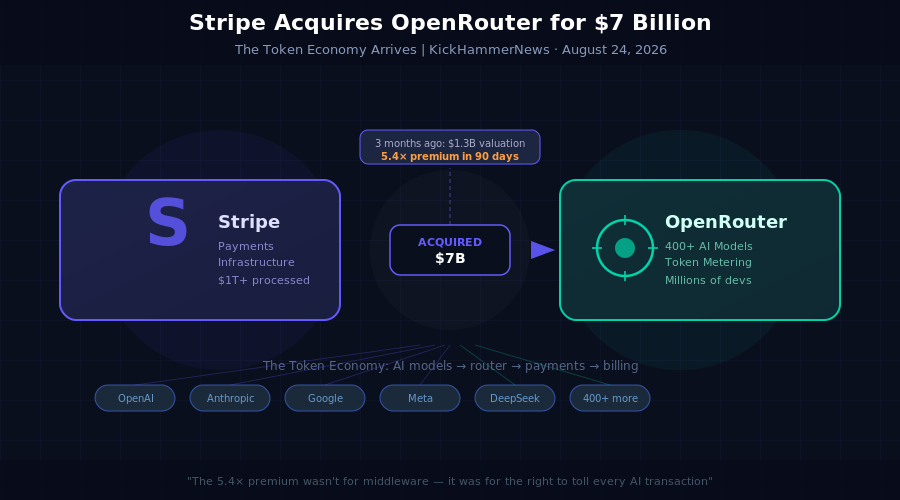
A payments company just paid a 5.4× premium for an AI model router. That sentence should stop you. Stripe, the company that processes over a trillion dollars in annual payments, finalized its acquisition of OpenRouter for more than $7 billion on August 16, 2026. Three months before the deal closed, OpenRouter was valued at $1.3 billion. The math is either insane or visionary—and the answer depends entirely on whether you believe AI tokens are becoming a new form of currency.
The Deal
OpenRouter’s product is deceptively simple: one API, 400+ AI models. Developers integrate once with OpenRouter and gain unified access to every major foundation model—OpenAI, Anthropic, Google, Meta, DeepSeek, and hundreds more. Instead of managing separate credentials, rate limits, billing cycles, and response formats for each provider, they go through a single gateway. Millions of developers already do exactly this.
Stripe’s product is also deceptively simple: developers integrate once with Stripe to accept payments. The company doesn’t care what you’re selling. It cares that money moves reliably and that it collects a fee on every transaction.
Put those two products together and the acquisition logic becomes clear. OpenRouter meters token consumption. Stripe processes payments. AI spending is measured in tokens, and tokens cost money. The company that controls metering and payments controls the transaction layer for every AI-powered business on the planet.
That’s not hyperbole—it’s infrastructure math. Visa and Mastercard proved that owning the transaction layer generates durable, compounding returns. Stripe is betting the same dynamic applies to AI token flows.
Why the Premium Is Defensible
Paying 5.4× a company’s recent valuation sounds reckless until you examine the alternatives. Every major cloud provider—AWS, Azure, Google Cloud—wants to own the AI routing layer. Microsoft has deep relationships with OpenAI and Anthropic. Google has Vertex AI. Amazon has Bedrock. Once any one of these players acquired OpenRouter, the opportunity for Stripe closed permanently.
Network effects in routing accelerate exponentially. More models attract more developers. More developers attract more model providers. OpenRouter at 400+ models and millions of users has crossed the threshold where the network becomes genuinely defensible. A well-funded competitor can build an API gateway in months, but replicating the model relationships and developer adoption that OpenRouter has accumulated takes years.
There’s also a data angle that most coverage underweights. Every API call routed through OpenRouter generates signal: which models developers choose, for which use cases, at what volumes, with what cost sensitivities. Stripe gains real-time intelligence on AI adoption patterns before public metrics reveal the trend. They’ll see which AI companies are scaling before anyone else does. That information advantage compounds over time.
How AI Billing Actually Works—And Why It’s Hard
The strategic logic only lands if you understand how usage-based AI billing actually functions in practice. It’s genuinely complex in ways that favor whoever builds the plumbing first.
Each AI provider prices differently. OpenAI charges per token with different rates for input vs. output. Anthropic prices by model tier. Google uses a combination of token pricing and context window surcharges. Model prices change frequently, sometimes without advance notice. Enterprise commitments unlock volume discounts that require real-time tracking. Some providers offer spot pricing that varies by demand.
For an AI startup billing its own customers, this creates a painful problem: you have to meter your consumption from multiple providers, convert those meters into customer invoices, and process payments—all while your underlying costs shift constantly. This is fundamentally a payments and metering problem. It’s exactly what Stripe and OpenRouter, combined, are built to solve.
The integrated product that emerges from this acquisition lets an AI startup route through OpenRouter, have their consumption automatically metered, and bill their customers through Stripe—with zero additional instrumentation. The developer experience becomes frictionless. That friction reduction is worth far more than $7 billion in aggregate across the AI startup ecosystem.
Who Gets Hurt
Not everyone wins from this consolidation. Independent AI gateway startups—Portkey, LiteLLM, and others—now compete against a well-capitalized incumbent with integrated payments and established developer relationships. Competing on features is difficult when the baseline offering includes seamless billing. Expect acquisitions or pivots among the smaller players within 12 months.
Hyperscalers face a more subtle problem. AWS Bedrock, Google Vertex AI, and Azure AI Studio all offer model routing. But none integrate with a payments layer the way Stripe-OpenRouter will. Developers building commercial AI products—the ones who need to bill customers for AI consumption—may prefer the integrated stack, pulling them out of the hyperscaler ecosystem. The threat to cloud lock-in is real.
Enterprises that built internal AI gateways face an uncomfortable rebuild-vs-buy reassessment. Many organizations deployed internal routing layers to manage multi-model strategies. Stripe-OpenRouter changes the cost equation. Maintaining internal gateway infrastructure suddenly looks expensive compared to a managed offering that includes billing integration out of the box.
What Changes for Developers
For developers building AI products, the acquisition validates multi-model strategies as mainstream. Companies with single-provider dependencies face higher switching costs as routing layers consolidate. The practical takeaway is architectural: build abstractions that accommodate model flexibility. Don’t call OpenAI or Anthropic directly if you can route through a gateway that lets you swap models without changing your integration.
Pricing on OpenRouter will almost certainly change post-acquisition. Stripe may subsidize AI routing to drive payment volume. Or they may extract margin from the captive developer base. Annual commitment pricing, if available now, is worth locking in before the acquisition integration is complete. After that, expect pricing to reflect Stripe’s market position rather than OpenRouter’s startup-era generosity.
The data practices question deserves careful attention. Every API call through a third-party router exposes information about your usage patterns, model selection, and volume. That data is now part of Stripe’s business intelligence. For most AI startups, this is an acceptable tradeoff. For companies handling sensitive applications, it’s worth auditing what flows through third-party infrastructure.
The Pattern This Reveals
Zoom out from the specific deal and a clear investment principle emerges: when the market is uncertain about winners at one layer of the stack, own the layer that serves all possible winners.
Models commoditize. The gap between the best foundation model and the fifth-best shrinks every quarter. Applications face winner-take-all dynamics that are hard to predict in advance. But infrastructure persists. The routing, metering, and billing layers serve every model and every application without picking winners. That’s where durable value accrues.
Stripe didn’t try to predict whether OpenAI or Anthropic or Google wins the model wars. They acquired the toll booth that all of them drive through. The 5.4× premium wasn’t for middleware—it was for the right to collect a fee on every transaction in the emerging token economy.
Whether AI spending reaches the scale that justifies $7 billion depends on usage growth outpacing price compression. That’s the bet Stripe made. Given that AI API call volumes have been growing at rates that routinely exceed analyst forecasts, it’s not an unreasonable one.
The token economy is arriving. Stripe just bought the mint.


