August 29, 2026
After months of heated debate, proposed counter-proposals, and a formal ballot that stretched across eight competing options, Debian’s developers have spoken: generative AI tools are welcome in the project — provided contributors use them responsibly. The result of the 2026 General Resolution on LLM usage marks one of the most significant governance decisions in Debian’s 33-year history, and its implications ripple far beyond the project itself.
How We Got Here
The debate inside Debian did not appear out of thin air. For at least two years, open-source communities across the software world have grappled with a question that no existing policy framework was designed to answer: when a contributor submits a patch, a documentation update, or a packaging fix that was substantially written by a large language model, who is responsible for its quality — and is it even appropriate?
Within Debian, tension surfaced early in 2026 when longtime developer Lucas Nussbaum proposed that the project formally permit AI-assisted contributions. His proposal triggered an avalanche of counter-proposals. By the time voting opened, Debian members were weighing eight distinct options, ranging from an outright ban on LLM-generated content to a permissive stance that treated AI output like any other tool. In between sat nuanced middle-ground proposals covering mandatory disclosure, opt-in package flags, and case-by-case maintainer discretion.
That breadth tells its own story. The Debian developer community — famously deliberate and technically rigorous — was not of one mind. Anti-AI factions argued that blindly accepting generated patches degrades the human accountability that underpins Debian’s reputation for quality. Pro-AI voices countered that prohibiting these tools amounts to penalizing volunteers whose limited spare time could otherwise be multiplied. Neither camp was wrong, which is precisely why the vote attracted so much attention.
What “Responsible Use” Actually Means
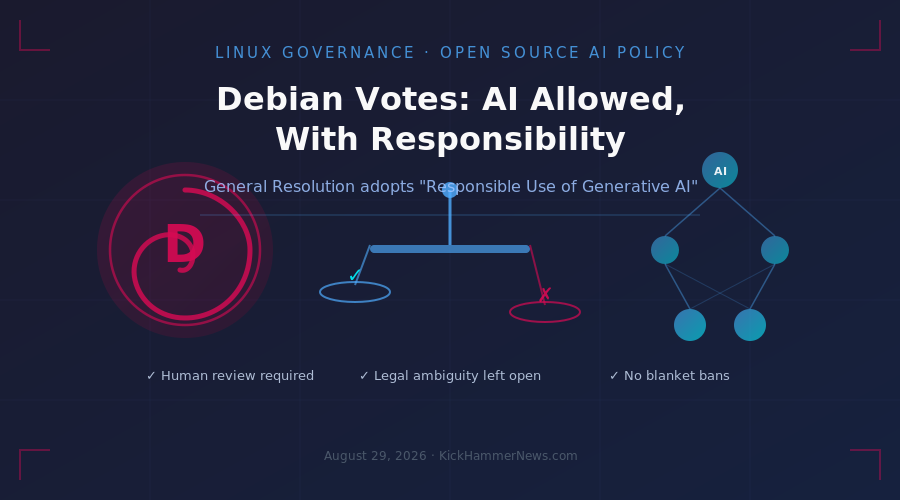
The winning resolution lands squarely in the center: Debian neither endorses nor prohibits generative AI tools. In plain terms, the project has chosen to treat AI assistance the way it treats any other tool — as ethically neutral, but subject to the same standards already applied to every contribution.
The key obligations the resolution places on contributors are worth examining closely. First, understanding: contributors are expected to understand, review, test, and where appropriate, modify AI-assisted output before incorporating it into Debian. Blindly accepting or uploading AI-generated material without appropriate human review is inconsistent with Debian’s established development practices. Second, accountability: the use of a generative AI tool does not diminish the contributor’s responsibility for the work they submit. Third, transparency: developers are encouraged to disclose whether a contribution was made with AI assistance — but this is not required.
That last point will disappoint some observers who had hoped for mandatory disclosure. The project’s reasoning is pragmatic: with no reliable automated way to detect AI-generated code, a disclosure mandate would create enforcement headaches without meaningfully improving oversight. The burden of quality, as always, falls on the human who presses submit.
The resolution also carves out explicit rules around security sensitivity. Contributors must not feed confidential information, embargoed security bugs, cryptographic keys, or credentials into third-party AI services. This is a sensible guardrail — one that mirrors policies already in place at many corporate development organizations — but its inclusion signals that the Debian project is thinking seriously about the operational risks of AI tool usage, not just the philosophical ones.
The Legal Ambiguity Debian Deliberately Left Unresolved
One of the more candid passages in the resolution acknowledges that the legal landscape around AI-generated content remains murky: questions of copyright, authorship, licensing, and potential reproduction of training data are described as “the subject of ongoing discussion in many jurisdictions.” Debian explicitly chose not to resolve these questions through the General Resolution.
That restraint is deliberate and arguably wise. Courts and regulators in the United States, European Union, and United Kingdom are still working through foundational cases involving AI-generated output and training data. A Linux distribution adopting a definitive legal position now would almost certainly have to revisit it within a few years as case law develops. Instead, the resolution asks individual contributors to exercise appropriate care, consider provenance and licensing implications, and avoid introducing content whose legal status they cannot reasonably justify — essentially, the same standard of professionalism Debian has always expected.
A Broader Signal to the Open-Source World
Debian’s vote matters well beyond its own package archive. Debian is the upstream parent of Ubuntu, Linux Mint, and hundreds of other derivatives. Its social contract and developer policies have historically set informal standards that other distributions reference or adopt wholesale. The message being sent today is clear: the open-source world is not going to categorically reject AI assistance, but it is going to insist that human accountability remains at the center of every contribution.
This stands in contrast to the approach taken by some corporate-backed AI coding tools that encourage developers to treat generated output as essentially production-ready. Debian’s model explicitly rejects that framing. Every patch is yours when you submit it — regardless of how you produced it.
That philosophy also addresses a problem that has been growing uncomfortably visible in recent months. The Linux kernel project reported in late August 2026 that AI/LLM tools analyzing the codebase have helped push CVE counts toward 2,000 per release — a staggering increase from the roughly 500 seen in prior cycles. Maintainers of several kernel subsystems have described the surge of AI-generated patch submissions as overwhelming, with some networking maintainers publicly stating they feel “completely overwhelmed” by the volume. The Debian resolution implicitly confronts this problem: it explicitly requires that contributors seeking to perform mass bug filing or large-scale automated changes seek prior discussion and consensus before proceeding, and that any automated process be overseen by a human who remains accountable for its behavior.
What Changes — and What Doesn’t
For the vast majority of Debian maintainers, the practical answer is: not much. Developers who have quietly used AI assistance to draft changelogs, generate boilerplate packaging scripts, or brainstorm debugging approaches can continue doing so. The difference is that the project has now officially acknowledged the practice, set boundaries around it, and affirmed that every resulting contribution still lives or dies on its own technical merits.
For critics of the decision, the concern is less about what is prohibited than about what is normalized. A policy that permits responsible use inevitably means different things to different contributors — and Debian’s distributed, volunteer-driven structure makes centralized enforcement essentially impossible. The resolution is, at its core, a trust-based framework. That has always been Debian’s model, and for 33 years it has produced one of the most respected software archives in computing.
Whether it holds in an era of increasingly capable AI tools remains one of the more interesting open questions in open-source governance. For now, Debian has chosen to extend to generative AI the same trust it extends to every other tool in a developer’s kit — while making clear that the developer, not the model, carries the weight of what gets shipped.
Sources: Phoronix — Debian Votes To Allow “Responsible Use Of Generative AI” | LWN.net — Debian weighs eight options in vote on LLM usage | The Register — Debian polls its developers | Phoronix — The Linux Kernel Is Approaching 2,000 CVEs Per Release