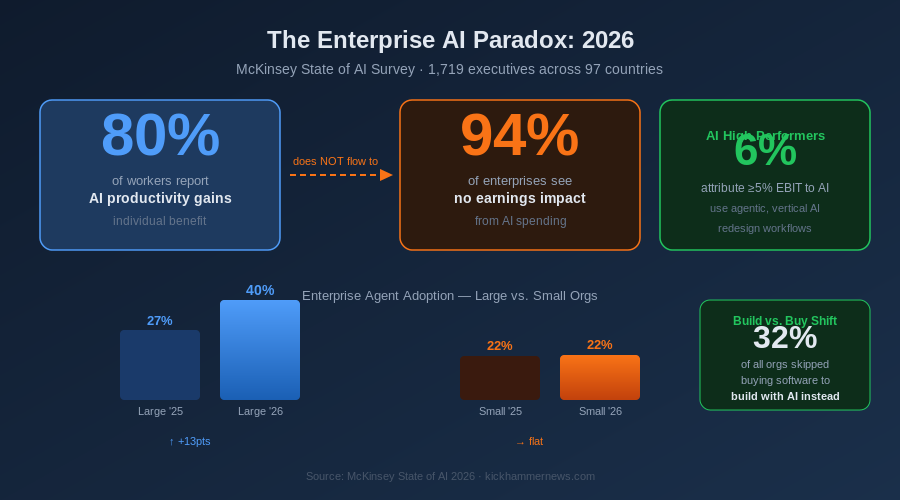
Artificial intelligence is everywhere in the enterprise. Chatbots handle customer queries, copilots autocomplete code, writing assistants polish quarterly reports. And yet, according to McKinsey’s newly released State of AI 2026 report — the most comprehensive annual snapshot of how companies are actually deploying the technology — the gap between the buzz and the balance sheet has never been more starkly exposed.
Ninety-four percent of enterprises, McKinsey found, cannot point to a meaningful earnings impact from AI despite record levels of spending. The survey, drawn from 1,719 participants across 97 countries, offers a sobering corrective to the breathless optimism that has dominated AI headlines for the past three years.
The Six Percent Club
The numbers are deceptively simple. Only six percent of organizations surveyed qualify as what McKinsey calls “AI high performers” — companies that attribute at least five percent of their earnings before interest and taxes (EBIT) directly to AI use and describe AI’s impact as significant. Another 31 percent report some EBIT contribution, but below that five-percent threshold. That leaves 63 percent reporting no measurable earnings impact whatsoever, even as they continue expanding AI deployment and logging what they describe as genuine productivity gains at the individual worker level.
The distinction between productivity and profitability is the crux of the problem. Roughly 80 percent of individual employees report that AI tools make them more productive. Meetings are shorter, first drafts are faster, code reviews take less time. Yet that time savings — created in abundance at the worker’s desk — is largely failing to flow upward into the income statement.
McKinsey’s analysts describe this as the “horizontal tools trap.” Products like chatbots, general-purpose copilots, and AI writing assistants are easy to procure, easy to roll out, and genuinely useful. But they spread productivity gains diffusely across thousands of individual tasks rather than concentrating them in a way that changes a company’s competitive position or cost structure. The gains are real. They just don’t move earnings at a level that shows up in a quarterly report.
Agents Are Reshaping the Picture — For Some
The more consequential finding may be what separates the six percent from everyone else: a decisive shift toward agentic AI.
Large enterprises that have scaled AI agents across one or more functions grew from 27 percent to 40 percent year-over-year, a significant jump. But smaller organizations registered essentially no change, hovering around 22 percent adoption. The divergence is accelerating a two-speed dynamic in which early movers compound advantage while the majority of companies run the same horizontal AI tools everyone else has access to.
The high-performing six percent are also driving the report’s most striking single data point: nearly half of them have declined to purchase at least one software product or feature in the past year because they chose to build the equivalent internally using agentic coding tools. Across all respondents, 32 percent made the same choice. The build-versus-buy calculus, long tilted toward buying for all but the largest technology companies, is shifting — and shifting fast.
The implications are significant for enterprise software vendors. If AI-native companies can spin up internal tools at a fraction of the cost of a commercial subscription, the SaaS pricing model that has powered a decade of software growth faces a structural challenge. Companies like Salesforce, ServiceNow, and SAP have been racing to embed AI into their platforms. The McKinsey data suggests that a substantial cohort of their most sophisticated customers may be deciding those platforms are no longer necessary.
Spending Keeps Rising, Regardless
Perhaps the most counterintuitive data point in the report: 94 percent of executives plan to maintain or increase AI investment in 2026 despite the earnings gap. Only six percent would reduce spending if current initiatives fail to deliver measurable financial value this year.
This is either a story of patient capital making long-term bets on transformative technology, or it is a story of institutional momentum — companies investing in AI because competitors are, because boards expect it, and because the optionality feels too valuable to forgo even without near-term proof of returns. Probably both are true at once.
The executives who are bullish point to a consistent pattern: enterprise technology transitions — cloud computing, mobile-first, e-commerce — routinely showed a multi-year gap between adoption and measurable financial returns. AI, the argument goes, is simply in that gap right now. The productivity benefits accumulating at the individual level are laying the groundwork for structural changes in how work gets organized and priced, and the earnings impact will follow.
Skeptics counter that the cloud transition had a clearer mechanism: it reduced capital expenditure and increased flexibility in ways that showed up directly on balance sheets. AI’s benefits, by contrast, are concentrated in cognitive tasks that are hard to price and even harder to attribute. When an employee with an AI copilot closes a deal twenty minutes faster, how much of that revenue belongs to the AI investment?
What High Performers Are Doing Differently
McKinsey’s data offers some clues. High performers are more likely to have deployed AI in vertical, domain-specific applications rather than general-purpose horizontal tools. They embed AI directly into revenue-generating or cost-sensitive workflows — pricing models, supply chain optimization, clinical decision support, fraud detection — rather than layering it on top of existing processes as a productivity add-on.
They are also more likely to have reorganized workflows around AI output rather than simply giving individual employees access to AI tools. The distinction matters enormously: handing a lawyer an AI research assistant and asking them to work faster is categorically different from redesigning the legal department’s intake, triage, and research processes around AI-first workflows and then measuring the outcome.
The report also notes that high performers invest significantly more in data infrastructure and model evaluation than their peers. They treat AI deployment as an engineering problem requiring ongoing measurement and iteration, not a software procurement event.
The Honest Assessment
For the majority of enterprises sitting outside the six percent, the McKinsey report is a useful mirror. The investments are not wasted — the productivity gains are real, the optionality is valuable, and the organizational learning that comes from deploying AI at scale will matter when more powerful capabilities arrive. But the path from productivity gains to earnings impact requires deliberate workflow redesign, vertical specificity, and the willingness to measure outcomes rigorously.
The AI era is not failing enterprise. It is simply, for most companies, still in its first chapter — one where the gap between doing and earning remains stubbornly wide.


