Security operations centers have long struggled with one inescapable bottleneck: the human analyst. Alerts flood in by the thousands, each one demanding attention, context, and judgment. Most get triaged at a glance. Some get missed entirely. Proofpoint is betting that a new AI agent built on OpenAI’s purpose-built Daybreak cyber models can change that calculus — not by replacing analysts, but by doing the exhausting legwork before a human ever touches the keyboard.
On September 3, 2026, Proofpoint announced the Proofpoint SOC Analyst Agent, the company’s first major product to emerge from the Daybreak Defense Network — a partnership it joined with OpenAI in June 2026 to apply cyber-tuned AI models across its security portfolio. The agent is currently entering private preview with a select group of beta customers, with general availability targeted before the end of Q3 2026.
What the Agent Actually Does
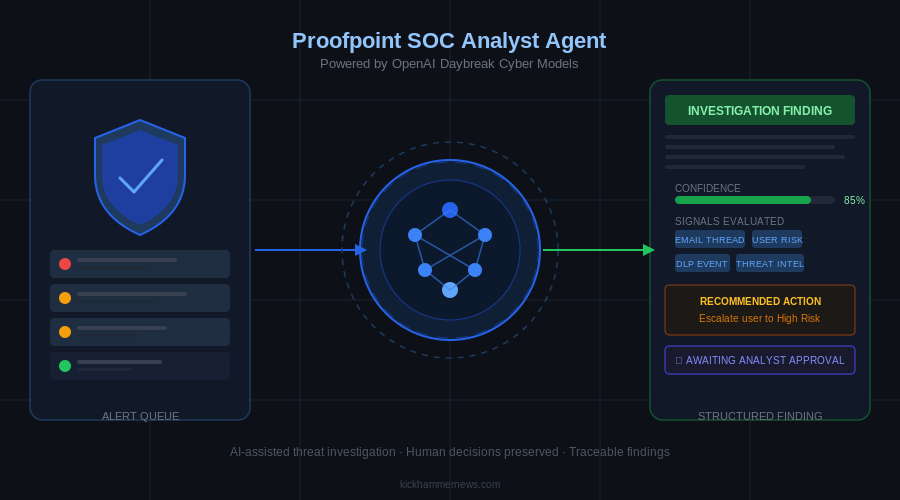
The SOC Analyst Agent is designed to sit inside existing Proofpoint investigation workflows and respond to natural-language questions from security analysts. An analyst can ask something as open-ended as “Was this email part of a broader campaign?” or “What’s this user’s risk history over the past 30 days?” The agent then plans the investigation autonomously, pulling context from across Proofpoint’s product surface — email alerts, DLP events, user risk signals, threat intelligence logs — and returns a structured finding with a recommended next step.
The key word is structured. Rather than surfacing a wall of raw logs or a vague summary, the SOC Analyst Agent produces traceable findings: a chain of reasoning that shows which signals it evaluated, how it weighted them, and what conclusion it reached. Analysts can follow that chain, agree or disagree, and escalate accordingly. The agent is explicit about what it doesn’t know, and consequential security decisions — blocking an account, quarantining a device, escalating to incident response — remain in human hands.
This matters for enterprise compliance. Security teams operating under frameworks like SOC 2, ISO 27001, or industry-specific regulations need audit trails, not black boxes. A finding that can’t be explained can’t be defended to a regulator or a board. Proofpoint’s approach of making the agent’s reasoning legible addresses a concern that has stalled broader AI adoption in security operations.
What Makes Daybreak Different
OpenAI announced the Daybreak model family and its associated Daybreak Defense Network earlier this year, positioning it as AI purpose-built for the security domain. Unlike general-purpose frontier models, Daybreak models are tuned on cybersecurity-specific data: threat intelligence feeds, incident reports, malware behavior patterns, and attack taxonomies. They are designed to understand the vocabulary of security operations — the difference between a false positive and a low-confidence true positive, the significance of a lateral movement indicator, the contextual weight of a user logging in from an unusual geography at 3 a.m.
Proofpoint is the first major email security vendor to bring Daybreak capabilities to market. By embedding these models directly into its investigation workflows rather than bolting on a generic AI assistant, Proofpoint is making a bet that domain-specificity produces better outcomes than raw model scale. A Daybreak-powered agent that understands the context of a phishing campaign is more useful than a general-purpose model that has to reconstruct that context from scratch every time.
The Human-in-the-Loop Architecture
A notable design decision in the SOC Analyst Agent is what it explicitly cannot do. Proofpoint has drawn a clear line: the agent investigates, it does not remediate. It can recommend blocking a sender, quarantining a message, or escalating a user to high-risk status — but it cannot execute those actions itself. A human analyst must approve every consequential step.
This is a deliberate response to a concern that has grown louder as AI agents become more capable: the risk of automated actions with irreversible consequences. In cybersecurity, a false positive that results in the automatic blocking of a critical vendor or the suspension of a key executive’s account can cause real operational damage. By keeping the agent in a “recommend and explain” role rather than a “detect and act” role, Proofpoint preserves human oversight at exactly the moment it matters most.
Critics may argue this limits the agent’s value — if a human still has to approve every action, how much time does it really save? The answer lies in the quality and speed of the investigation, not the remediation. An analyst who would have spent 45 minutes correlating logs from four different tools to understand a suspicious email thread can now get a structured summary in seconds, with the relevant signals already identified and ranked. The bottleneck moves from investigation to decision, which is exactly where human judgment belongs.
A Crowded But Immature Market
Proofpoint isn’t alone in bringing AI agents to security operations. CrowdStrike, Microsoft, Palo Alto Networks, and a growing roster of startups have all announced or shipped AI-powered investigation and triage capabilities in 2026. The market is moving fast, and the vendor claims are often difficult to evaluate in the absence of independent benchmarks.
What distinguishes Proofpoint’s approach is its use of a purpose-built cyber model (Daybreak) rather than a fine-tuned general-purpose model, and its explicit focus on keeping the agent inside Proofpoint’s own product surface rather than attempting to become a universal SIEM replacement. Whether that narrow scope proves to be a strength — deep integration, reliable context — or a weakness — limited visibility outside Proofpoint’s ecosystem — will depend on how security teams actually deploy it.
The broader implication is clear: the role of the human security analyst is changing. Not disappearing — the SOC Analyst Agent is explicit about that — but changing. The analysts who thrive in the next phase of security operations will be the ones who know how to work with AI agents effectively: reviewing findings critically, asking better questions, and reserving their judgment for the decisions that actually require it.
What to Watch
Proofpoint has said general availability is targeted for the end of Q3 2026 — which means the agent should be broadly available within weeks. Key questions for enterprise security teams evaluating the technology: How does it perform on threats outside Proofpoint’s email-centric visibility? Can the structured findings it produces integrate with third-party SIEM and SOAR platforms? And how does its accuracy on real-world phishing and BEC campaigns compare to what trained analysts catch manually?
Those answers will come from beta customers and, eventually, from the security research community. For now, the Proofpoint SOC Analyst Agent represents one of the most concrete examples yet of what agentic AI looks like when applied to a specific, high-stakes domain — and of the architectural choices that separate responsible deployment from automation for automation’s sake.
Sources: Proofpoint newsroom | Proofpoint blog | GlobeNewswire


