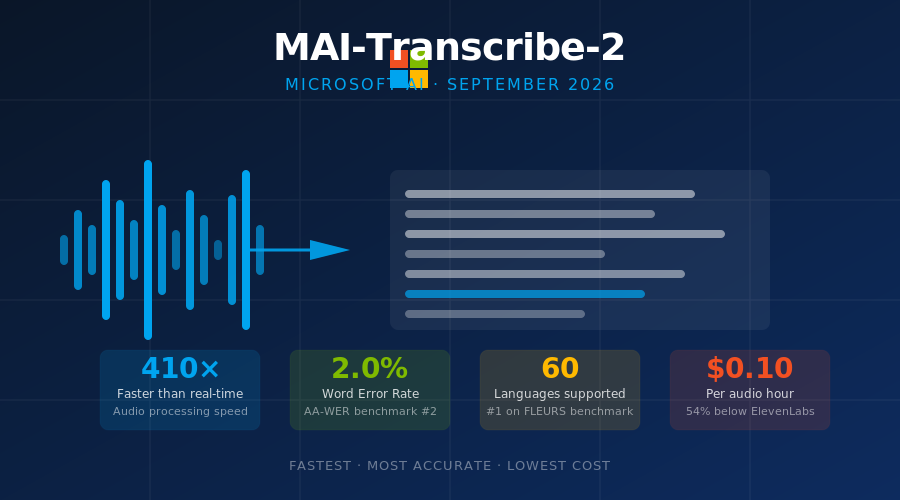
Microsoft has launched MAI-Transcribe-2, a speech recognition model that simultaneously tops accuracy benchmarks across 60 languages, processes audio up to 10 times faster than leading competitors, and undercuts rivals on price — a combination that is shaking up the transcription market just weeks after rivals had settled into an uneasy equilibrium.
Released on September 3, 2026 through the Microsoft AI division, MAI-Transcribe-2 is available via the Azure AI Foundry Fast Transcription API and is already drawing comparisons to the moment OpenAI’s Whisper democratized speech-to-text in 2022. The difference this time is that Microsoft isn’t offering a free, open-weight model — it’s staking out commercial territory with a pricing structure aggressive enough to force competitors to respond.
The Benchmark Story
In the highly competitive world of automatic speech recognition (ASR), benchmarks matter enormously to enterprise buyers evaluating transcription services for call centers, legal discovery, medical documentation, and media workflows. MAI-Transcribe-2 has made a strong opening statement on all of them.
On the FLEURS benchmark — a rigorous multilingual evaluation built by Google researchers from native speaker recordings across 102 languages — MAI-Transcribe-2 ranks first across 60 languages with an average word error rate (WER) of 5.2%. FLEURS is considered a gold standard for multilingual ASR because it uses genuine native-speaker speech rather than read text, making it difficult to game.
On the Artificial Analysis WER benchmark, which aggregates performance across real-world audio conditions, MAI-Transcribe-2 posts a 2.0% word error rate — placing it second overall behind Alibaba’s Fun-Realtime-ASR-preview (1.7%) and ahead of ElevenLabs Scribe v2 (2.2%), OpenAI’s GPT-Transcribe, and Google’s Gemini 3.5 Transcribe. For a model from a company that previously lagged in this space, second place globally is a significant result.
Speed is where the numbers become almost difficult to believe. Independent Artificial Analysis measurements show MAI-Transcribe-2 processing audio at approximately 410 times real-time speed — meaning an hour of audio takes around nine seconds to transcribe end-to-end. The previous-generation leader for long-form audio transcription ran at roughly 40 times real-time. That 10x throughput improvement isn’t just a benchmark curiosity; it translates directly to infrastructure cost savings and dramatically shorter turnaround times for latency-sensitive workflows.
$0.10 Per Hour: The Pricing Calculation
Microsoft is pricing MAI-Transcribe-2 at $0.10 per audio hour for an introductory period through the end of 2026. At $1.67 per 1,000 minutes, that sits well below what ElevenLabs Scribe v2 charges — and Microsoft claims it represents a 54% price reduction compared to ElevenLabs at equivalent accuracy levels. OpenAI’s Whisper-based transcription services and Google’s Speech-to-Text offerings are also undercut on a per-minute basis.
For enterprise customers running high volumes — broadcast media companies transcribing thousands of hours of archive footage, legal firms processing deposition recordings, healthcare systems handling physician dictation — the savings at scale are substantial. A company currently spending $100,000 annually on transcription could theoretically cut that figure dramatically even before factoring in the latency improvements.
The caveat: the $0.10 price is explicitly promotional, with Microsoft signaling that pricing will be revisited at the start of 2027. Competitors will almost certainly respond with their own pricing moves before then, which could benefit enterprise buyers negotiating contracts in the coming months.
What MAI-Transcribe-2 Actually Does
Beyond raw accuracy and speed, MAI-Transcribe-2 ships with a feature set that matters in production environments. Speaker diarization — the ability to identify and separate different speakers in a recording — is now built in, returning speaker-labeled segments with precise offset and duration metadata. This is essential for meeting transcription, interview workflows, and multi-party call analytics where knowing who said what is as important as what was said.
Word-level timestamps allow downstream applications to sync transcription text with media playback, which is critical for subtitling, video editing, and accessibility tools. The model also supports keyword biasing, letting applications provide domain-specific terminology — medical drug names, legal jargon, proprietary product names — that the model should weight toward in ambiguous acoustic conditions. This addresses one of the most persistent complaints about general-purpose ASR: its tendency to mishear specialized vocabulary even when the surrounding context makes the intended word obvious.
Language coverage reaches 60 languages with automatic identification, meaning the model detects which language is being spoken without requiring the caller to specify upfront. It also handles code-switching — the common real-world phenomenon of speakers mixing languages mid-sentence — which has historically been a weak point for narrowly trained ASR systems.
Transcription style is configurable between verbatim mode (capturing filler words, false starts, and hesitations) and clean mode (producing polished output more suitable for documentation or publishing). The API accepts audio files in WAV, MP3, and FLAC formats up to 300 MB.
Market Implications
The timing of this launch is pointed. ElevenLabs had been positioning its Scribe v2 product as the accuracy leader for enterprise transcription following its strong benchmark performance earlier in 2026. Google and OpenAI have both been expanding their transcription offerings as part of broader cloud AI strategies. MAI-Transcribe-2 disrupts that competitive positioning on three dimensions simultaneously — accuracy, speed, and price — which is unusual. Typically, frontier model launches trade off one dimension against another.
For Microsoft, the strategic logic is clear. Transcription is a forcing function for cloud adoption. Enterprises that route audio through Azure AI Foundry to use MAI-Transcribe-2 are also licensing Azure infrastructure, potentially expanding into Azure OpenAI, Azure AI Search, and downstream analytics tools. A below-market transcription service is, in that sense, a customer acquisition mechanism for the broader Azure ecosystem.
The dependency on Azure is worth noting: MAI-Transcribe-2 requires an Azure subscription and a Microsoft Foundry resource for Speech. It is not available as a standalone API or through third-party providers outside Azure at launch, though OpenRouter has begun listing the model for routing purposes.
What Comes Next
The speech recognition market has proven surprisingly durable despite years of predictions that it would be subsumed by larger language models. The reality is that ASR remains a specialized task where dedicated models outperform general-purpose ones, latency requirements are strict, and cost matters at scale. MAI-Transcribe-2’s arrival suggests Microsoft has invested seriously in closing what had been a gap relative to OpenAI and Google.
The more interesting question is what the 10x speed improvement enables beyond faster batch processing. At 410 times real-time, a transcription service can afford to re-run segments multiple times for error correction, apply ensemble techniques across multiple inference passes, or operate in genuinely real-time applications previously excluded by latency constraints. Microsoft hasn’t announced those applications yet, but the infrastructure now exists to support them.
For now, enterprises re-evaluating their transcription stack heading into Q4 budget cycles have a new option that, on the numbers, is difficult to ignore.


