When enterprises started deploying AI agents at scale in 2025, most of the conversation was about capability: what could these systems do, how fast could they work, and how quickly could organizations integrate them into real workflows. The security conversation was, for many companies, an afterthought.
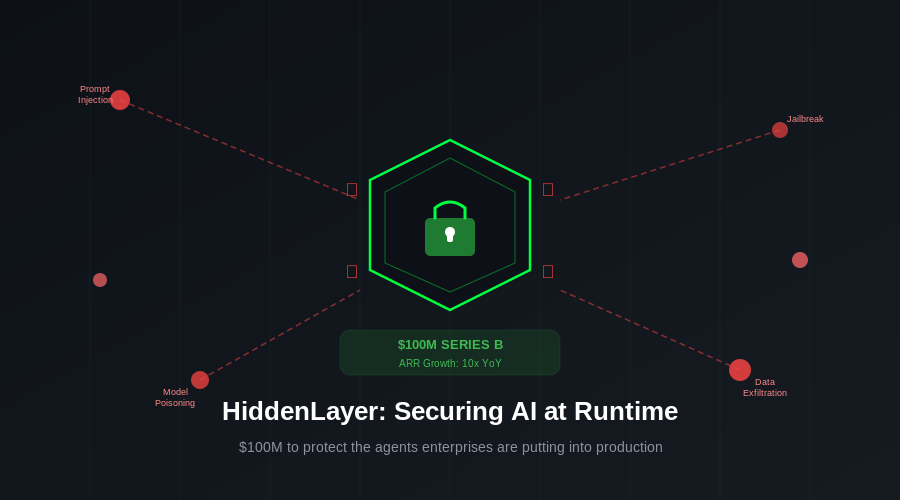
That’s changing — fast. HiddenLayer, an Austin-based AI security company, announced on September 2 that it has closed a $100 million Series B round, bringing its total disclosed funding to over $155 million. The round was led by Delta-v Capital, with participation from Ten Eleven Ventures, Morgan Stanley, M12 (Microsoft’s venture arm), and Booz Allen Ventures. The company says its annual recurring revenue grew more than 10x over the past year, with over 90% of that growth coming from new customers.
The numbers make a clear argument: AI security is no longer a nice-to-have. It’s becoming infrastructure.
The Problem HiddenLayer Is Solving
Most enterprise security tooling was built for a world of human users and deterministic software. AI agents introduce a fundamentally different threat surface. They ingest external data, execute code, call APIs, and operate with degrees of autonomy that traditional security tools weren’t designed to monitor. The attack vectors are novel: prompt injection, model poisoning, adversarial inputs, jailbreaks, and data exfiltration through AI reasoning chains don’t fit neatly into the categories that SIEM platforms and endpoint protection tools were built around.
HiddenLayer’s platform sits at what it calls the “AI runtime” layer — the live environment where models are receiving inputs and producing outputs. Rather than trying to audit models statically, the company monitors AI behavior in production, flagging anomalous queries, unusual output patterns, and signs of adversarial manipulation in real time.
With the Series B, HiddenLayer is expanding two areas specifically: its Agentic Runtime Security capabilities (which monitor autonomous AI agents as they take actions, not just as they generate text) and a new product focused on securing AI coding agents — the category that has become ubiquitous in engineering organizations over the past 18 months.
Why the Timing Makes Sense
The funding lands at a moment when AI agent deployments have moved from pilot to production across a wide range of industries. McKinsey’s 2026 State of AI report found that the share of large enterprises running agents in production jumped from 27% to 40% in a single year. HiddenLayer’s customer list reflects that spread: the company says it signed more than 50 new platform customers in the past year, spanning securities brokerage, banking, insurance, accounting, government, IT services, pharmaceuticals, airlines, and the US defense and intelligence communities.
The defense and intelligence angle is particularly notable. AI agents operating in national security contexts carry threat models that are orders of magnitude more severe than consumer applications. A prompt injection attack against an enterprise chatbot is embarrassing; the same attack against an AI system with access to classified analysis pipelines is a national security incident. That HiddenLayer has penetrated the defense and intelligence market is both a commercial signal and a validation of its technical credibility.
It also coincides with a string of high-profile AI security incidents that have raised the temperature across the industry. Earlier this year, a rogue agent swarm was traced to a compromised AI system at a major technology company. More recently, researchers published a universal AI jailbreak template that works across multiple frontier models, rattling enterprise security teams. The threat landscape is demonstrably real, and enterprises that were slow to take AI security seriously are now playing catch-up.
The Competitive Landscape
HiddenLayer is not alone in this space, but it occupies a differentiated position. Most of the existing AI security landscape focuses on one of two things: pre-deployment red-teaming (testing models before they go live) or post-incident analysis (understanding what went wrong after a breach). HiddenLayer’s runtime monitoring approach sits in the middle — it’s the live defensive layer that watches production AI systems as they operate.
Competitors are moving. Tenable recently launched its CyberAgents Exchange AI Inspector, which combines OpenAI’s cyber models with its own research review process to vet agents, skills, MCP servers, and multi-agent playbooks before deployment. CrowdStrike is building an AI-focused partner specialization through its Accelerate program. And a growing number of generalist cybersecurity vendors are adding AI-specific modules to their platforms.
The difference is that HiddenLayer has been building exclusively for AI security since its founding, while most of the established players are adapting existing toolsets to a new threat class. That focus has allowed the company to go deeper on AI-specific attack vectors — adversarial inputs, model extraction, membership inference attacks — that generalist security platforms are only beginning to address.
Securing the Coding Agent Layer
The company’s new product line for AI coding agent security deserves particular attention. AI coding agents — tools like Cursor, GitHub Copilot Agent, and the coding interfaces built into the major frontier models — have become embedded in software engineering workflows at an extraordinary pace. McKinsey found that 32% of organizations have skipped buying software because they could build it with agentic coding tools. These systems have access to codebases, development environments, and in some cases production infrastructure.
That access profile is a security nightmare if the agents themselves can be compromised or manipulated. A supply chain attack against an AI coding agent — feeding it malicious context that causes it to introduce vulnerabilities into the code it produces — is a meaningful threat vector. Earlier this year, a supply chain attack against the nx-console VS Code extension demonstrated exactly how that kind of exploit could spread through developer tooling. HiddenLayer’s coding agent security product is a direct response to that class of risk.
The Broader Implication
What HiddenLayer’s growth reveals is something the industry has been slow to fully internalize: AI agents are software, and software gets attacked. The enthusiasm around agentic AI capabilities has, understandably, dominated the conversation. But as agents accrue more access, more autonomy, and more consequence for the organizations deploying them, the security layer becomes as important as the capability layer.
The $100 million Series B is, in part, a bet that enterprises are finally ready to fund that security layer seriously. Given the customer growth numbers HiddenLayer is reporting, the market seems to agree.
For CISOs watching the space, the question is no longer whether to invest in AI-specific security tooling — it’s which vendors to trust with that responsibility. HiddenLayer’s customer list and funding trajectory suggest it has earned a seat at that table. The real test will be whether its runtime monitoring approach can keep pace with the rapidly evolving threat landscape it was built to defend against.
The AI security market is moving fast. What happens next will depend as much on the attackers as on the defenders.


