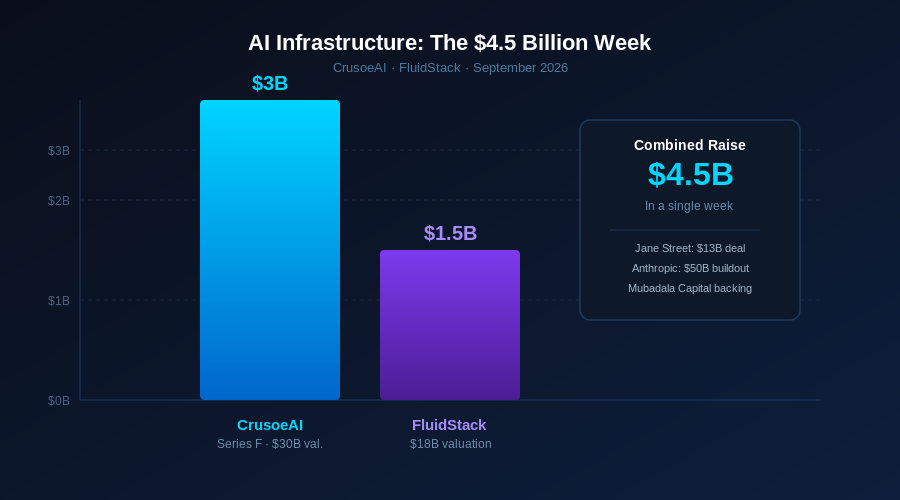
In a single week that sent tremors through Silicon Valley and beyond, two AI infrastructure companies quietly secured a combined $4.5 billion in new funding — marking what analysts are already calling the largest AI infrastructure capital deployment week in history. CrusoeAI’s $3 billion Series F and FluidStack’s $1.5 billion raise aren’t just headline numbers; they represent a fundamental shift in where the serious money is flowing in the AI economy.
CrusoeAI’s $3 Billion Bet on Energy-First AI
Denver-based Crusoe Energy — now operating simply as CrusoeAI after pivoting fully into AI compute — closed a $3 billion Series F co-led by Atreides Management and Valor Equity Partners, with Mubadala Capital also participating. The raise values the company at approximately $30 billion, a remarkable ascent for a company that began life helping oil fields burn off excess methane more cleanly.
But what truly caught the market’s attention wasn’t the valuation — it was the contract that backstopped it. Jane Street, the famously secretive quantitative trading firm that has increasingly bet on AI to sharpen its already razor-thin arbitrage strategies, reportedly signed a five-year, roughly $13 billion cloud computing contract with Crusoe. That’s not a vendor relationship. That’s a strategic dependency.
Jane Street’s choice of Crusoe over hyperscalers like AWS or Google Cloud speaks volumes. Crusoe’s differentiated pitch has always been cost and energy efficiency: by co-locating data centers near stranded or renewable energy sources, the company can offer compute at rates that undercut traditional clouds while maintaining a greener footprint. For a trading firm processing billions of market signals a day through increasingly complex AI models, those economics matter enormously.
“This isn’t just about building more GPUs,” one infrastructure analyst told reporters this week. “Crusoe has figured out that the next decade of AI compute isn’t about who has the most silicon — it’s about who can deliver that silicon at a sustainable cost basis.”
The $3 billion will fund aggressive expansion of Crusoe’s data center footprint, with reported plans for new facilities in Texas, Wyoming, and the Pacific Northwest — all regions with abundant renewable or low-cost energy. The company has been notably tight-lipped about customer specifics beyond Jane Street, but industry insiders suggest several top-five hedge funds are already in conversations about similar arrangements.
FluidStack: Building the Backbone for Anthropic’s Ambitions
While CrusoeAI grabbed the bigger headlines on valuation, FluidStack’s $1.5 billion raise may carry even greater strategic significance for the broader AI industry. The UK-founded neocloud — which aggregates GPU capacity from data centers worldwide into a unified platform — raised at an $18 billion valuation, more than doubling its $7.5 billion mark from just months ago in July 2026.
The growth driver? A sprawling partnership with Anthropic to house and manage the AI safety company’s fleet of one million Google TPUs (Tensor Processing Units). FluidStack is building the physical facilities — the actual buildings, cooling infrastructure, and networking — where those TPUs will run. The two companies have publicly committed to constructing $50 billion worth of AI infrastructure across the United States over the coming years, a program that, if executed, would rank among the largest private infrastructure buildouts in American history.
The scale is almost difficult to comprehend. One million TPUs running in FluidStack-managed facilities, powering the models that increasingly underpin enterprise AI deployments, healthcare AI systems, legal research tools, and consumer-facing applications. FluidStack effectively becomes the invisible plumbing through which Anthropic’s ambitions flow.
For FluidStack’s investors — a roster that has grown to include several sovereign wealth funds alongside established VC firms — the bet is that AI demand will continue to dramatically outpace the supply of reliable, scalable compute. Every model release, every new enterprise adoption curve, every government AI procurement contract adds another layer of pressure to an infrastructure stack that is perpetually behind.
“We’re not building data centers to service today’s workloads,” FluidStack’s CEO said in a statement accompanying the funding announcement. “We’re building for the models that will run in 2028 and 2030. The demand we’re planning for doesn’t fully exist yet.”
Why This Week Matters Beyond the Numbers
The CrusoeAI and FluidStack raises are happening against a backdrop that would have seemed implausible even 18 months ago. The AI infrastructure market has bifurcated sharply: on one side, the hyperscalers (AWS, Google Cloud, Microsoft Azure) continue spending hundreds of billions annually on their own build-outs. On the other, a new class of specialized infrastructure companies is carving out defensible niches by offering what the giants cannot — speed, specialization, energy efficiency, or custom partnerships.
What’s particularly striking about this week’s funding is who is writing the checks. Mubadala Capital, the Abu Dhabi sovereign wealth fund, has now participated in AI infrastructure rounds across Crusoe, G42, and several undisclosed data center ventures. Sovereign capital is flowing into American AI infrastructure at a pace that would have triggered geopolitical alarm bells a few years ago — today, it’s welcomed as necessary to keep pace with China’s own reported $295 billion AI infrastructure program announced earlier this year.
The Jane Street angle adds another dimension worth watching. Traditional finance’s embrace of AI infrastructure is accelerating beyond buying chips or licensing models — major financial institutions are now vertically integrating into compute itself, either through direct contracts like Jane Street’s or through infrastructure investments. When the world’s most sophisticated quantitative trading firms start acting like hyperscale cloud customers, it signals that AI compute has become a genuine factor of production in financial markets.
The Supply Crunch Isn’t Over
Despite the billions flowing into new capacity, experts caution that AI infrastructure supply will remain constrained well into the late 2020s. The bottlenecks are multiple: transformer capacity for high-voltage electrical connections, custom networking hardware lead times stretching 18 months or more, cooling systems that can handle the thermal density of next-generation accelerators, and the simple human reality that skilled data center engineers are in desperately short supply.
CrusoeAI and FluidStack are both racing to secure commitments on all of these fronts. Crusoe’s energy-first model gives it an edge on power procurement, while FluidStack’s aggregation model allows it to be more nimble about where it builds versus where it leases capacity from partners.
For enterprises trying to plan their own AI compute strategies, the takeaway is uncomfortable: even with billions of dollars flowing into new infrastructure, the queue for premium GPU and TPU capacity isn’t clearing anytime soon. The companies writing nine-figure checks this week are essentially buying their place in line for a resource that remains deeply scarce.
Looking Ahead
The CrusoeAI and FluidStack funding rounds mark a maturation point for the AI infrastructure market. These are no longer speculative bets on whether AI demand will materialize — that question has been answered. They are calculated wagers on which companies will build the durable, efficient, and scalable infrastructure layer that the next generation of AI applications will depend on.
With Jane Street’s $13 billion cloud contract anchoring Crusoe and Anthropic’s $50 billion buildout plan underwriting FluidStack, both companies enter the next phase with rare advantages: not just capital, but committed, long-duration customer relationships that provide the revenue visibility to plan construction cycles measured in years rather than quarters.
The $4.5 billion week may look, in retrospect, like the moment AI infrastructure stopped being a supporting story and became the main event.
*Sources: Crunchbase, ValueAddVC, CryptoIntegrat, AI Herald*


