Amazon Web Services has quietly made one of its most significant model partnerships of 2026, bringing the full MiniMax model family — including the flagship M2.5 — into its Amazon Bedrock platform. For enterprise teams that have been watching the race for ever-larger context windows and more capable agentic AI, this is a move that changes the practical math of what’s possible inside the AWS ecosystem.
What MiniMax Brings to Bedrock
MiniMax, the Chinese AI lab best known for its work on long-context multimodal models, has spent the better part of the last two years iterating aggressively on a problem that has frustrated enterprise developers everywhere: how do you build AI systems that can reason across enormous bodies of information without losing coherence?
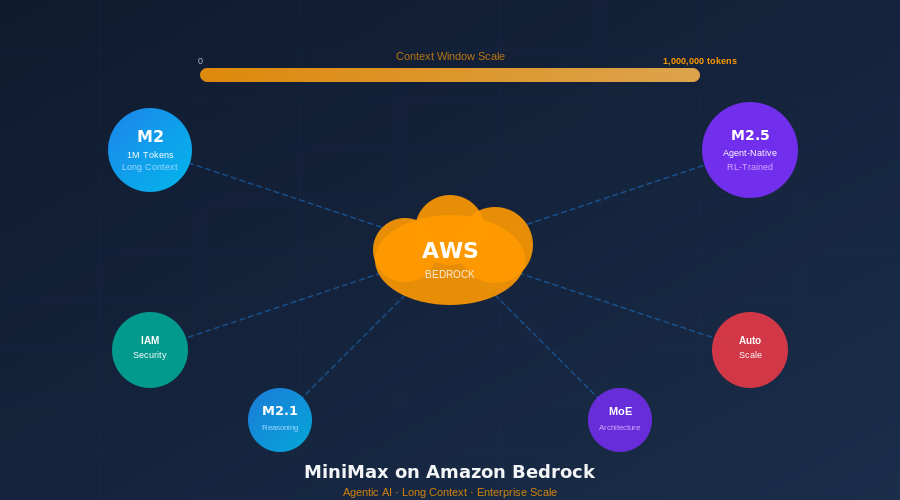
The three models now available on Bedrock answer that in different ways. The MiniMax M2 delivers a 1 million token context window, enough to feed an entire year’s worth of customer support transcripts into a single prompt and extract meaningful patterns. The M2.1 builds on that foundation with improved reasoning chains, making it significantly better at multi-step problem decomposition. But the headline act is the M2.5 — described internally by MiniMax as “agent-native” — which was trained using reinforcement learning specifically to handle the kind of iterative, tool-using workflows that define modern agentic AI applications.
For developers and enterprise architects who have been stitching together retrieval-augmented generation (RAG) pipelines, vector databases, and chunking strategies to work around the context limitations of older models, the arrival of M2 and M2.5 on Bedrock represents a meaningful architectural simplification. When you can fit a full document corpus into a single context window and reason across it natively, a lot of the scaffolding that has become standard enterprise AI practice becomes optional — or disappears entirely.
Why AWS, Why Now
The timing of this partnership is not incidental. AWS has been under increasing pressure to expand Bedrock’s model catalog beyond the core Anthropic relationship that anchored the platform’s early identity. Competitors have moved fast: Microsoft Azure has deepened its OpenAI integration, Google Cloud has Gemini baked directly into its infrastructure, and a growing number of enterprise buyers are making cloud platform decisions based at least partly on which foundation models are available natively.
The MiniMax partnership signals that AWS is willing to embrace a genuinely pluralistic model strategy — one where the best model for a given task wins, regardless of who built it or where they’re headquartered. That’s a significant philosophical shift, and it mirrors a broader trend in the industry: enterprise AI buyers increasingly want access to a wide portfolio of specialized models rather than a single general-purpose system.
There’s also a geopolitical dimension worth acknowledging. MiniMax is a Chinese company operating in an environment where US-China technology relationships remain complicated. Bringing MiniMax models onto a US cloud platform creates new questions about data sovereignty, training provenance, and regulatory compliance — questions that AWS will need to answer clearly for customers in regulated industries. For now, the models are accessible under standard AWS security controls, which means customer data processed through Bedrock’s API stays within AWS’s managed infrastructure and doesn’t flow back to MiniMax’s systems.
The Agentic Angle
What makes the M2.5 particularly interesting is not just its context window but its training methodology. The reinforcement learning approach used to develop its agent-native capabilities means the model has been optimized for the kinds of decision loops that characterize modern AI agents: take an action, observe the result, revise the plan, repeat.
This is increasingly important as enterprise AI moves from the “assistant that answers questions” paradigm to the “agent that executes workflows” paradigm. The difference is not just technical — it’s a fundamentally different relationship between AI systems and the business processes they’re embedded in. An AI assistant generates a report; an AI agent monitors a data feed, flags anomalies, routes tickets, updates a CRM record, and notifies a human when something requires judgment that falls outside its confidence threshold.
MiniMax’s RL-trained M2.5 was built with those kinds of loops in mind. Developers accessing it through Bedrock get the model’s capabilities packaged with AWS’s operational guarantees — auto-scaling, SLA-backed availability, unified IAM access controls, and billing integration — which removes a significant friction point for enterprises that want to experiment with frontier models without standing up independent infrastructure.
The service tier structure that AWS has introduced for MiniMax models also reflects a maturing understanding of enterprise AI procurement. Standard tier provides on-demand access at baseline pricing. Priority tier offers 25 percent better latency, useful for customer-facing applications where responsiveness matters. Flex tier trades higher latency for lower cost, appropriate for batch processing workloads like overnight document analysis or large-scale content auditing where speed is less critical than economics.
What This Means for Enterprise Developers
For engineering teams evaluating AI platforms in the second half of 2026, the Bedrock MiniMax expansion opens up several use cases that were previously difficult or expensive to run at scale.
Long-document legal analysis is an obvious starting point. Law firms and corporate legal departments have been among the most active enterprise AI adopters, but they’ve been constrained by the gap between the length of real legal documents and the context windows of available models. A 1 million token context window starts to close that gap meaningfully.
Financial services teams doing compliance review, fraud pattern analysis, or regulatory filing summarization have similarly been working around context limitations for years. The M2 family’s capacity changes what’s tractable in a single inference call.
On the software engineering side, the M2.5’s agent-native training makes it a credible candidate for complex code review, automated refactoring, and the kind of multi-file reasoning that has historically required specialized coding models. Early benchmarks suggest the model performs competitively on software engineering tasks while also handling the natural language components of developer workflows — writing documentation, explaining architectural decisions, drafting technical specifications — without requiring teams to switch between specialized models.
The Bedrock integration also means that enterprise teams already invested in the AWS ecosystem can access MiniMax models through the same tooling, access controls, and billing infrastructure they use for everything else. That operational continuity matters more than it might seem: in large organizations, the overhead of standing up a new vendor relationship, negotiating data processing agreements, and integrating a new API into existing security and compliance workflows can easily take months. Bedrock consolidates that friction.
Looking Ahead
The MiniMax addition to Bedrock is one data point in a larger pattern. The enterprise AI market in 2026 is converging on a model-agnostic infrastructure layer where cloud platforms compete on selection breadth, operational quality, and integration depth rather than on exclusive access to any single model.
That’s good for enterprise buyers, who gain negotiating leverage and the flexibility to swap models as the state of the art evolves. It’s a tougher competitive environment for model developers, who increasingly have to win on technical merit in a marketplace where buyers can compare them directly. And it puts cloud platforms in an interesting position as the infrastructure layer that ultimately determines which AI capabilities reach enterprise scale.
For now, MiniMax’s M2 family is available on Bedrock with immediate access for AWS customers. Whether the partnership expands — deeper integration, additional model versions, joint go-to-market — will depend on adoption curves and the competitive dynamics of a market that continues to move faster than almost anyone predicted.


