Google’s latest model posts benchmark wins over Anthropic’s Opus 5 and aims to reclaim the coding crown
Google DeepMind has quietly been cooking up one of its most consequential AI releases in years. Gemini 3.8 Flash — known internally by the codename “Skimaki” — officially launched on September 2, 2026, and it arrives with an explicit mission: narrow the gap between Google and its rivals Anthropic and OpenAI in AI-assisted software engineering, the segment that increasingly drives enterprise AI adoption.
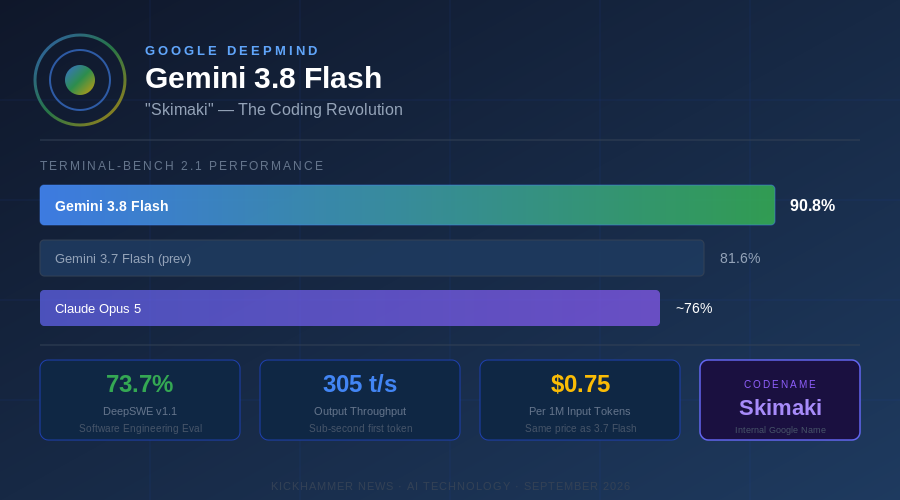
The results are eye-catching. On Terminal-Bench 2.1, a benchmark that measures how reliably a model can complete real-world command-line and coding tasks end to end, Gemini 3.8 Flash scored 90.8% — up from 81.6% on the previous 3.7 Flash release, a 9-point jump that few industry analysts expected. The model also posted a 73.7% headline score on DeepSWE v1.1, a rigorous software engineering evaluation designed to simulate the kinds of multi-file, long-horizon tasks developers face every day.
Perhaps most striking is what’s happening inside Google’s own walls. Engineers testing Skimaki inside Jetski, Google’s internal coding assistant platform, reportedly preferred the new model over Anthropic’s Claude Opus 5 — the reigning flagship from San Francisco’s most safety-focused AI lab. Google’s own benchmark comparisons show 3.8 Flash leading Opus 5 on several evaluations, including the Vals Finance Agent v2 and Terminal-Bench 2.1.
What Makes Skimaki Different
The 3.8 Flash model isn’t just an incremental tweak to its predecessor. It couples configurable thinking levels — allowing developers to trade reasoning depth for speed depending on the task — with sub-second time-to-first-token latency and an output throughput that clocks in at approximately 305 tokens per second. For production applications where both quality and responsiveness matter, that’s a combination that’s hard to ignore.
The model introduces what Google calls “agentic task handling improvements,” designed specifically for the kind of multi-step, tool-using workflows that underpin modern AI coding assistants, DevOps automation, and enterprise software pipelines. Where earlier Flash models sometimes stumbled on tasks requiring sustained reasoning across dozens of steps, Skimaki aims to maintain coherence through complex chains of function calls and context switches.
Google also improved the model’s performance in “specialized domains” — a category that includes financial analysis, legal document parsing, and scientific reasoning. This positions 3.8 Flash not just as a coding model, but as a general-purpose reasoning engine that happens to excel at software engineering.
The Pricing Play
Here’s what may matter most to enterprises making real decisions: Gemini 3.8 Flash is priced identically to its predecessor. At $0.75 per million input tokens and $3.75 per million output tokens, with an introductory promotional price locked in through December 31, Google is clearly positioning this as a cost-effective alternative to premium frontier models. For comparison, frontier-class models from Anthropic and OpenAI typically carry significantly higher price tags when run at comparable capability levels.
Google is offering the introductory pricing through the Gemini API, Google AI Studio, and Google Antigravity — the company’s CLI-based developer tooling that launched earlier this year. Enterprise customers can also access the model through Google Workspace integrations, including Gemini in Google Sheets.
Availability and Ecosystem Integration
Gemini 3.8 Flash is now live across Google’s product portfolio. Gemini AI Pro and Ultra subscribers can access it directly in the Gemini app, in AI Mode, and through several Workspace applications. Developers have immediate access through the Gemini API and AI Studio, with Antigravity support available for those working in terminal-first development environments.
The model supports Google’s standard multimodal inputs, including text, images, documents, and structured data, maintaining the broad input flexibility that’s become a baseline expectation for frontier AI models.
The Bigger Picture: Google’s Coding Credibility
For the past two years, the AI coding market has been dominated by a two-horse race between OpenAI and Anthropic. Claude’s reputation for producing clean, well-reasoned code has made it the preferred model for many professional developers, while OpenAI’s GPT and o-series models have dominated enterprise procurement deals. Google’s Gemini models, despite strong general performance, have consistently trailed on the coding-specific evaluations that matter most to the developer community.
Skimaki represents Google’s clearest attempt yet to change that narrative. The 9-point improvement on Terminal-Bench isn’t just a number — it represents the difference between a model that can reliably complete complex automated tasks and one that fails unpredictably. In production environments where AI agents are running unattended workflows, reliability at this level matters enormously.
The competitive implications extend beyond bragging rights. Enterprise AI budgets are increasingly being allocated around coding assistants, with companies like GitHub Copilot and a growing constellation of IDE integrations fighting for developer mindshare. Google’s ability to offer a model that developers credibly prefer — at Flash pricing — reshapes the economics of that competition.
What’s Next
The timing of Gemini 3.8 Flash’s launch is no accident. With Apple’s recent leadership transition to John Ternus, the AI industry is watching closely to see whether the company will accelerate its efforts to develop a genuine frontier model. Meanwhile, Anthropic’s Claude Fable 5 and Fable 5.1 continue to set the bar for enterprise safety and reasoning performance. OpenAI’s GPT-6 and Astra series are pushing the frontier on agentic capabilities.
Against this backdrop, Google’s decision to invest heavily in a Flash-tier model — rather than leading with a Gemini Ultra 4 announcement — signals a strategic bet that the enterprise market will be won at the application and pricing layer, not just at the frontier performance layer. If Skimaki’s early numbers hold up under real-world developer scrutiny, it may be the most commercially important model Google has shipped in years.
For developers, the message is simple: it’s worth running your own benchmarks. The AI coding race just got a lot more interesting.
Sources: Google DeepMind, Quartz, 9to5Google, NPower User, DataCamp, Emergent.sh, BenchLM.ai


