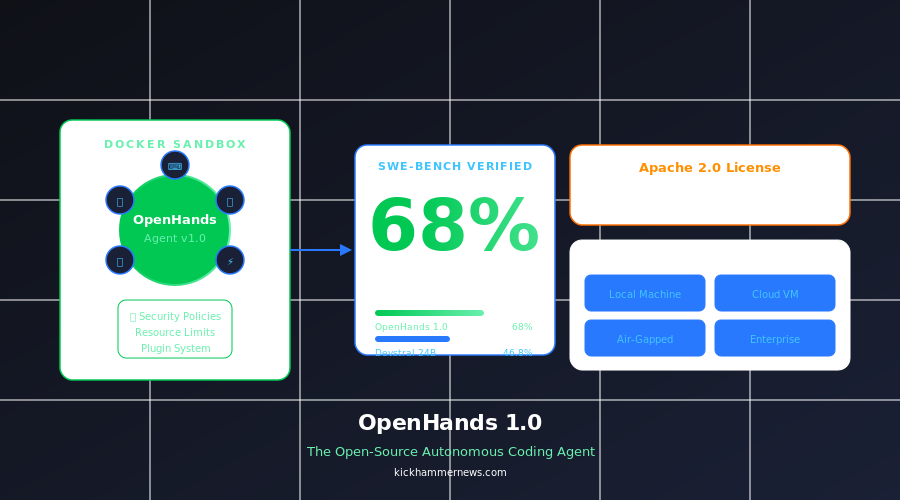
For years, the unspoken rule in autonomous AI coding was simple: open-source options were for tinkerers, commercial products were for teams that needed things to actually work. That rule ended last week when OpenHands shipped its 1.0 release — a production-ready autonomous coding agent that can independently handle roughly 68% of real-world software tasks, on par with the best commercial alternatives, and fully self-hostable.
What OpenHands Actually Is
OpenHands (previously known as OpenDevin) is an open-source platform designed to run AI software agents that operate much like a human developer: they read a problem description, plan a solution, write code, execute shell commands, browse the web for documentation, run tests, and iterate on failures — all without human hand-holding at each step.
The key word in that description is “autonomously.” Unlike GitHub Copilot, which autocompletes lines as you type, or a chatbot that writes code you have to copy-paste and test yourself, OpenHands takes a task and drives it to completion inside a sandboxed environment. When something breaks, it figures out why and tries again.
Version 1.0, released this month, marks the project’s graduation from ambitious research demo to production-grade software.
What’s New in 1.0
The headline benchmark number — 68% on SWE-bench Verified — gets the attention, but the more operationally significant changes in 1.0 are on the infrastructure side.
Production-ready Docker sandboxing is now standard. Every agent session runs inside an isolated container with enforced resource limits and security policies. This matters enormously for teams considering self-hosting: in earlier versions, letting an agent execute arbitrary code on your infrastructure was a genuine risk calculation. Now the isolation is robust enough that enterprises can plausibly run OpenHands in their own environment without handing the agent root access to everything.
A plugin system lets teams extend agent behavior for their specific stacks. Need the agent to understand your internal CI pipeline? Check your company’s internal docs before making changes? Enforce specific linting rules? Plugins make those customizations possible without forking the core project.
Finetuning recipes ship alongside the release, allowing teams with access to sufficient compute to adapt models — including smaller open-weight ones — for their specific codebases and task profiles.
The Benchmark That Actually Matters
SWE-bench Verified has become the industry standard for measuring autonomous coding agents. Unlike toy benchmarks, it presents agents with real GitHub issues from real production repositories: actual bug reports, feature requests, and integration failures that human engineers filed and eventually fixed. An agent succeeds by making the same fix the human did, verified by the project’s own test suite.
At 68% on the verified split, OpenHands with a capable frontier model is operating in territory previously occupied only by well-funded commercial products. For context: Devin 2.0, from the startup that effectively launched this category, publicly reported approximately the same score. OpenHands with Devstral 24B — a smaller, fully self-hostable model — reaches 46.8%, still competitive with where Devin 2.0 was a year ago.
The implication is significant. Teams that couldn’t justify the cost or the data-sharing terms of commercial autonomous coding tools now have a credible alternative they can run entirely on their own infrastructure.
Why Open-Source Matters Here
The autonomous coding agent space has, until recently, been dominated by commercial products with opaque internals, restrictive terms, and pricing that assumes enterprise budgets. For developers at smaller companies, in regions with unfavorable currency exchange rates, or in industries with strict data residency requirements, the commercial options were either unaffordable or unusable.
OpenHands changes that calculus. The Apache 2.0 license means the code can be used commercially, modified, and redistributed without fees. The Docker-first architecture means it runs wherever containers run, from a local developer machine to a cloud VM in whatever jurisdiction you need. The plugin system means it can be adapted to workflows that no commercial vendor would bother to support.
There’s also a less obvious advantage: trust. When an autonomous agent is executing code in your repository, you want to understand exactly what it’s doing and why. With a proprietary system, you’re trusting a vendor’s documentation. With OpenHands, you can read the source.
The Bigger Picture
OpenHands 1.0 arrives at a moment when the autonomous coding agent market is quietly fracturing. GitHub Copilot Workspace just added parallel agent sessions, letting teams run multiple specialized agents simultaneously on the same codebase. OpenAI’s Codex-based cloud products are iterating rapidly. Amazon Q Developer, JetBrains AI, and a dozen well-funded startups are all targeting the same workflow.
The differentiator OpenHands offers isn’t features — it’s control. The teams most likely to adopt it are those who have decided that self-hosting is a requirement, not a preference: regulated industries handling sensitive code, enterprises with strict data sovereignty needs, research labs that want to experiment with custom models, and development teams at companies that simply cannot afford the per-seat costs of commercial alternatives.
A McKinsey survey from earlier this year found that 32% of organizations have already skipped purchasing at least one software product because they can build equivalent functionality with agentic coding tools. OpenHands gives those organizations a way to run the agentic coding layer itself without buying it from a vendor.
Getting Started
OpenHands runs on any machine with Docker. The quickstart requires roughly ten minutes: pull the container, configure an API key for whichever model backend you want to use (it supports OpenAI, Anthropic, and most open-weight models via vLLM or Ollama), and point it at a repository. The web UI surfaces agent reasoning steps, file diffs, and test results in real time.
For teams considering self-hosting with a fully local model stack, the project’s documentation now includes detailed guides for running Devstral 24B on hardware ranging from a single A100 to a multi-node cluster.
What to Watch
The 1.0 release is a milestone, not a ceiling. The OpenHands roadmap includes a multi-agent orchestration mode — essentially the open-source answer to GitHub Copilot Workspace’s parallel sessions — and deeper integration with popular CI/CD systems. There are also early signs of community-contributed plugins for common enterprise toolchains.
The bigger question is whether the 68% SWE-bench number translates to real-world productivity gains for the teams that adopt it. Benchmarks are constructed environments; actual software development is messier. But OpenHands 1.0 is, for the first time, production software worth taking seriously. The assumption that autonomous coding agents require a commercial vendor is no longer safe to make.
*Sources: OpenHands documentation, DEV Community, AI Agent Store daily digest, McKinsey State of AI 2026*


