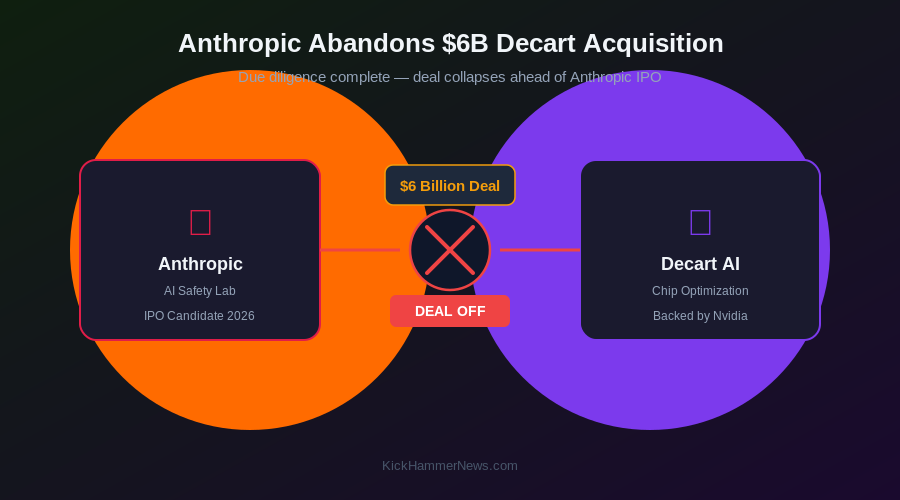
The deal would have been Anthropic’s largest acquisition by a wide margin. Now it’s off — and the timing couldn’t be more awkward.
Anthropic has abandoned plans to acquire Decart AI, the Nvidia-backed startup that makes AI chips run faster and cheaper, according to a report from Bloomberg on September 8, 2026. The company conducted due diligence on a deal valued at roughly $6 billion before walking away, with no public explanation for why talks collapsed.
The withdrawal is notable on multiple fronts. It would have been, by a substantial margin, the biggest acquisition in Anthropic’s history. It comes as the company reportedly prepares for an IPO as early as this fall. And it involves a target — Decart AI — whose technology sits squarely at the intersection of two things Anthropic desperately needs more of: inference efficiency and chip-level optimization.
That Anthropic looked hard at Decart, then walked away, says something. The question is what.
What Decart Does
Decart AI operates in a niche that has quietly become one of the most valuable in the AI ecosystem: making existing hardware do more with less.
The company builds software that optimizes how AI workloads run on silicon. Its tools reduce the computational overhead of training and running large models, enabling the same hardware to process more requests at lower cost. For AI labs burning through hundreds of millions of dollars in compute annually, that kind of efficiency is not a nice-to-have — it’s existential.
Nvidia backed Decart at an earlier stage, a signal that the chip giant sees value in the company’s approach to squeezing more performance out of its own GPUs. At a $6 billion valuation, Decart was priced at roughly a 50% premium over its most recent private valuation — a significant markup that reflects either genuine scarcity value or, depending on your view, the irrational exuberance that still characterizes AI deal-making.
Why Anthropic Was Interested
Anthropic’s compute costs are staggering. The company runs Claude models across millions of API calls daily, serving enterprise customers, developers, and consumers through Claude.ai. Every percentage point of inference efficiency translates directly to margin — and Anthropic, despite reporting its first profitable quarter earlier this year, is still fighting to make the unit economics of frontier AI work at scale.
Beyond efficiency, a Decart acquisition would have given Anthropic deeper hardware-level control at a moment when the entire industry is scrambling to reduce dependency on Nvidia. OpenAI is building its Jalapeño chip with Broadcom. Google has its TPUs. Amazon has Trainium and Inferentia. Meta has its MTIA chips. Anthropic, until now, has relied almost entirely on Nvidia GPUs and, more recently, on a partnership with custom chips from Samsung.
Decart’s software-layer optimization approach wouldn’t have given Anthropic its own silicon, but it would have given the company capabilities to extract more value from whatever hardware it runs on — a meaningful competitive advantage when GPU availability remains constrained and prices remain elevated.
Why It Fell Apart
Anthropic hasn’t said. Bloomberg reported only that the company “walked away” after due diligence, which could mean almost anything.
In M&A, due diligence kills deals for a handful of recurring reasons: technology that doesn’t hold up under scrutiny, IP ownership issues, cultural misalignment, regulatory concerns, or a valuation that stops making sense once you’ve seen the books. At $6 billion for a startup, any of these could apply.
There’s also a timing factor. Anthropic is reportedly eyeing a public offering in the fall of 2026. An acquisition of this size, funded primarily through equity or debt, would complicate an IPO roadshow considerably. Investors evaluating an Anthropic prospectus would want clarity on how a $6 billion outlay fits into the company’s capital allocation story — and “we bought a chip optimization startup right before going public” is a hard narrative to land cleanly.
It’s possible that Anthropic’s CFO and board looked at the deal in the context of an imminent IPO and decided the integration risk wasn’t worth it. A cleaner balance sheet makes for a smoother public offering.
The Broader Context: Anthropic’s Acquisition Strategy
Anthropic has not been an aggressive acquirer. The company has made smaller, targeted moves — primarily talent acquisitions and small team buyouts — but has avoided the kind of large-scale M&A that has characterized OpenAI and Google’s recent strategies. OpenAI acquired Rockset, acquired Jonathan Ive’s design firm, and has been in discussions about multiple other targets. Google DeepMind has made numerous acquisitions. Anthropic has largely built rather than bought.
A $6 billion deal would have represented a genuine strategic pivot. The fact that it got to due diligence before collapsing suggests Anthropic’s leadership was seriously considering a change in approach. The fact that it collapsed at that stage suggests either the target didn’t meet expectations, or the company pulled back from the strategic rationale itself.
For Decart, the failed deal is less catastrophic than it might appear. The company remains funded, retains its Nvidia backing, and now carries the implicit credibility of having attracted serious acquisition interest from one of the world’s leading AI labs. It will likely attract other suitors, or proceed toward its own independent path to scale.
What It Signals for the Market
The collapse of a high-profile AI acquisition in due diligence is worth watching as a market signal. The past 18 months have seen AI valuations compressed slightly as investors demanded more revenue proof and clearer paths to profitability. The era of acquiring companies at 50x revenue multiples with minimal scrutiny appears to be moderating — if not ending.
Anthropic’s withdrawal suggests at least some discipline is returning to how AI labs evaluate targets. That’s arguably healthy for the broader ecosystem, even if it leaves individual deals undone.
There’s also a competitive intelligence dimension. If Anthropic spent meaningful time in Decart’s systems and ultimately decided the technology wasn’t worth $6 billion, that’s a data point for other potential acquirers. Alternatively, if Anthropic walked away for purely financial reasons unrelated to Decart’s technology, the company remains as attractive a target as it was before.
The IPO Shadow
The most plausible explanation for the deal’s collapse may be the simplest: Anthropic is going public, and the timing was wrong.
The company has reportedly been profitable, has revenue growing at triple-digit rates, and has built the brand recognition necessary for a credible public offering. Adding a $6 billion acquisition to the balance sheet weeks before an S-1 filing would introduce complications that no investment banker would recommend.
If that’s the answer, the Decart story is less about strategic recalibration and more about financial discipline in service of a larger near-term goal. Anthropic may well return to acquisition mode once it has public company currency to deploy.
For now, Decart AI remains independent — and Anthropic heads toward its IPO with one fewer complication on its plate.
Anthropic and Decart AI declined to comment on the deal. The Bloomberg report, published September 8, 2026, cited people familiar with the matter.


