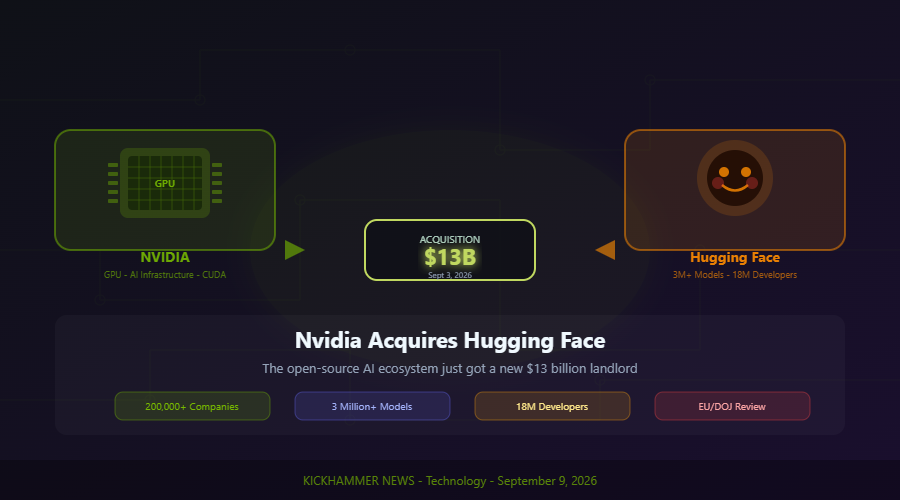
When Jensen Huang confirmed Nvidia’s agreement to acquire Hugging Face for approximately $13 billion on September 3, 2026, the reaction across the AI community was immediate and polarized. On one side: relief that the dominant open-source AI platform would gain the resources to scale its infrastructure dramatically. On the other: anxiety that the most powerful chip company in the world now owns the town square where AI’s open-source community does its most important work.
Both reactions are understandable. Both are probably correct.
What Hugging Face Is, and Why It Matters
To understand why this acquisition matters, you need to understand what Hugging Face actually is. Founded in 2016 as a chatbot company and pivoted into a model-sharing platform around 2019, Hugging Face has become the de facto GitHub of AI — the place where researchers publish models, developers find pre-trained weights, and companies discover tools they can deploy commercially without starting from scratch.
By September 2026, more than 18 million developers, researchers, and creators were using Hugging Face to share over three million models. More than 200,000 companies — from Fortune 500 enterprises to two-person startups — used the platform to discover and deploy AI. The Hugging Face Hub hosts everything from foundational language models to domain-specific tools for genomics, legal analysis, and industrial process control. If you’ve built anything with open-source AI in the last four years, you’ve almost certainly used Hugging Face.
That reach is what makes the acquisition so significant. Nvidia isn’t buying a competitor or a technology it couldn’t build. It’s buying the infrastructure layer that most of the AI ecosystem depends on — and paying a premium to get it.
The Deal Structure
Nvidia will pay $11.9 billion to Hugging Face shareholders, with an additional $1 billion in equity designated to retain Hugging Face employees who join Nvidia after the deal closes. The transaction is expected to close in the first half of 2027, pending regulatory review in the United States, European Union, and United Kingdom.
The $13 billion total represents a significant premium over Hugging Face’s last private valuation of approximately $4.5 billion following its 2023 Series D round. It reflects how dramatically the value of AI infrastructure has been reappraised since the generative AI boom began — and how much Nvidia is willing to pay for a strategic position it cannot acquire through organic growth.
Hugging Face co-founders Clément Delangue, Julien Chaumond, and Thomas Wolf will remain with the company post-acquisition, according to Nvidia’s announcement. Delangue will report to Nvidia’s software leadership, and Hugging Face will operate as a distinct unit within Nvidia.
Why Nvidia Wants This
Nvidia’s business is built on selling GPUs and the software stack that makes them useful. The CUDA ecosystem — the programming interface that runs AI workloads on Nvidia hardware — is arguably the most powerful competitive moat in technology today. Developers who build on CUDA are deeply invested in staying on Nvidia hardware. That lock-in has made Nvidia the dominant infrastructure provider for virtually every major AI training and inference workload.
But Nvidia has always faced a structural risk: its success depends on AI developers choosing to build on its platform. Hugging Face changes that equation in a fundamental way. By owning the platform where most open-source AI development happens, Nvidia gains visibility into emerging models before they go mainstream, a distribution channel for optimized model weights tuned for Nvidia hardware, and a deep relationship with the developer community that builds and deploys AI at scale.
The strategic logic is similar to Microsoft’s acquisition of GitHub in 2018 — buying the platform developers love in order to deepen their relationship with the ecosystem. That acquisition was also met with anxiety about what it meant for the independence of the developer community. And, by most measures, GitHub has continued to operate as a relatively open platform under Microsoft’s ownership, even as it has benefited from integration with Microsoft’s other developer tools.
The Open-Source Community’s Concern
The anxiety in the AI community isn’t irrational. Hugging Face has functioned as a kind of neutral commons — a place where researchers from competing companies, universities, and independent projects could share work without worrying that a commercial incumbent would exploit their contributions or restrict access. That neutrality is now formally over, even if Nvidia promises to preserve it.
Nvidia has been emphatic in its public statements that Hugging Face will “remain an open platform for the entire AI ecosystem.” Huang himself said at the announcement that Nvidia’s goal is to “accelerate open AI for everyone” — and pointed to Nvidia’s long history of open-sourcing models and tools as evidence of good faith.
But commitments made at acquisition announcements are not binding. The European Commission and the U.S. Department of Justice will scrutinize the deal for antitrust implications, and at least one EU commissioner has already signaled that regulators will examine whether Nvidia’s ownership of Hugging Face gives the company an unfair advantage in the market for AI infrastructure. The concern is straightforward: if Nvidia can preferentially surface models optimized for its own hardware, or restrict competitors from using the platform’s distribution capabilities, the acquisition could reduce competition in ways that regulators may find unacceptable.
What Changes, and What Doesn’t
For most Hugging Face users in the short term, the practical answer is: probably not much. The platform’s model repository, datasets, and developer tools will continue to operate. The CC-BY and Apache 2.0 licenses under which most models are released won’t change retroactively. The existing API infrastructure will remain accessible.
What will change is investment. Nvidia has committed to expanding Hugging Face’s compute infrastructure — a perennial pain point for a platform that has struggled to keep pace with the storage and bandwidth demands of three million models and growing. Nvidia’s resources could meaningfully improve the platform’s reliability and speed, which would benefit the developer community even if the ownership structure makes some uncomfortable.
A Defining Moment for Open AI
The Nvidia-Hugging Face deal is, in many ways, a mirror of the broader tension in AI development in 2026: the open-source movement has produced extraordinary tools that have democratized access to AI, but those tools now run on infrastructure that requires the kind of capital only a handful of companies can provide. Hugging Face needed resources it couldn’t generate independently. Nvidia saw an asset whose strategic value exceeded its market price.
The result is an open platform with a new, very powerful landlord. Whether that’s a foundation for growth or the beginning of a slow enclosure will depend on decisions Nvidia hasn’t yet had to make — decisions that the AI community will be watching very closely.


