China’s EV giant starts mass production of its humanoid robot as Optimus struggles to scale
A humanoid robot walked off an automated production line this week in China. It didn’t stumble. It didn’t need a hand. It just walked — autonomously, off a conveyor system that itself was designed specifically to manufacture its kind. The robot was XPeng’s IRON, and the moment marked something the humanoid robotics industry has been chasing for years: genuine, line-ready mass production.
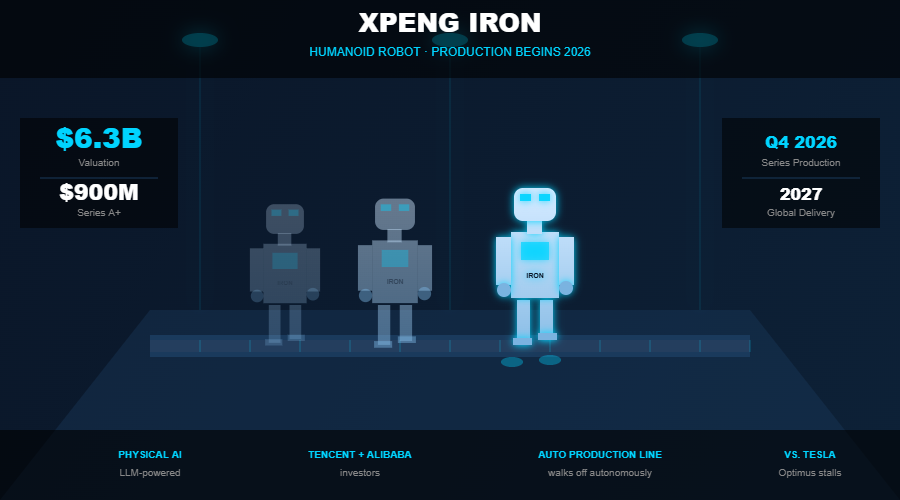
XPeng, the electric vehicle maker that has spent the last two years quietly building one of China’s most ambitious robotics programs, confirmed this week that IRON has successfully completed manufacturing on an automated production line and is targeting series production by the end of 2026. The milestone arrives just weeks after XPeng’s robotics division closed over $900 million in new funding at a post-money valuation of $6.3 billion — a figure that puts it in a very different conversation than most of the humanoid robotics startups that have been chasing the space.
The IRON Story
IRON isn’t XPeng’s first robotics project, but it is the one the company is betting its commercial robotics future on. The robot is designed for what XPeng calls “Physical AI” — systems that combine large language model reasoning with embodied physical capabilities, letting robots handle tasks in real-world environments rather than structured, pre-programmed settings.
The production line that completed IRON’s first automated manufacturing run is itself significant. XPeng has commissioned humanoid robot production infrastructure specifically engineered for future mass production — not a proof-of-concept manufacturing run, but a process designed to scale. The company’s plan calls for initial commercial deployment of IRON in XPeng’s own stores and facilities in China, with the first commercial deliveries — both domestically and in international markets — targeted for 2027.
Initial units will serve operational roles in XPeng showrooms, handling customer interactions and basic tasks while the company accumulates real-world data to improve IRON’s Physical AI models. It’s a practical approach: using your own facilities as a testing ground before selling to external customers means XPeng controls the feedback loop, the data, and the pace of improvement in a way that’s harder to maintain once third-party deployments scale.
The $900 Million Round and Who’s Betting on It
The funding round that preceded the production milestone tells its own story. XPeng’s robotics unit raised over $900 million from IDG Capital, Gaorong Ventures, Tencent, and Alibaba — the latter two being strategic investors with obvious interests in how Physical AI develops across China’s industrial and commercial landscape. The round values the robotics unit at $6.3 billion before the fresh capital, making it one of the most valuable humanoid robotics companies in the world.
Tencent and Alibaba’s participation is particularly notable. Both companies are building out their own AI ecosystems and increasingly view humanoid robotics as a convergence point between cloud AI, large language models, and physical infrastructure. An investment in XPeng Robotics is partly a bet on IRON specifically, and partly a bet on Physical AI as a category that will eventually run on their platforms and integrate with their services.
The funds will go toward software and hardware R&D, training and iteration of Physical AI models, high-quality data generation — arguably the most important input for improving a robot’s ability to handle real-world variability — and global commercial expansion. That last item signals that XPeng isn’t thinking of IRON as a domestic product. The 2027 international delivery timeline suggests serious intent to compete outside China.
The Comparison Everyone Is Making
It is difficult to write about XPeng IRON in September 2026 without noting what Tesla’s Optimus is doing — or more precisely, what it is struggling to do. Tesla has been public about Optimus as a long-term strategic priority for years, and Elon Musk has made ambitious claims about production timelines and unit economics that have consistently been revised as the technical challenges proved greater than initial projections.
As of this week, XPeng’s IRON has completed an automated production run and is on a credible schedule for end-of-year series production. The contrast with Optimus’s scaling challenges has not been missed by industry observers. The robotics race, like the EV race before it, is increasingly becoming a story where Chinese manufacturers move fast through production ramp-up while American competitors contend with higher costs, supply chain complexity, and the gap between public promises and manufacturing reality.
This doesn’t mean XPeng wins the long game. IRON faces enormous challenges in making the leap from showroom deployments to the diverse, unpredictable environments where humanoid robots would need to operate to justify the cost at scale. Physical AI models still struggle with edge cases that humans handle intuitively, and the training data requirements to close that gap are significant. XPeng’s plan to use its own facilities as early deployments is smart, but it also defines the scope of what IRON can do in its first generation.
What XPeng Has That Others Don’t
XPeng’s unusual advantage in the humanoid robotics space comes from its EV background. Building cars at scale — managing supply chains, tolerating failure rates, integrating hardware and software in real-world manufacturing — is better preparation for humanoid robot production than almost any other industry. The company already operates automated manufacturing facilities and has the engineering talent to think about production at scale, not just prototype quality.
The Physical AI framing is also worth taking seriously. Most humanoid robot programs have focused primarily on physical capability — can the robot walk, carry things, not fall over? XPeng is explicitly betting that the future of robotics is about AI-native systems that use large language models to understand instructions, adapt to context, and reason about tasks rather than executing pre-programmed sequences. If that bet is right, XPeng’s integration of its robotics unit with China’s AI ecosystem — including its investors Tencent and Alibaba — gives it structural advantages in training data and model access that pure robotics companies lack.
The Bigger Picture
IRON’s production milestone is one data point in a fast-moving story. The humanoid robotics industry has been telling a future-tense story for most of the last decade — soon, robots will be everywhere, doing jobs that humans don’t want to do, transforming manufacturing and logistics and elder care. What XPeng demonstrated this week is that the timeline is compressing. Automated production lines, a funded robotics unit valued at $6.3 billion, and a clear 2026/2027 commercial deployment schedule are not hypothetical milestones. They are things that happened.
The industry is watching carefully. Whether IRON can scale from its initial showroom deployments into genuine broad commercial applications — and whether XPeng can build the Physical AI models sophisticated enough to make that expansion viable — will be among the most watched stories in robotics over the next 18 months. But one thing is no longer in question: a humanoid robot walked off a production line in China, and the race to the future just got a lot more real.
IRON’s series production is targeted for Q4 2026, with first commercial deliveries in China and international markets planned for 2027. XPeng’s robotics unit is separately incorporated from XPeng Motors.


