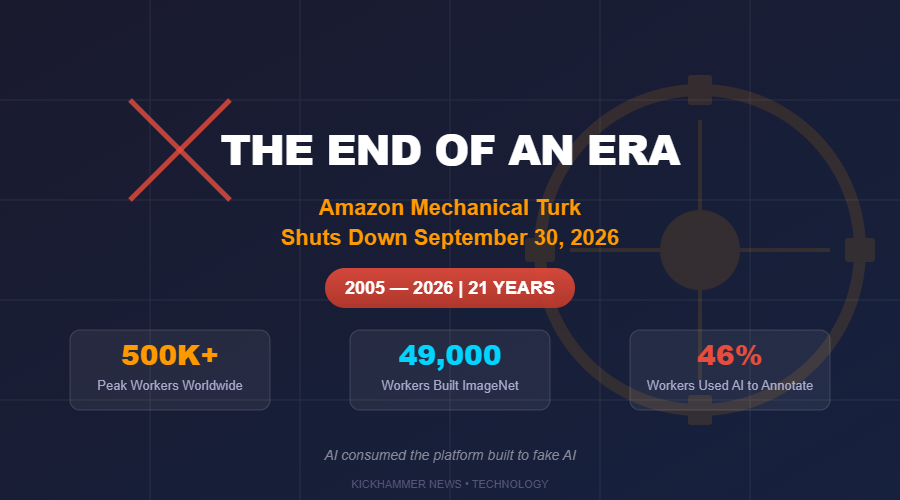
In seventeen days, one of the internet’s most consequential and least celebrated platforms will go dark. Amazon Mechanical Turk — the crowdsourcing marketplace that quietly powered the golden age of AI research — will close permanently on September 30, 2026. Its shutdown is a fitting, if ironic, epitaph for a service that did more to launch the modern AI industry than almost anything else, only to be devoured by the very technology it helped create.
The Invisible Machine That Built AI
When Jeff Bezos launched Mechanical Turk in November 2005, he called it “artificial artificial intelligence” — a network of human workers performing small cognitive tasks that computers couldn’t yet handle. At its peak, the platform hosted more than 500,000 workers across 190 countries, completing tasks that ranged from transcribing receipts to identifying objects in photographs to judging the emotional tone of product reviews.
The name itself was a historical joke. The original Mechanical Turk was an 18th-century chess-playing “automaton” that concealed a human chess master inside, fooling audiences into believing a machine could think. Bezos found the metaphor apt: behind the scenes of every supposedly smart AI system, human beings were doing the cognitive labor that made it possible to fake intelligence.
That human labor turned out to be foundational. The construction of ImageNet — the dataset that ignited the deep learning revolution when it was released in 2009 — relied on 49,000 MTurk workers from 167 countries, who collectively sifted through more than 160 million candidate images to produce a carefully labeled training set. When Fei-Fei Li and her team published their landmark 2012 results showing that neural networks trained on ImageNet could finally recognize objects with human-level accuracy, they were crediting not just a clever algorithm but an army of anonymous human workers who had spent years clicking and sorting for a few cents per task.
Similar stories repeated across the AI research ecosystem for two decades. Sentiment analysis, speech recognition, named-entity extraction, medical imaging annotation — nearly every supervised-learning breakthrough of the 2010s was, somewhere along its pipeline, downstream of people working on MTurk.
When AI Ate Its Own Trainer
The platform’s decline followed a now-familiar arc: gradual erosion, then sudden collapse.
The warning signs emerged quietly in 2022. A study by researchers at the Swiss Federal Institute of Technology (EPFL), published the following year, found that between 33 and 46 percent of MTurk workers were using large language models — primarily ChatGPT — to complete writing and annotation tasks rather than doing them by hand. Workers were, in other words, hiring AI to do the jobs they had been hired to do for AI.
The contamination problem was more than a quality-control headache. If a significant share of workers outsourced their tasks to the same AI systems the data was intended to train, the resulting labels and annotations were no longer reliably human-generated. The circular feedback loop — AI training on data produced by AI — turned Mechanical Turk’s output from a training asset into a potential source of noise in AI development pipelines. For researchers who depended on MTurk for ground-truth human evaluations of model outputs, the entire premise of the platform had been undermined.
Amazon stopped accepting new customers on July 30, 2026. On August 25, it announced the full closure for the end of September, ending SageMaker Ground Truth — its enterprise annotation service built on the MTurk network — at the same time. The company offered no public statement beyond standard service-discontinuation boilerplate.
What We Lose
The shutdown is not simply a business story. MTurk was, for two decades, one of the internet’s most significant labor platforms, and its closure raises questions that haven’t been adequately examined.
At its height, the platform provided meaningful supplemental income for hundreds of thousands of workers — many of them in countries where the dollar-denominated payouts represented significant earning power relative to local wages. Researchers have estimated that by the mid-2010s, a substantial fraction of MTurk workers in the United States were using the platform as a primary income source, working full-time hours for what averaged out to well below minimum wage. The working conditions were a persistent ethical flashpoint: workers were classified as contractors, received no benefits, and had no appeal mechanism when requesters rejected their work without explanation.
The platform’s closure removes that income source from workers who had not necessarily migrated elsewhere. It also eliminates the most accessible avenue that academic researchers — particularly those at institutions without access to proprietary data-labeling vendors — had for conducting studies that required human annotators. The downstream effects on social science and NLP research, where MTurk-recruited participants had become standard practice, may be felt for years.
Where Data Comes From Now
The alternatives to Mechanical Turk form a fragmented landscape. Scale AI, which built its business on high-quality labeled data for autonomous vehicles and frontier AI model training, serves the enterprise tier but at price points that are inaccessible to academic budgets. Appen operates a global network of annotators but has faced its own workforce-quality concerns. Prolific, a platform designed explicitly for research recruitment, offers better compensation and stronger quality controls but operates at smaller scale.
For frontier AI labs, the human-annotation model has already been substantially supplemented by synthetic data generation — using AI to create and label training data rather than relying on humans. This approach resolves the MTurk contamination problem by design, but raises its own questions about the eventual convergence of AI systems trained on AI-produced feedback toward homogenous failure modes.
Amazon’s SageMaker replacement for annotation workflows — announced alongside the MTurk closure — leans heavily on automated labeling with human-in-the-loop review for edge cases. The implication is clear: Amazon believes the future of data annotation is predominantly automated, with humans serving as quality-control spot-checkers rather than primary annotators.
The Irony Cuts Deep
There is something worth dwelling on in the precise shape of Mechanical Turk’s death. The platform was built to simulate machine intelligence using hidden human workers. It was then killed because human workers started simulating it using actual machine intelligence. AI consumed the platform that was built to fake AI.
For all the high-minded discourse about superintelligence and civilizational risk that dominates AI conversation in September 2026, the closure of Mechanical Turk represents a quieter and more immediate transformation: the displacement of the human laborers whose invisible work made the AI revolution possible. The machines have taken the jobs of the people who taught the machines to work.
On October 1, 2026, the last of those tasks will go unclicked. The Mechanical Turk will stop performing.


