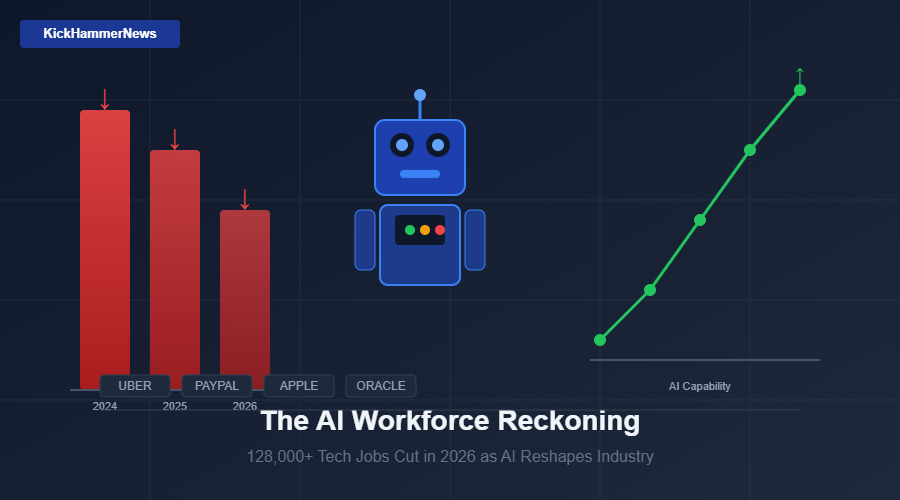
The numbers are staggering. In just the first ten days of September 2026, more than 6,300 technology workers lost their jobs. The year-to-date figure has already surpassed 128,000 — a tally that exceeds the full-year total from 2025 with nearly four months still to go. Welcome to the great AI reckoning, a seismic reshaping of the global technology workforce that is unfolding in real time.
The companies making headlines this month — Uber, PayPal, Apple, Oracle, and Zomato — represent a cross-section of the industry, and their decisions reflect a consistent underlying logic: streamline human operations to free up capital for artificial intelligence investments. Whether executives call it “restructuring,” “de-layering,” or “accelerating AI adoption,” the message to employees is the same. The age of cheap, abundant white-collar labor in tech is over.
Uber’s 3,300-Person Bet on Autonomous Futures
Uber delivered the largest single announcement of the month, disclosing plans to eliminate approximately 3,300 corporate roles — roughly 10 percent of its total workforce. The ride-hailing giant framed the cuts as a management restructuring designed to reduce layers, consolidate duplicated teams, and accelerate decision-making speed. But the subtext is unmistakable: Uber is betting its future on autonomous vehicles and robotaxi technology, and that bet requires a fundamentally different kind of employee base.
The company has been investing aggressively in AV partnerships and its own autonomous platform infrastructure. Every dollar spent maintaining bloated corporate headcount is a dollar not deployed toward the software engineers, ML researchers, and robotics specialists who will define Uber’s competitive position five years from now. The restructuring is not a retreat — it is a reorientation.
This dynamic is playing out across the ride-sharing and logistics sectors broadly. Companies that built enormous operational and support teams during the pandemic-era growth boom are now reckoning with the fact that AI tools can perform much of that work at a fraction of the cost.
PayPal’s Accelerating Automation Push
PayPal’s announcement was even more dramatic in percentage terms. The payments giant disclosed plans to reduce its workforce by approximately 20 percent — nearly 4,800 employees — over the next several years. Unlike Uber, PayPal was explicit about the role of AI in its strategy: the company said it intends to “accelerate AI adoption and automation across its operations” as part of the restructuring.
This is a candid acknowledgment of something many companies are tiptoeing around. The routine tasks that make up enormous swaths of financial services work — fraud detection, customer support routing, transaction reconciliation, compliance monitoring — are increasingly handled by AI systems that are faster, cheaper, and more accurate than human teams. PayPal’s headcount reduction is the balance sheet expression of that technological reality.
The payments industry is under particular pressure. AI-native fintech competitors have emerged in recent years with radically leaner cost structures, and incumbent players face a stark choice: automate or cede ground.
Apple’s Inheritance Problem
Perhaps the most symbolically charged story in this wave of layoffs involves Apple, which disclosed job cuts even as it undergoes the most consequential leadership transition in the company’s post-Jobs history. John Ternus, Apple’s longtime hardware chief, became chief executive earlier this year, inheriting the uncomfortable distinction of running the only major technology company without a frontier AI model of its own.
Apple’s AI strategy has long been a source of analyst frustration. While OpenAI, Google, Anthropic, and Meta have each deployed powerful frontier models, Apple has emphasized on-device processing and privacy-preserving approaches that critics argue have left it technologically behind. The company’s workforce restructuring appears connected to a broader strategic reassessment under Ternus — a recognition that the company must accelerate its AI capabilities or risk irrelevance in a world where AI is becoming the primary interface through which people interact with technology.
The Structural Story Behind the Headlines
Individual company announcements are easier to understand when viewed against the macroeconomic backdrop. Technology companies massively over-hired during 2020-2022, when remote work drove demand for software tools and pandemic-era conditions seemed to promise sustained growth. That hiring binge left many organizations with organizational structures that were expensive, slow, and duplicative.
The AI revolution has now created both the incentive and the tool to address that bloat. Advanced language models can handle support queries, generate code, analyze legal documents, summarize financial reports, and perform dozens of other tasks that previously required dedicated human teams. The productivity gains are real and measurable. For publicly traded companies facing investor scrutiny of AI-related capital expenditures, demonstrating that AI is reducing operational costs is increasingly a financial necessity.
The tracker Layoffs.fyi, which monitors technology workforce reductions, recorded 128,536 cuts across 299 companies through September 10. The acceleration in 2026 reflects not a single cause but a convergence: post-pandemic correction, rising AI capability, and growing executive confidence that automation investments will deliver returns.
What This Means for Workers
The human cost of these transitions is real and should not be understated. Behind every percentage point of workforce reduction are individuals navigating job loss, career uncertainty, and the psychological toll of displacement. The workers most vulnerable in this wave tend to be those in roles that are most easily automated — customer support, data entry, basic coding, administrative coordination — which often means mid-level employees who built careers on skills that AI can now replicate.
Retraining initiatives exist across the industry, but their track record is mixed. The skills in demand — AI model evaluation, prompt engineering, AI systems integration, applied machine learning — require significant investment to acquire, and the pace of change means today’s most valuable skills may shift again in two years.
The Road Ahead
The September 2026 layoff wave is unlikely to be the last. As AI models continue to improve and their costs continue to fall, the economic logic that is driving current restructuring will intensify. Companies that have not yet fully automated automatable functions will face competitive pressure from those that have.
The optimistic view holds that AI creates new categories of work even as it eliminates old ones — that the demand for humans who can design, train, audit, and collaborate with AI systems will absorb displaced workers and ultimately expand the labor market. The pessimistic view notes that technological unemployment has historically been a transitional pain that falls most heavily on workers least equipped to navigate it.
What is clear is that the technology industry is in the middle of a structural transformation as significant as the shift from mainframe to personal computing or from desktop software to the cloud. The companies that navigate it successfully will be those that invest in AI thoughtfully, reskill their workforces honestly, and build organizational cultures capable of adapting to a world where human and artificial intelligence work alongside each other.
The layoffs of September 2026 are not the end of this story. They are closer to the beginning.


