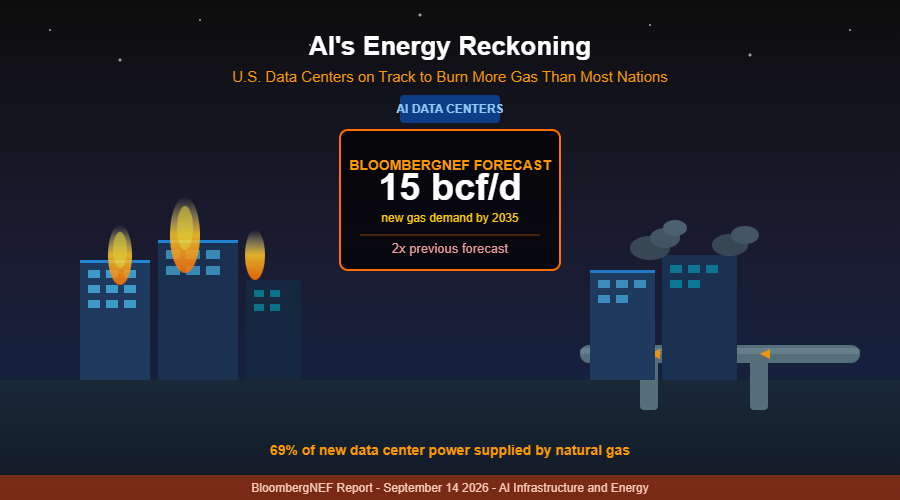
A bombshell new report released today by BloombergNEF is forcing a stark reckoning with one of the most consequential side effects of the AI boom: the staggering energy demands of the infrastructure powering it. According to the analysis, U.S. data centers are on track to burn more natural gas than virtually every country on Earth — a projection that has more than doubled from BloombergNEF’s own forecast issued just nine months ago.
The numbers are difficult to comprehend in the abstract. Gas consumption to produce electricity for U.S. data centers is expected to grow by 15 billion cubic feet per day over the ten years ending in 2035. That figure would surpass the total current gas consumption of every nation on Earth except China, Russia, Iran, and the United States itself.
The Scale of the Revision
Perhaps the most alarming aspect of the BloombergNEF report is not the headline figure itself, but how dramatically the situation has changed in less than a year. The firm’s December 2025 forecast projected data center gas demand growth of 6.9 billion cubic feet per day. The September 2026 revision puts that number at 15 billion — more than double the previous estimate, in under twelve months.
What changed? The acceleration of AI deployment at the enterprise level has been more rapid than analysts modeled. The launch of a new generation of AI reasoning models, the explosive adoption of agentic AI platforms across Fortune 500 companies, and the construction of hyperscale inference clusters by OpenAI, Anthropic, Google DeepMind, Meta, and xAI have collectively pushed energy demand projections into territory that would have seemed implausible in 2024.
Why Natural Gas?
The BloombergNEF analysis projects that natural gas will supply 69% of the power needed by new grid-connected data center facilities. The reasons are straightforward: natural gas is abundant and inexpensive to produce in the United States, and gas power plants can rapidly adjust their output to match the real-time demands of 24/7 data centers.
AI workloads — particularly inference at scale — require consistent, uninterrupted power that cannot depend on intermittent renewable sources alone. Solar and wind will continue to expand, and many data center operators have made commitments to 100% renewable energy matching. But “matching” — buying renewable energy credits to offset consumption — is not the same as running on renewables in real time. The gap is filled by gas, and that gap is widening.
The Infrastructure Challenge
The combined gas demand from AI data centers and liquefied natural gas (LNG) export plants presents a formidable supply challenge. BloombergNEF notes that U.S. gas producers are currently projected to increase output by 35 billion cubic feet per day between 2025 and 2035. Under the new data center forecast, they will need to find an additional 11 billion cubic feet per day on top of that to meet demand.
Grid connection is its own bottleneck. The U.S. electricity grid, particularly in regions like PJM, is already struggling under a massive backlog of interconnection requests. Adding tens of gigawatts of new gas-powered generation to serve AI infrastructure will require new pipelines, new power plants, new transmission lines, and regulatory approvals that historically take years to obtain.
The Geopolitical Dimension
The natural gas story is also a geopolitical one. The United States has become the world’s leading exporter of LNG, shipping liquefied natural gas to Europe, Asia, and Latin America. The surge in domestic data center demand for gas is now in direct competition with LNG export capacity — meaning that U.S. AI infrastructure could affect global energy prices and energy security for allied nations.
The Climate Calculation
The environmental implications are unavoidable. Natural gas burns more cleanly than coal, but it is still a fossil fuel. More concerning to climate scientists is methane — the primary component of natural gas — which leaks from wells, pipelines, and equipment at rates that carry a warming potential far higher than CO2 over short time horizons.
AI companies have largely been quiet about the full scope of their energy footprint. Published sustainability reports focus on renewable energy matching percentages and efficiency improvements per unit of computation. They have been less forthcoming about the absolute scale of energy consumption — which, as the BloombergNEF report makes clear, is growing faster than efficiency gains can offset.
What Comes Next
The question the report implicitly poses is whether the United States can build the energy infrastructure required to power the AI economy without locking in decades of additional fossil fuel dependence. Nuclear energy, particularly advanced reactors and small modular reactors (SMRs), is increasingly discussed as the only scalable firm low-carbon power source. But nuclear takes time — years to a decade per project — and the AI buildout is happening now.
For the immediate future, the answer is natural gas. Lots of it. The BloombergNEF report is a clear signal that the AI era will reshape the American energy landscape in ways that go far beyond what the tech sector has publicly acknowledged — and that the time to begin grappling with those consequences is already here.


