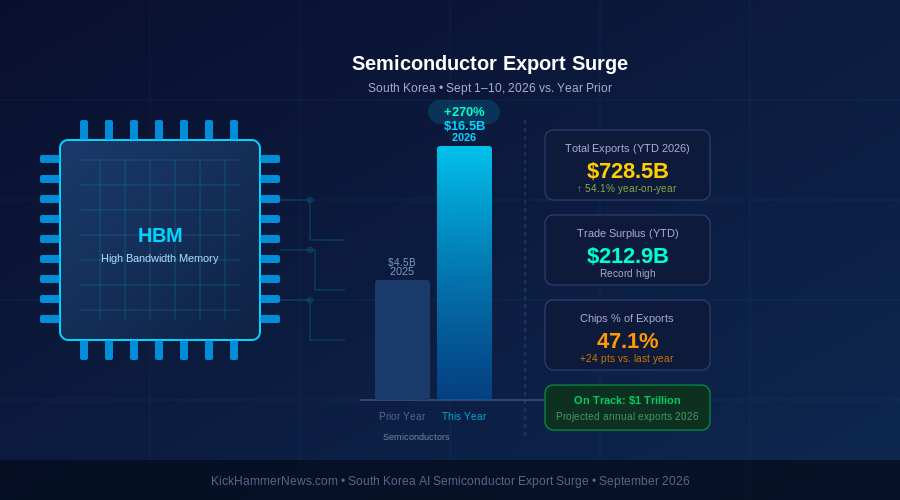
September 15, 2026 — In the first ten days of September 2026, South Korea shipped $35 billion worth of goods abroad. That alone would be remarkable. But the number hiding inside that headline is the one that’s reshaping global technology supply chains: semiconductor exports leaped 270 percent year-on-year to $16.5 billion — the highest ever recorded for any comparable period. Chips now account for 47.1 percent of everything South Korea sells to the world, up nearly 24 percentage points from a year ago.
The AI infrastructure buildout isn’t slowing down. If anything, it’s accelerating, and South Korea finds itself at the very center of it.
A Nation Riding the Memory Wave
The story of South Korea’s export boom is really the story of two companies: Samsung Electronics and SK hynix. Together, they produce the overwhelming majority of the world’s High Bandwidth Memory (HBM) — the stacked, high-speed DRAM chips that sit beside every major AI accelerator, from Nvidia’s H100 and B200 series to custom silicon from Google, Amazon, and Microsoft. Without HBM, the large language models and AI agents now embedded in enterprise software, smartphones, and cloud platforms simply cannot function at scale.
Demand for HBM and server DRAM has been insatiable. Every new AI data center — and the world has been building them at a historic pace — requires hundreds of thousands of high-bandwidth memory modules. South Korea’s chipmakers have had to race to expand capacity even as they command premium prices that would have seemed unimaginable just three years ago.
The ripple effects have been felt throughout the Korean economy. Semiconductor bonuses — typically paid semi-annually at Samsung and SK hynix — have grown large enough that the Bank of Korea has flagged them as a potential inflation driver, complicating monetary policy decisions at a time when rate setters are already navigating a stronger won and rising energy costs.
The Numbers Behind the Headline
South Korea’s total exports from January through mid-September 2026 reached $728.5 billion — a 54.1 percent increase from the same period the year before. The trade surplus for the year has climbed to $212.9 billion. By virtually any measure, this is the most successful export year in the country’s history, and the year isn’t over yet.
South Korea is now widely projected to become only the fourth country to surpass $1 trillion in annual exports, joining the United States, China, and Germany in a club that reflects the scale of a nation’s integration into global commerce. Given current trajectory, analysts suggest that milestone could arrive before the end of Q4.
The export surge extends beyond semiconductors, though chips remain the dominant driver. Petroleum products jumped 57 percent to $1.87 billion in early September. Automobile exports rose 10 percent to $1.7 billion. Shipbuilding — a traditional Korean strength — posted gains of 66.8 percent, while steel climbed 10.3 percent. But none of these individually compare in magnitude to the semiconductor surge, and none of them would be growing at this pace without the underlying demand for AI infrastructure that chips facilitate.
By geography, exports to China doubled to $7.95 billion in the Sept. 1–10 window, while shipments to the United States jumped 137.5 percent to $7 billion — the two largest customers pulling hard from opposite directions of the geopolitical divide.
The HBM Advantage and Its Fragility
South Korea’s dominance in HBM is not an accident. It is the product of decades of investment, manufacturing expertise, and painful cycles of boom and bust that eventually concentrated memory production among a small number of highly capable firms. Samsung and SK hynix collectively control what industry analysts estimate is around 70 to 80 percent of the global HBM market. Micron Technology of the United States holds most of the remainder.
That concentration creates an extraordinary strategic advantage — but also a vulnerability. The same geographic concentration that makes South Korea essential to global AI supply chains also makes it a single point of failure. Geopolitical tension on the Korean Peninsula, even a relatively minor escalation, could send shockwaves through every AI laboratory and data center on the planet. It is a tension that has not been lost on American or European policymakers, who have watched the AI chip supply chain map with increasing attention since 2024.
China has taken note as well. In a pointed contrast to South Korea’s model — where Samsung and SK hynix largely fund their own expansion — Beijing has been channeling coordinated public financing into its domestic chipmakers, treating semiconductor independence as a matter of national survival. Chinese firms including CXMT and YMTC are working to close the technical gap in DRAM and NAND production, though analysts believe they remain several years behind the leading-edge products that South Korea’s giants produce.
What It Means for Global AI Deployment
For companies building or scaling AI systems in 2026, the practical implication of South Korea’s chip boom is mixed. On one hand, production has been ramping — prices for some memory configurations have stabilized after years of sharp increases. On the other hand, HBM supply remains tightly constrained relative to demand. AI labs and hyperscalers continue to compete aggressively for allocation, and any disruption in South Korean production capacity — whether from a natural disaster, a labor dispute, or a geopolitical incident — would immediately be felt in AI deployment timelines worldwide.
The memory crunch has also begun influencing how AI systems are designed. Model architectures increasingly optimize for memory efficiency; inference providers are building shared-memory clusters to maximize utilization of every HBM module they can acquire. In a sense, the constraints imposed by South Korea’s finite production capacity are quietly shaping the trajectory of AI research itself.
The Trillion-Dollar Question
South Korea’s path to $1 trillion in exports, if it arrives this year, will be seen primarily as a technology story — specifically, an AI memory story. That is both a source of pride and a cause for strategic reflection inside Seoul’s government and boardrooms. A country whose export economy has become nearly half dependent on a single product category — however lucrative — is exposed to the cyclicality that has historically characterized semiconductor markets.
Korean policymakers are well aware of this. Efforts are underway to diversify the country’s advanced technology portfolio: defense exports (already a growing category), next-generation battery technology, robotics, and biotech all feature in long-term industrial strategy. But for now, the memory wave is lifting all boats, and South Korea is surfing it with extraordinary skill.
The AI revolution was always going to require physical infrastructure. Massive compute clusters, enormous data centers, miles of fiber — and at the heart of all of it, the dense stacks of silicon memory that make trillion-parameter models run. South Korea didn’t plan to become the world’s indispensable AI memory supplier. It just built the capability, through decades of discipline and capital, to be the one country that could.
Now the world is calling, and South Korea is answering — 270 percent faster than this time last year.
—
Sources: Korea JoongAng Daily, Korea Customs Service, Startup Fortune, TechTimes, Korea Times


