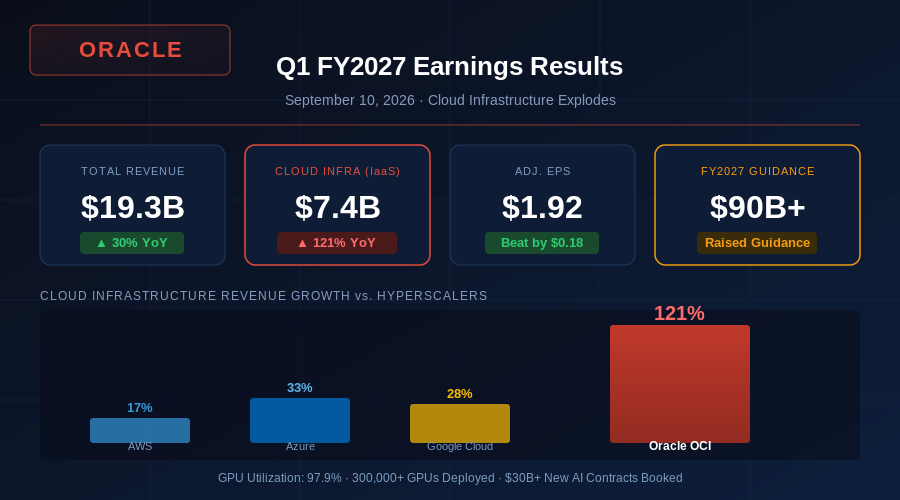
Oracle reported its first-quarter fiscal year 2027 results on September 10, 2026, delivering a thunderclap to Wall Street and cementing the company’s transformation from a legacy database vendor into one of the world’s fastest-growing AI infrastructure providers. Total revenues rose 30% year-over-year to $19.3 billion, beating analyst expectations of $19.14 billion, while adjusted earnings per share came in at $1.92 — a full 18 cents ahead of the consensus estimate of $1.74.
The headline number, though impressive, barely captured the full story. Oracle’s cloud infrastructure division — the IaaS business underpinning its AI ambitions — grew a staggering 121% year-over-year to $7.4 billion. GPU utilization hit 97.9% across the quarter, with more than 300,000 GPUs deployed globally. The company booked over $30 billion in new AI cloud contracts in just three months. For a company that critics once dismissed as too slow, too legacy-bound, and too reliant on on-premises database revenues, these numbers represent a fundamental reordering of enterprise cloud competition.
How Oracle Outpaced Its Rivals
The 121% infrastructure growth rate doesn’t just beat Oracle’s own prior quarters — it towers over its hyperscaler peers. Amazon Web Services grew roughly 17% in its most recent comparable period; Microsoft Azure came in around 33%; Google Cloud reported approximately 28%. Oracle, the relative newcomer to cloud infrastructure at scale, is growing at multiples of its bigger rivals.
The explanation lies partly in timing and partly in focus. Oracle was late enough to the cloud infrastructure market that it could build its second-generation data centers purpose-designed for AI workloads — dense GPU clusters, ultra-low-latency interconnects, and a network fabric optimized for the parallelism that training and inference demand. While AWS and Azure retrofitted existing general-purpose infrastructure for AI, Oracle built for it from the ground up.
The company’s partnerships have also proved transformative. Its landmark agreement with OpenAI — valued at approximately $300 billion over the contract period — has directed enormous AI workloads to Oracle Cloud Infrastructure. Microsoft, despite being OpenAI’s primary investor, does not have exclusive cloud rights; Oracle carved out a substantial share of the inference and training traffic that would otherwise default to Azure. Other hyperscalers are taking note.
Cloud Applications Hold Steady, Services Recover
While infrastructure stole the spotlight, Oracle’s other segments delivered steady performance. Cloud Applications (SaaS) revenue grew 10% to approximately $4.2 billion, with Fusion ERP and NetSuite continuing to attract mid-market and enterprise customers migrating away from SAP and legacy on-premises deployments. The NetSuite Next platform, rolled out across North America in Q1, contributed meaningfully to new customer additions.
On-premises license revenues, long the bellwether of Oracle’s decline narrative, contracted further — but at a slower pace than in prior quarters. CFO Safra Catz noted on the earnings call that database license renewals are increasingly converting to cloud subscriptions, which shifts revenue from one-time recognition to recurring monthly billings. This dynamic is a near-term headwind to reported revenue but structurally positive for the company’s visibility and margin profile.
Services revenue bounced back modestly, aided by a wave of Fusion Cloud implementation projects that required Oracle Consulting involvement. The company has historically struggled to grow its services business against competition from Accenture, Deloitte, and Indian IT firms, but the complexity of agentic AI deployments on Fusion is creating demand that implementation partners alone cannot fully satisfy.
The $90 Billion Question
Oracle raised its full-year FY2027 revenue guidance to at least $90 billion — a number that would have seemed fantastical even two years ago, when the company was posting annual revenues in the $52–53 billion range. Non-GAAP earnings per share guidance for the full year was set at $8.10. For Q2 FY2027, the company projected revenue growth of 30–34%, suggesting no let-up in the trajectory that has defined this fiscal year.
The guidance relies heavily on continued GPU availability and the pace of data center buildout. Oracle has been aggressively expanding capacity across the United States, Europe, the Middle East, and Asia, signing power purchase agreements and land leases at a rate that rivals Meta’s infrastructure ambitions. But capacity constraints remain a genuine risk. The company acknowledged on the call that demand continues to exceed supply, and that its 97.9% GPU utilization rate — while a marketing highlight — also means there is essentially no slack in the system for unexpected surges or customer ramp-ups.
Stock Reaction and Analyst Takeaways
Oracle shares rose approximately 4.3% in after-hours trading following the earnings release, with the stock touching $159.58 after closing the regular session at $152.94. The move was somewhat muted relative to prior blowout quarters, suggesting that investor expectations had already priced in substantial outperformance. Analysts from Barclays, JPMorgan, and Morgan Stanley all raised their price targets in the days following the release, with several noting that Oracle’s infrastructure unit is now large enough to be valued as a standalone entity comparable to mid-sized public cloud providers.
The bear case remains centered on capital expenditure. Oracle spent over $6 billion in CapEx during Q1 alone, and its planned $50 billion annual run-rate of infrastructure investment requires sustained revenue generation that would not survive a demand slowdown. If AI adoption among enterprise customers plateaus or if competing infrastructure providers bring excess capacity online — depressing per-GPU pricing — Oracle’s growth story could unravel faster than the current consensus assumes.
What This Means for Enterprise Customers
For CIOs and enterprise architects, Oracle’s Q1 results carry practical implications that extend beyond financial metrics. The company’s stated backlog now exceeds $100 billion in remaining performance obligations, much of it multi-year AI infrastructure commitments. That backlog creates durability but also means new customers seeking capacity face real queue times.
Oracle’s Fusion ERP suite is increasingly competing not just on features and price but on the AI inference latency advantage that running applications on the same infrastructure as their AI models provides. The pitch to enterprise buyers is integration: your financials, your supply chain, and your AI agents all run on one network, with data never leaving Oracle’s custody. For regulated industries — banking, healthcare, defense — that pitch is resonating in ways it never did when Oracle was purely a software company.
The company’s agentic AI features, including the Agentic Builder launched in Q1 and tighter APEXLang integrations unveiled at last week’s CloudWorld preview, are intended to lock in customers who might otherwise consider Amazon Bedrock or Microsoft Azure AI Foundry for their next application layer. If Oracle can demonstrate that its AI stack delivers measurable ROI advantages, the infrastructure subscription revenues that drove this quarter’s results will prove not just spectacular — but durable.
For an industry that spent a decade writing Oracle’s epitaph, Q1 FY2027 is a reminder that enterprise software cycles are long, and that the companies positioned at the intersection of data gravity and AI compute are not always the ones the market expects.


