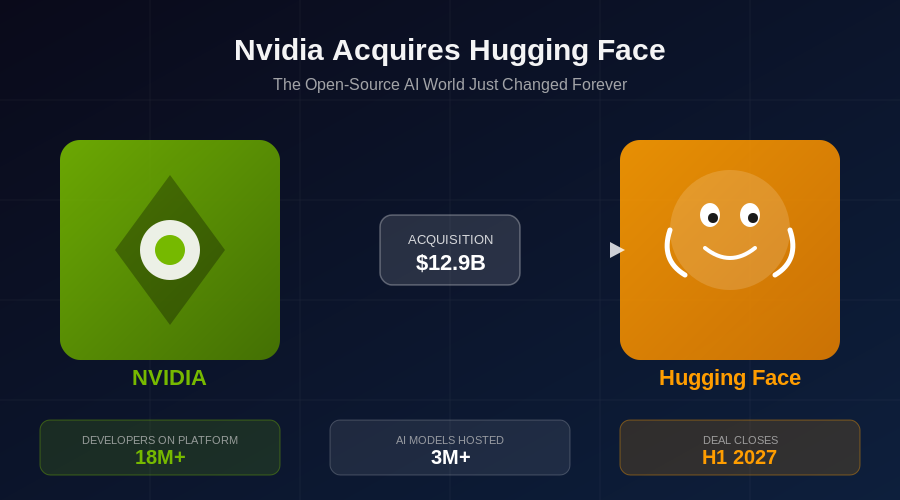
When Hugging Face CEO Clément Delangue quietly approached Nvidia’s Jensen Huang over the summer with an audacious idea — what if the world’s dominant AI chipmaker bought the world’s most important open-source AI platform — it probably felt more like a long shot than a business deal. Three months later, Nvidia has inked one of the most consequential acquisitions in artificial intelligence history, agreeing to purchase Hugging Face for $12.9 billion in a move that reshapes the competitive landscape of AI development for years to come.
A Marketplace for the AI Age
To understand why this deal matters so much, you first need to understand what Hugging Face actually is. Founded in 2016 as a chatbot company, Hugging Face pivoted toward machine learning tools and quickly became the de facto hub of the open-source AI community. Today, more than 18 million developers, researchers, and creators use the platform to share over 3 million models, 500,000 datasets, and 1 million applications. It is, in effect, the GitHub of artificial intelligence — the place where the global research community posts, discovers, and builds upon the work of others.
That community centrality made Hugging Face extraordinarily valuable not just as a business, but as an infrastructure layer underpinning huge swaths of modern AI development. Academic researchers, startups, and enterprise developers alike depend on it daily.
The Deal’s Structure
The acquisition agreement, which Nvidia announced officially on September 3, 2026, breaks down into $11.9 billion paid to Hugging Face shareholders, plus up to $1 billion in equity-based retention awards for Hugging Face employees who choose to join Nvidia’s ranks. The deal is expected to close in the first half of 2027, subject to the usual gauntlet of regulatory approvals.
At $12.9 billion, it ranks as Nvidia’s second-largest acquisition ever, trailing only the company’s $20 billion purchase of assets from chip startup Groq last December. It also signals a dramatic strategic evolution for Nvidia — from a hardware company that happens to benefit from AI, to an increasingly vertically integrated AI ecosystem player.
Jensen Huang’s Strategic Logic
For Huang, the acquisition reflects a clear-eyed reading of where the AI market is heading. In a blog post accompanying the announcement, Huang wrote that Nvidia and Hugging Face “realized that open-source AI in general was at a turning point, and that it needed more resources, more scale, more visibility.”
That framing is telling. The open-source AI world has matured enormously over the past few years, with powerful models from Meta (Llama series), Mistral, and a wave of Chinese labs challenging the proprietary offerings of OpenAI and Anthropic. But growth has also strained infrastructure. Hugging Face’s servers have buckled under the demand of model uploads and API calls. Community governance has become more complex. The platform needed resources it simply didn’t have as a standalone company.
Nvidia, flush with cash from its dominance of the AI chip market, can provide exactly those resources. And in return, Nvidia gets deep integration with the ecosystem where AI models actually live — a strategically invaluable position.
The Open-Source Question
The acquisition immediately sparked concerns within the AI research community. Would Nvidia quietly push developers toward its own CUDA-based infrastructure? Would access to popular models become contingent on using Nvidia hardware? Would the famously open, collaborative culture of Hugging Face survive absorption into a $3 trillion corporation?
Nvidia moved quickly to address these fears, and its commitments are unusually specific. Nvidia has publicly stated that its own compute will not be required to build on or deploy through Hugging Face. The platform will continue supporting models from across the entire ecosystem — from every model builder, not just Nvidia partners. Multi-cloud and multi-accelerator development will remain supported, meaning researchers can continue training on AMD, Intel, or custom hardware without penalty.
Hugging Face will also maintain its own brand and organizational identity, at least for the foreseeable future. Delangue has emphasized that the partnership with Nvidia will allow the platform to expand rather than contract its mission.
Skeptics remain. Critics note that corporate promises about openness have a mixed track record — GitHub, acquired by Microsoft in 2018 for $7.5 billion, has remained largely open, but other acquisitions have followed less happy paths. Regulatory bodies in the EU and US are also expected to scrutinize the deal carefully, given Nvidia’s already-dominant position in AI compute and the potential for the acquisition to further entrench that dominance by controlling the platform where open-source AI lives.
Market Implications
The strategic ripple effects extend well beyond Hugging Face itself. For Nvidia, the acquisition marks an explicit move to compete not just on chips but on the full AI development stack. Google has TensorFlow and Vertex AI. Microsoft has Azure and a deep OpenAI partnership. Amazon has SageMaker. Nvidia has long supplied the hardware underpinning all of these platforms while remaining curiously absent from the software and community layer — until now.
For competitors, the acquisition raises uncomfortable questions. If Nvidia controls the platform where most open-source models are distributed, does it have subtle ways of advantaging its own ecosystem? Will model builders on AMD hardware find friction in ways that are difficult to quantify? The questions may not have bad answers, but they will shape competitive strategy across the industry.
For the broader AI research community, the deal offers a bittersweet resolution to a genuine resource problem. Hugging Face needed more than it could generate alone, and Nvidia can provide it. Whether that bargain preserves what made Hugging Face special — its open, meritocratic, genuinely global research culture — remains to be seen.
The Bottom Line
Nvidia’s $12.9 billion bet on Hugging Face is the clearest signal yet that the AI chips race is evolving into something broader and more complex: a race for ecosystem control. Jensen Huang didn’t just buy a popular developer tool. He bought the infrastructure layer where the future of open-source AI is built, stored, and shared.
Whether that’s good news for the researchers who built that community, or primarily good news for Nvidia’s shareholders, may depend entirely on how faithfully the chipmaker honors the commitments it has made. The deal closes in 2027. The verdict will take longer than that.
Sources: NVIDIA Blog, CNBC, TechCrunch, Bloomberg, CNN Business, The Information


