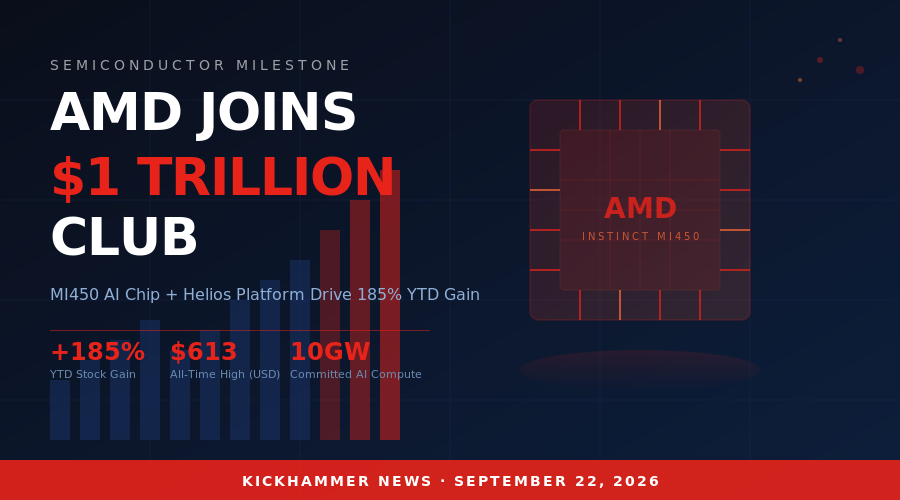
In a milestone that would have seemed fantastical just three years ago, Advanced Micro Devices crossed the $1 trillion market capitalization threshold on September 21, 2026, cementing its place in a rarefied tier of corporate giants. AMD’s stock surged nearly 10% to reach an all-time intraday high of $613.92, pushing its total market value past the trillion-dollar mark for the first time in the company’s 56-year history.
AMD is now only the fourth U.S. semiconductor company to breach this barrier, joining Nvidia, Broadcom, and Micron in a club that reflects the extraordinary transformation of the chip industry in the age of artificial intelligence. The company’s shares have risen approximately 185% in 2026 alone — a five-day rally fueled by AI demand that culminated in Monday’s historic session.
From Underdog to Unstoppable
The story of AMD’s rise is a Silicon Valley comeback narrative unlike any other. For decades, the company played second fiddle to Intel in the CPU market and appeared perpetually outgunned by Nvidia in GPUs. The turning point came in 2020 with the release of the EPYC server processors, which began eroding Intel’s datacenter dominance. But it was the AI revolution that truly transformed AMD’s fortunes.
When the generative AI boom began in earnest in 2023, Nvidia held near-monopoly control over AI training hardware. AMD was viewed as a distant challenger. What followed was an aggressive engineering and strategy overhaul that, by 2026, has made AMD a genuine alternative for hyperscalers and AI labs burning through compute at unprecedented rates.
The Instinct MI450, AMD’s latest AI accelerator, is at the center of this transformation. The chip represents a major leap in performance per watt and is integrated into AMD’s “Helios” rack-scale infrastructure platform — a tightly bundled system that combines next-generation Instinct GPUs, EPYC server processors, and networking technology inherited from AMD’s acquisition of Pensando. Helios allows customers to deploy AI infrastructure at gigawatt scale with dramatically simplified integration.
The Big Customer Bet
What really moved AMD stock — and arguably what moved the needle on the trillion-dollar valuation — were the landmark customer agreements announced earlier in 2026. The deals read like a who’s who of the AI industry.
OpenAI committed to deploying an initial one-gigawatt cluster using the Instinct MI450 series, with the first tranche scheduled to go live in the second half of 2026. Meta signed on for up to six gigawatts of AMD Instinct GPUs. Anthropic, one of the most well-funded AI labs in the world, pledged to deploy up to two gigawatts of MI450 GPUs inside Helios racks, with the first gigawatt slated for the first half of 2027. Microsoft Azure deepened its AMD collaboration as well.
These are not token commitments. A single gigawatt of compute represents a staggering capital deployment — billions of dollars in hardware alone, plus the power and cooling infrastructure to run it. When Anthropic, OpenAI, and Meta collectively commit to nearly ten gigawatts of AMD hardware, the market takes notice.
The deals also include performance-linked warrant structures that tie AMD’s long-term equity upside to its hyperscaler partners’ growth — a creative financing mechanism that further aligns incentives across the AI supply chain.
What Triggered This Week’s Rally
Monday’s 9% pop was partly catalyzed by an unexpected demand signal: Meta’s new Muse AI agent became the most-downloaded free iPhone app in the United States over the weekend, igniting fresh excitement about consumer AI adoption and the compute infrastructure it requires. Investors immediately connected the dots — more AI consumption means more chips, and AMD is increasingly in the path of that spending.
The broader semiconductor sector rallied in tandem. But AMD’s gain was outsized, reflecting the market’s recalibration of where the company sits in the AI hardware hierarchy. No longer just an alternative to Nvidia, AMD is being treated as an essential second source of supply — a status that commands a dramatically higher valuation multiple.
The Road That Led Here
AMD’s trillion-dollar moment wasn’t a sudden development. It was the product of sustained investment in chip architecture, a strategic pivot toward AI accelerators, and a multi-year effort to build the software ecosystem — the ROCm platform — that makes AMD GPUs programmable by the same frameworks that run on Nvidia hardware.
ROCm compatibility remained a significant pain point for years. Developers fluent in Nvidia’s CUDA framework faced friction migrating workloads to AMD silicon. That friction hasn’t entirely disappeared, but it has diminished substantially. AMD’s engineering teams have made ROCm faster, more stable, and more broadly compatible with popular frameworks like PyTorch and JAX. Enterprise customers report that migration from Nvidia to AMD is no longer the ordeal it once was.
The Helios platform amplifies this progress. By bundling compute, memory, networking, and management software into a validated rack-scale system, AMD reduces the integration burden for customers. A hyperscaler doesn’t need to design its own interconnect topology or worry about compatibility between GPU nodes and storage fabric — Helios handles that. It’s a page borrowed directly from the playbook that made Nvidia’s DGX SuperPOD systems dominant, but with AMD’s own architectural twist.
What Comes Next
The trillion-dollar valuation raises obvious questions about sustainability. Can AMD maintain this momentum? The competitive dynamics remain fierce. Nvidia is not standing still — it continues to ship its own next-generation hardware and maintain a commanding software ecosystem lead. Custom silicon from hyperscalers (Google’s TPUs, Amazon’s Trainium, and Microsoft’s Maia chips) poses a longer-term structural threat to both AMD and Nvidia’s merchant silicon businesses.
There are also supply chain constraints to navigate. The most advanced AI chips require extreme ultraviolet (EUV) lithography at TSMC’s leading-edge nodes. TSMC’s capacity is finite, and both AMD and Nvidia are competing for the same wafer starts. If AI demand continues to accelerate faster than fab capacity, AMD will need to manage customer expectations carefully.
Still, the bears have been wrong about AMD for three consecutive years. The MI450 is shipping. The Helios platform is installed in some of the world’s largest data centers. Anthropic, OpenAI, and Meta have put real money — tens of billions of dollars worth — on AMD silicon delivering results. That’s not a bet the market is inclined to fade right now.
A New Semiconductor Landscape
AMD’s trillion-dollar milestone marks something larger than a single company’s success. It signals that the semiconductor industry has entered a structurally different era — one where AI compute spending has become so large that it can support multiple well-capitalized players at the highest tier. The winner-take-all dynamics that once characterized the chip business are giving way to something more pluralistic.
For the AI industry as a whole, AMD’s rise is arguably healthy. A credible alternative to Nvidia keeps pricing competitive, motivates continued architectural innovation, and gives hyperscalers negotiating leverage they didn’t have two years ago. When Google, Microsoft, and Meta can threaten to double their AMD orders, it changes the conversation.
Advanced Micro Devices began 2026 as an ambitious challenger with a story to tell. It ended the third week of September as a trillion-dollar company with receipts to show for it. In the brutally competitive world of AI silicon, that is about as definitive a statement as a chip company can make.