In the mid-19th century, American investors poured their fortunes into an audacious gamble: steel rails stretching from coast to coast. Some got rich. Many went bankrupt. But the railroads got built, and they transformed the world regardless of who profited. Now Goldman Sachs is drawing the same comparison to what’s happening inside the server farms of Amazon, Microsoft, Alphabet, Meta, and Oracle — and the numbers are staggering enough to make even seasoned Wall Street analysts do a double take.
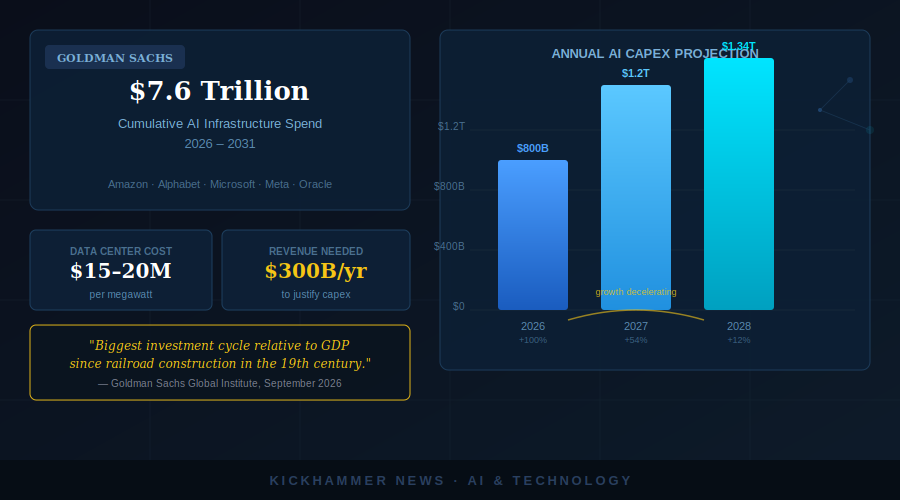
According to a report published this week by the Goldman Sachs Global Institute, those five hyperscale companies are on track to collectively spend .2 trillion on AI infrastructure in 2027 alone — a figure that exceeds Wall Street’s consensus estimate by $100 billion, and represents a 50% jump from the already eye-popping $800 billion projected for 2026. Zoom out further, and the picture becomes even more extraordinary: Goldman projects $7.6 trillion in cumulative AI capital expenditure between 2026 and 2031, spanning compute chips, purpose-built data centers, and the electrical infrastructure required to power it all.
To put it differently: the five largest tech companies in America are about to embark on a multi-year construction project nearly four times the size of the entire U.S. interstate highway system measured in today’s dollars — with no federal mandate, no guaranteed return, and a growing chorus of skeptics asking whether the revenue will ever arrive to justify it.
The Revenue Problem
Goldman’s analysts are unambiguous about the core tension at the heart of this buildout: the numbers need to pencil out, and they haven’t yet.
To justify $1.2 trillion in annual infrastructure spending, the five hyperscalers collectively need to generate roughly $300 billion per year in AI-attributable revenue. Cloud revenue — the most direct proxy for AI monetization — has accelerated sharply, jumping from 25% annual growth in 2024 to 48% in the second quarter of 2026. That’s an encouraging trajectory. But Goldman’s report is careful to note that “growing cloud sales are not the same thing as proving that AI services will produce durable returns after chips, electricity and depreciation are paid for.”
The depreciation issue alone deserves scrutiny. Next-generation AI data centers cost between $15 and $20 million per megawatt to build — roughly twice the price of traditional cloud facilities. These buildings are expensive not just because of the hardware inside them, but because of the power density, cooling systems, and specialized infrastructure required to run modern AI accelerators at scale. Historically, data centers were built to last 15 to 20 years. But AI hardware generations turn over so rapidly that the architecture of a newly commissioned facility may already be obsolete within two to three years of opening.
That’s a significant durability problem for assets that need to earn back their construction costs over many years.
Four Variables That Could Change Everything
Rather than offer a single forecast, Goldman frames its analysis around four assumptions that will ultimately determine whether this buildout looks like railroad genius or dot-com folly.
The lifespan of AI chips is what the bank calls “the single most influential variable in determining the scale of cumulative AI infrastructure investment.” If chips prove useful for six years instead of four, replacement cycles stretch out and cumulative spending drops materially. If rapid generational improvements render chips obsolete in two years instead of four, replacement demand surges. Right now, nobody really knows — because AI workloads are still evolving fast enough that demand patterns for any given hardware generation are genuinely uncertain.
Data center construction costs are rising and may keep rising. Power density is increasing with each new chip generation, driving up both building costs and ongoing electricity bills. Architectural obsolescence adds another layer of uncertainty, since companies don’t yet know whether to depreciate these assets aggressively (assuming rapid obsolescence) or slowly (assuming broad utility across AI tasks).
Chip architecture mix may matter more for who profits than for how much gets spent. NVIDIA’s GPUs currently command gross margins around 75%, making NVIDIA arguably the biggest near-term beneficiary of the buildout. If AI-specific chips (ASICs) designed by Amazon, Google, Microsoft, and others displace GPU demand, NVIDIA’s take shrinks even as total infrastructure spending holds. Conversely, if cheap ASICs make AI more accessible and drive elastic demand for more compute, total spending could actually increase even as per-unit costs fall.
Build-out elongation is already happening, and not in anyone’s business plan. Power grid interconnection queues — the waiting list to connect a new data center to the electrical grid — now stretch years in some U.S. regions. Labor shortages in specialized trades like electrical contracting are real and worsening. Memory chip supply, particularly high-bandwidth memory needed to run the latest GPU clusters, has periodically constrained deployment. Goldman’s base case assumes these bottlenecks cause delays without fundamentally reducing investment; its stress scenario suggests they could create a feedback loop that undermines confidence in the entire buildout.
Spending on Borrowed Money
Perhaps the most consequential detail buried in Goldman’s report is a balance-sheet observation: the five hyperscalers are now spending more on AI infrastructure than their combined operating cash flow generates. For the first time in the modern tech era, the companies leading this buildout are financing part of it with debt.
That’s not a crisis — these are among the most creditworthy borrowers in the world — but it is a meaningful shift. It means the revenue justification clock is now ticking against not just shareholder patience, but interest payments. And it means that a paradigm-shifting development — Goldman explicitly cites the January 2025 DeepSeek moment, when a Chinese lab demonstrated competitive AI capabilities at a fraction of the assumed compute cost — could not just slow the buildout but create stranded assets on a massive scale.
Growth Is Already Slowing
Buried in the topline numbers is a trend that Goldman says AI infrastructure suppliers should be watching carefully: the growth rate of spending is decelerating fast. The year-over-year increase in hyperscaler AI capex was nearly 100% in 2026. Goldman projects it will fall to 54% in 2027 and then drop sharply to just 12% in 2028.
In absolute terms, spending keeps rising. But companies selling chips, networking equipment, cooling systems, and power infrastructure to these hyperscalers will see growth rates compress dramatically over the next 24 months — even in Goldman’s optimistic scenario. For companies whose valuations rest on AI-infrastructure tailwinds continuing at current pace, that deceleration matters.
The Fundamental Bet
Goldman’s bottom line is essentially philosophical: this is a bet by the world’s wealthiest and most sophisticated technology companies that AI will prove economically transformative enough to justify an investment cycle of a scale unseen since the Industrial Revolution. They may be right. The historical record suggests that transformative infrastructure investments often do pay off — though not always for the original investors.
In 1870, many railroad companies were financially ruined even as the tracks they laid became the skeleton of the American economy. In 2001, telecom firms were destroyed by the fiber they overbuilt — fiber that later became the backbone of the internet that generated trillions in value for companies that didn’t exist when the cables were buried.
The $7.6 trillion question is whether Amazon, Microsoft, Alphabet, Meta, and Oracle have timed this bet well enough to be in the winning column when the returns eventually materialize — or whether they’ll be remembered as the ones who built the rails that someone else rode to riches.
Goldman Sachs, to its credit, doesn’t claim to know. The report’s most honest line may also be its most important: “Current estimates of the ultimate scale of the AI build-out are far more conditional than they appear.”


