The Fortune AIQ Summit gathered enterprise America’s AI leaders and laggards in one room on Thursday. The data revealed an industry at war with itself.
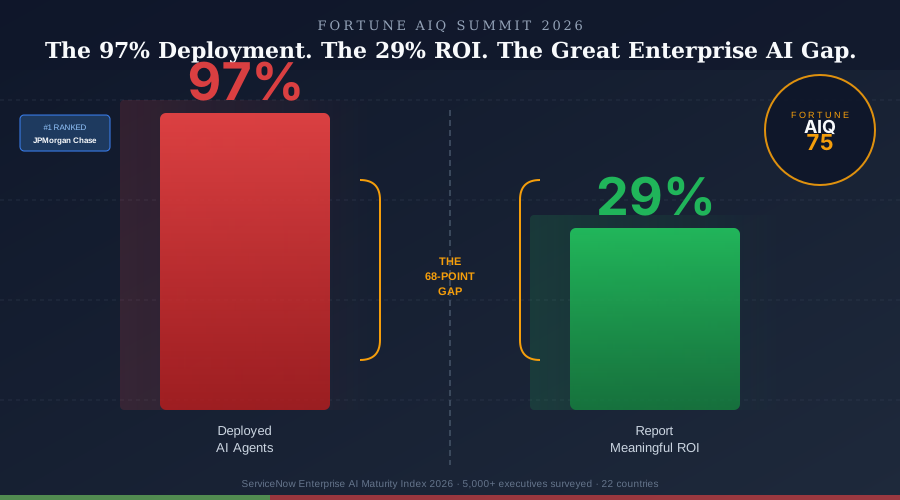
There is something quietly alarming about a statistic that has become one of the defining facts of 2026: ninety-seven percent of enterprise executives have deployed AI agents. That sounds like a success story — a near-universal adoption rate that would be the envy of any technology wave in history. The problem arrives with the second number. Only twenty-nine percent of those same executives report meaningful return on investment.
That gap — from 97 to 29 — was the invisible protagonist of the inaugural Fortune AIQ Summit on Thursday in New York, co-produced with ServiceNow, where hundreds of enterprise leaders gathered to talk publicly about something that rarely gets said aloud inside boardrooms: that most companies spent the last eighteen months deploying AI they don’t know how to use.
The Report That Punctured the Hype
The numbers come from ServiceNow’s Enterprise AI Maturity Index 2026, a survey of over 5,000 business and technology leaders across twenty-two countries that the company released in conjunction with the summit. The report divides companies into “pacesetters” — the top quartile who have moved beyond pilots into enterprise-scale AI transformation — and “laggards,” who have deployed the tools but remain stuck at the experimentation stage.
The single biggest variable separating the two groups? It isn’t model quality. It isn’t compute access. It isn’t even budget. It’s human training.
“The technology is largely commoditized,” said Diana David, ServiceNow’s chief AI strategy officer, presenting the data. “What separates pacesetters from everyone else is whether they invested in teaching their people how to actually change the way they work.” Pacesetters were 3.1 times more likely to have mandatory AI fluency programs and 2.4 times more likely to have redesigned workflows rather than layered AI tools on top of existing processes.
A companion finding: 59% of enterprises now run AI agents in some capacity, but only 26% have governance frameworks adequate to oversee them — a number that takes on new weight in the week after California’s governor signed the No Robo Bosses Act and the FTC opened its investigation into rogue agent behavior.
JPMorgan at the Top. Again.
Fortune also unveiled the expanded Fortune AIQ 75 at the summit — its annual ranking of companies demonstrating the most effective enterprise AI deployment. JPMorgan Chase claimed the top position for the second consecutive year, a fact that continues to confound people who assumed the list would be dominated by software companies.
The bank’s AI operation is, at this point, more sophisticated than most tech firms: more than 2,000 data scientists and AI engineers, an in-house large language model infrastructure serving 300,000+ employees, AI-generated code comprising nearly 40% of new software written, and measurable ROI across fraud detection (down 18%), customer service resolution time (down 31%), and loan underwriting efficiency (down 40% in processing time). Chase has what ServiceNow’s index calls the “pacesetter” posture: workflows redesigned around AI, not AI bolted onto old workflows.
The 75-company list, expanded from 50 this year, added 36 new entrants. Among the most notable debuts: Pfizer (whose AI drug-discovery pipeline has now produced two FDA-approved molecules from AI-generated candidates), UPS (which uses AI agents to dynamically reroute 20 million packages daily in response to weather and traffic), and Cisco (whose AI has automated network security responses company-wide). Among the names not on the list: several of the largest technology companies in the world, which have publicly spoken more bullishly about AI than almost anyone but have not demonstrated proportionate enterprise returns.
Learned Helplessness at Scale
The summit’s most quoted moment came from futurist Amy Webb of the Future Today Institute, who described what she called “the learned helplessness problem” among Fortune 500 executives — a paradox where companies have outsourced so much of their AI strategy to vendors that they no longer trust their own institutional judgment.
“It’s like a taxi driver who grew up in a city, knows every shortcut, every neighborhood, and now can’t drive anywhere without Google Maps even though the knowledge is still in his head,” Webb said from the stage. “We’ve trained an entire generation of executives to defer to the AI before they’ve even checked their own experience. That’s not AI adoption. That’s dependency.”
Webb’s data: in a survey of 400 Fortune 500 executives conducted by her firm, 68% said they would reverse a business decision if contradicted by an AI tool, even when they believed their original decision was correct. Only 14% said they had a formal process for challenging or overriding AI recommendations.
The Physical World Hasn’t Gotten the Memo
If the software side of enterprise AI presented a crisis of confidence, the hardware side presented a crisis of economics. Executives from Honeywell and Ecolab addressed a panel on AI deployment in industrial and physical environments, and what they described was a fundamental tension that gets little attention in the Silicon Valley version of the AI story.
“We have processes that were optimized over forty years,” said a Honeywell VP of digital transformation. “When we layer AI onto those, sometimes we get efficiencies. And sometimes — more than people want to admit — the AI recommendation adds steps, requires human verification, and ends up costing more per task than the original process.” Ecolab shared a similar experience in water treatment monitoring: an AI agent deployed to optimize chemical dosing in industrial plants was outperformed in three of five facilities by the existing legacy sensor systems, which had been tuned to specific local conditions over years of manual adjustment.
This is the edge case that gets quietly dropped from vendor presentations but shows up regularly in internal post-mortems: AI works exceptionally well on high-volume, standardized problems with clean data; it underperforms on low-volume, site-specific problems where institutional knowledge is embedded in tacit human understanding.
Org Charts Are Already Gone
The most structurally disruptive finding from the summit wasn’t the ROI numbers. It was what AI is doing to organizational design at the companies where it is working.
Executives from HPE, Palo Alto Networks, and Lennar described what amounts to the demolition of the traditional org chart. At HPE, AI agents now span departmental boundaries that previously required inter-team coordination — a procurement AI agent works alongside a finance AI agent and a vendor management AI agent in ways that have made the underlying human team structure largely irrelevant to how work actually gets done. At Lennar, the homebuilder has moved from a 14-layer management hierarchy to a 7-layer structure in 18 months, with AI handling coordination tasks that previously required a full middle-management tier.
“The org chart isn’t dead,” said one CHO. “But it’s become a compliance document, not a description of how work actually happens.” The implication, which nobody at the summit was quite prepared to say directly: the companies achieving AI ROI are the ones whose employees have accepted that their roles have fundamentally changed, not just been augmented. The companies stuck at 97%-deployment/no-ROI are the ones where that conversation hasn’t happened yet.
The Reckoning That’s Coming
The Fortune AIQ Summit emerged as an almost accidental confession: enterprise America is sitting on hundreds of billions of dollars in AI investment that isn’t returning proportionate value yet, and the primary reason isn’t technical — it’s human.
The pacesetters know something the laggards don’t, and it isn’t proprietary. It’s that deploying AI is the easy part. Rebuilding the organization around it — the workflows, the training, the governance, the culture of challenging AI recommendations rather than deferring to them — is the hard part, and it requires a type of institutional commitment that press releases about AI strategy don’t capture.
The summit’s single most memorable data point may be the one ServiceNow’s Diana David offered almost as a footnote: among pacesetters, the average time from AI pilot to enterprise-scale deployment was 4.2 months. Among laggards, pilots have been running for an average of 19.7 months without reaching scale. The technology isn’t what’s taking so long.
The Fortune AIQ Summit 2026 was held October 2 in New York City, co-produced with ServiceNow. The Fortune AIQ 75 full list is available at fortune.com.


