The infrastructure layer for the agentic AI era is being built in real time — and Supabase just made a $150 million bet on who controls it.
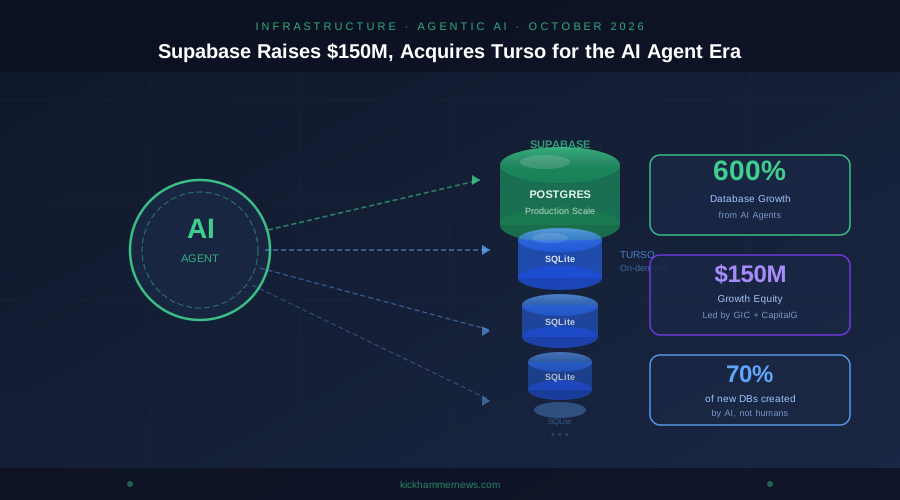
Supabase, the open-source backend-as-a-service platform powering millions of applications, announced it has closed a $150 million growth equity round led by Singapore’s GIC sovereign wealth fund, with participation from Alphabet’s CapitalG, IronArc, and SquarePeg. Alongside the funding, the company revealed it has agreed to acquire Turso, a lightweight Rust-based SQLite platform engineered specifically for the demands of autonomous AI systems. The announcement marks a defining moment in how the technology industry is thinking about database architecture — and who, or what, will be building software in the years ahead.
When Agents Become the Developers
For decades, the standard model for database consumption has been straightforward: a developer designs a schema, deploys a server, and human users interact with the application. AI agents are dismantling that model with startling speed.
Supabase reports that 70% of all new databases created on its platform are now provisioned not by human developers, but by AI tools and coding assistants. The platform adds over four million new databases every month, and has watched the number of databases created by autonomous agents surge by 600% in the past year alone. The company’s 13 million-strong developer community is increasingly stepping back from the act of database creation — and handing the keys to the machines they built.
“Agents are spinning up millions of databases to power the prototypes, explorations, dashboards, and apps they’re building,” said Supabase co-founder and CEO Paul Copplestone. The scale of this shift has forced the company to rethink its entire infrastructure strategy. Traditional database provisioning — which assumes relatively modest, slow-growing deployments — simply cannot keep pace with agents that may spin up a new environment for a single task and discard it minutes later.
The Turso Solution: Millions of Databases on Demand
This is where Turso enters the picture. The startup, founded by Glauber Costa — a veteran of Linux, virtualization, and storage technologies at IBM and Red Hat — built its database from the ground up for this kind of ephemeral, high-velocity workload.
Turso rebuilt SQLite in Rust, creating a cloud infrastructure capable of managing millions of databases simultaneously. Individual databases can be loaded on demand and automatically paused when inactive, slashing costs for short-lived AI tasks. The architecture eliminates the need to provision massive servers in anticipation of traffic; instead, compute resources materialize the instant an agent needs them and vanish when it doesn’t.
For AI agents — which may prototype an application, run an analysis, build a user-specific dashboard, and spin down within a single session — this model is transformative. The alternative, forcing agents to share traditional server-backed databases, creates bottlenecks, raises security concerns around data isolation, and burns compute on idle resources. Turso’s architecture solves all three problems at once.
Costa and co-founder Pekka Enberg will lead the integration of Turso into Supabase’s infrastructure, alongside their full engineering team.
Bridging SQLite and Postgres: One Continuous Path
One of the most strategically significant aspects of the Turso acquisition is what it enables architecturally: a seamless continuum from lightweight, disposable databases to full production-scale infrastructure.
Turso handles the SQLite side — fast, lean, and perfect for agents that need immediate, isolated environments without the overhead of a full relational database. Supabase’s existing platform handles Postgres — the complex queries, multi-user access patterns, and production workloads that serious applications demand. Together, they create what Supabase describes as “a single path from a small database for an agent to a full-fledged production workload.”
In practical terms, this means an AI agent can begin building an application in a cheap, ephemeral SQLite environment, and if that application proves valuable enough to go to production, it can migrate to Postgres without a painful architectural overhaul. It’s a vision of software development that begins in conversation and ends in scale — without manual intervention at either end.
Alongside the Turso announcement, Supabase also introduced Supabase Compute, a new product offering hosted sandboxes for long-running AI agents. The feature addresses another gap in current AI infrastructure: agents that need persistent compute environments for tasks that last hours or days, not milliseconds.
A $10 Billion Company, Four Months After a $500 Million Round
The timing of this additional $150 million raise — just four months after Supabase closed a $500 million Series F at a $10 billion pre-money valuation — underscores how quickly the market for AI infrastructure tooling is moving. The round includes employee liquidity provisions, a sign that the company is managing talent retention in an intensely competitive hiring environment.
Investors are betting that the infrastructure layer for autonomous AI systems will be a defining market of the late 2020s. With compute, models, and agent frameworks maturing rapidly, the battle is now moving to the data layer — the unglamorous but critical question of where AI systems store, retrieve, and operate on information. Supabase, with its open-source roots, massive developer community, and newly acquired edge database capabilities, is positioning itself to be the answer.
The Broader Shift: Developers as Overseers
The statistics embedded in Supabase’s announcement — 70% of new databases created by AI, 600% agent-driven growth — are more than marketing copy. They represent a fundamental inflection in the nature of software development. Human developers are increasingly moving up the stack, from writers of code to architects of systems, while autonomous tools handle the lower-level construction work.
This shift was predicted for years, but the speed of its arrival has surprised even industry insiders. The fact that a developer infrastructure company is raising $150 million and making acquisitions specifically to serve AI-agent demand — not human-developer demand — tells you something about where the industry believes the center of gravity is moving.
The question is no longer whether AI agents will become major consumers of developer infrastructure. They already are. The question now is which companies will have built the right architecture to serve them when the next wave hits.
For Supabase, the Turso acquisition is an answer to that question — and a signal to the market that the database era of autonomous AI has officially begun.