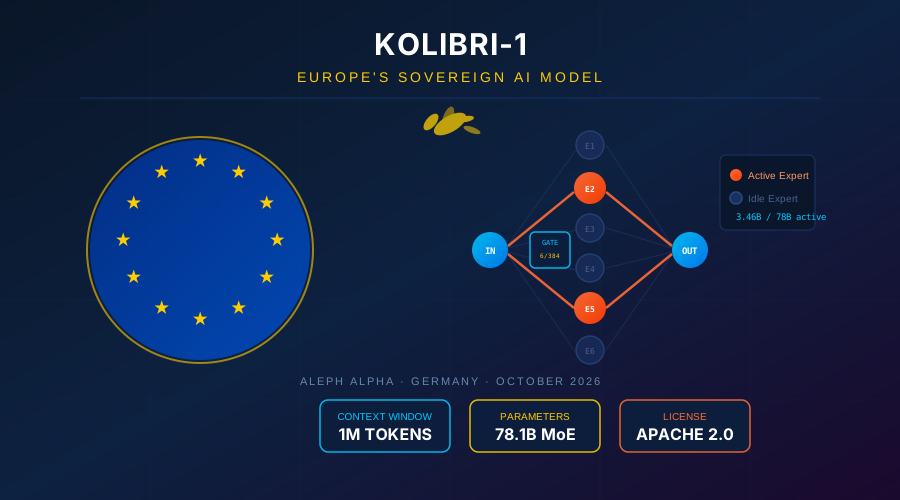
In a world where AI leadership has been dominated by American and Chinese tech giants, Germany’s Aleph Alpha is making a bold statement: Europe can build world-class AI on its own terms. On October 3, 2026, the Heidelberg-based company released Kolibri-1, an open-weight mixture-of-experts language model with 78.1 billion total parameters — and it comes with a twist that sets it apart from virtually every competitor in the market.
Kolibri-1 is not designed to win benchmark leaderboards. It is designed to stay within European borders.
What Is Kolibri-1?
At its core, Kolibri-1 is a large language model built specifically for self-hosted enterprise deployment. Unlike ChatGPT, Claude, or Gemini, it will never be available as a cloud API from Aleph Alpha. The model’s files are distributed freely on Hugging Face under an Apache 2.0 license — which means anyone can download it, modify it, and deploy it, without sending a single byte of data to an external server.
The architecture is a sparse mixture-of-experts transformer. While the model has 78.1 billion total parameters, only 3.46 billion are active for any given token it processes — thanks to 384 expert modules per layer, of which just 6 (plus one shared expert) activate per token. This approach dramatically reduces inference costs while preserving the accumulated knowledge of a far larger system.
The context window starts at 262,144 tokens and has been validated to scale to 1,048,576 tokens — over one million — making Kolibri-1 capable of processing book-length documents, lengthy legal contracts, or extended technical specifications in a single pass.
The model is bilingual: English and German, exclusively. This is not a limitation by accident. It is a design choice that reflects exactly who Kolibri-1 was built for.
The Sovereignty Play
For years, European regulators, enterprises, and governments have been caught in a bind. The most capable AI systems in the world are built and hosted by US companies, which means any sensitive query — whether a patient’s medical record, a bank’s internal risk analysis, or a government ministry’s communications — must travel across the Atlantic to be processed. This creates compliance headaches under GDPR and EU data sovereignty requirements, and it creates geopolitical discomfort that is becoming harder to ignore.
Kolibri-1 directly addresses this problem. The model was trained on infrastructure spanning Germany and Finland, optimized for the German language, and designed from the start to run entirely on-premise within European legal jurisdictions.
“This is not a solution that asks European institutions to trust us with their data,” the Aleph Alpha team stated in the release documentation. “It is a solution that puts the data under their own control.”
Approximately 21-24% of the model’s 20 trillion training tokens are in German — a figure that dramatically exceeds what standard language pipelines provide. Aleph Alpha custom-filtered Common Crawl specifically to recover high-quality German documents, addressing a longstanding problem where standard tokenization pipelines discard German administrative and technical prose because word-length parameters were tuned for English text. The result is a model that handles German compound nouns, legal terminology, and bureaucratic prose with significantly higher fidelity than any US-based general-purpose model.
Aleph Alpha also developed a custom UniBPE tokenizer for German compound words — the notoriously long vocabulary units that English-centric systems tend to fragment into inefficient pieces. This tokenizer improvement alone could yield measurable cost savings for enterprises processing large volumes of German-language documents.
The Merlin-Arthur Protocol: Halting Instead of Hallucinating
Perhaps the most technically ambitious aspect of Kolibri-1 is a training innovation Aleph Alpha calls the “Merlin-Arthur protocol.” Named for the Arthurian legend dynamic — in which Merlin provides evidence and Arthur must judge — this method trains the model to recognize when it does not have sufficient evidence to answer a question.
Rather than hallucinating a plausible-sounding response (the failure mode that has embarrassed enterprises and practitioners for years), Kolibri-1 is designed to abstain. It learns to say, effectively, “I don’t have the information to answer this reliably” rather than constructing fiction with confidence.
For regulated industries — banking, healthcare, legal services, government operations — this is potentially transformative. A medical AI that confabulates a drug interaction or a legal system that invents case citations can cause serious harm. A model that abstains when uncertain, while frustrating in some contexts, is far safer for high-stakes deployment.
The Merlin-Arthur protocol represents a meaningful departure from how most frontier labs approach training. Rather than scaling up capability and hoping hallucinations decrease (a strategy that has yielded uneven results), it injects a structural incentive for epistemic honesty at training time.
How It Was Built
Kolibri-1’s training compute numbers reveal the scale of Aleph Alpha’s investment: 768 NVIDIA B200 GPUs across 96 HGX nodes, running for approximately 392,000 GPU-hours during pre-training alone. The training data totaled 20 trillion tokens: roughly 62.5% English, 23.9% German, and 13.6% code across multiple programming languages.
Model weights are stored in FP8 precision, with bfloat16 for embeddings and normalization layers — a configuration that balances memory efficiency against numerical stability.
Deployment is not casual. Running Kolibri-1 at minimum viable capacity requires approximately 78GB of GPU memory — two NVIDIA A100 80GB cards, one H200, one B200, or equivalent hardware. This positions it firmly in enterprise territory, not the consumer market.
Benchmarks and Competitive Position
Aleph Alpha has been notably candid about performance relative to its peers. On English benchmarks, Kolibri-1 scores approximately 75.5 overall — below Alibaba’s Qwen3.8 27B model, which scores 80.2 despite activating roughly one-eighth the parameters per token.
This honesty is itself unusual in an industry where “state of the art” claims are often made with selective benchmark presentation. Aleph Alpha frames Kolibri-1’s performance not as raw capability maximization but as optimization for a specific “Pareto frontier”: maximizing quality per decoded token per GPU rather than absolute performance. For organizations that value throughput and infrastructure costs alongside accuracy, this framing is legitimate.
No independent third-party benchmarks have been run yet on the full released weights. The model also has no multimodal capabilities — it processes text only — and no hosted API from Aleph Alpha means organizations must provision and manage their own infrastructure.
Who Is This For?
Kolibri-1 is explicitly not for the general consumer market. Aleph Alpha’s target audience consists of:
The Apache 2.0 license with no commercial restrictions is a significant differentiator. Many open-weight models from larger companies include usage caps or prohibited-use clauses that create legal complexity for enterprises. Kolibri-1 has none.
The Bigger Picture: European AI Sovereignty in 2026
Kolibri-1 arrives at a moment of genuine reckoning for Europe’s position in the global AI race. Bloomberg Intelligence reported this week that America’s technological advantage over China in AI has reached historic lows. Meanwhile, Europe remains largely absent from the frontier model landscape, dependent on technology built and controlled by companies headquartered in California, Seattle, and Beijing.
The EU AI Act has created compliance obligations without creating competitiveness. European governments have poured investment into AI research without producing foundation models that challenge the US-China duopoly at scale.
Aleph Alpha’s approach concedes the raw capability contest — Kolibri-1 does not attempt to outperform GPT-6 Astra or Claude Fable-5.1 on general benchmarks — and instead carves out a different kind of leadership: the ability to run powerful AI within European borders, under European law, with European language optimization and European-trained safety properties.
Whether this constitutes a viable long-term strategy or a high-minded retreat from the frontier remains to be seen. But for the segment of the market Kolibri-1 targets — European regulated industries with real compliance constraints — the release represents something no amount of US or Chinese frontier model investment can replicate: an option that keeps the data at home.
The model is available now on Hugging Face. Organizations interested in deployment can access the model weights, documentation, and infrastructure requirements through Aleph Alpha’s official release pages.
Sources: Aleph Alpha release documentation, online-tech-tips.com, mer.vin, orcarouter.ai, innfactory.ai


