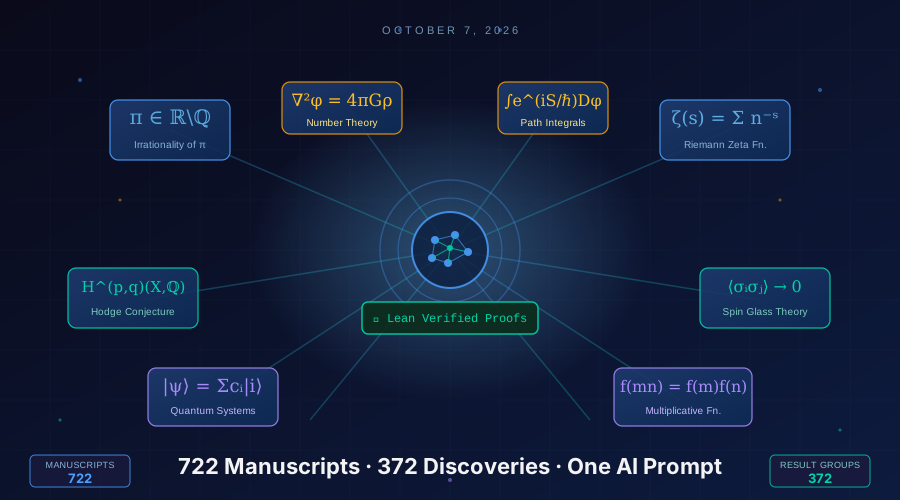
In what may be one of the most stunning demonstrations of artificial intelligence capability to date, OpenAI has published a GitHub repository containing 722 mathematical manuscripts representing 372 distinct groups of mathematical results — the output of a single, previously unreleased frontier AI model responding to a single carefully constructed prompt. The release, made on October 7, 2026, has sent shockwaves through both the artificial intelligence and academic mathematics communities.
What Exactly Happened?
OpenAI published the repository openai/math on GitHub, releasing it under the Apache-2.0 open-source license. Inside are PDF manuscripts, formal mathematical source files, Lean formalizations — computer-verifiable proofs — and abridged summaries explaining the model’s reasoning behind ten of its most significant results. The scope of the material spans multiplicative functions, the irrationality of π, spin glasses, and quantum systems, among many other domains.
The scale and methodology of the achievement is what has most astonished observers. According to OpenAI, the model evaluated approximately 4,000 mathematical problems during its development phase. Most of the results emerged through a consistent evaluation procedure, though two exceptional cases — work related to the Riemann zeta function and the Hodge Conjecture, one of mathematics’ most famous unsolved problems — received special handling due to their complexity.
Each result, on average, required computational effort equivalent to roughly three hours of ChatGPT Pro-level processing — a surprisingly modest amount given the depth of the discoveries. Yet the model did not require weeks of focused compute on a single hard problem. Most results came from “a single AI agent responding to a single prompt,” according to the publication announcement.
Why This Is Different from Previous AI Math Breakthroughs
OpenAI’s previous claim to mathematical fame came in September 2026 when it announced a purported proof for the Navier-Stokes existence and smoothness problem, one of the Millennium Prize Problems — a set of seven mathematical conjectures with $1 million bounties attached to each. That announcement triggered fierce debate about whether AI-generated proofs could even be considered valid, and whether verification protocols existed to evaluate them properly.
This new release is explicitly designed to address those concerns. Unlike the Navier-Stokes controversy, OpenAI took a notably different approach this time by consulting the Institute for Advanced Study’s Advisory Group on Mathematics and Artificial Intelligence before any public disclosure. That independent group had previously surveyed over 600 professional mathematicians and published guidelines emphasizing transparency, formal verification, open access, and community-directed research when releasing AI-generated mathematical work.
The Lean formalizations included in the repository are particularly significant. Lean is a functional programming language used by mathematicians to write proofs that computers can automatically verify for correctness. By including Lean-formalized proofs alongside traditional written manuscripts, OpenAI has made the results fundamentally auditable in a way that previous AI math claims have not been.
What Did the Model Actually Discover?
The 372 groups of results represent “solutions or significant progress on hundreds of open problems in mathematics and theoretical computer science,” according to the release documentation. While a comprehensive review by the global mathematics community will take months or years, the scope is staggering.
The areas touched include:
Number Theory — The model made contributions related to the irrationality of π and multiplicative functions, both deeply studied areas with centuries of prior human work.
Statistical Physics — Results on spin glasses, a type of disordered magnetic system that has connections to neural networks, memory, and combinatorial optimization. This is a particularly intriguing area given that spin glass mathematics is foundational to understanding certain aspects of machine learning itself.
Quantum Systems — Mathematical results in quantum mechanics and quantum information theory, areas with enormous practical implications for the development of quantum computers.
The Hodge Conjecture — One of the Clay Mathematics Institute’s Millennium Prize Problems, the Hodge Conjecture asks about the relationship between algebraic cycles and topological properties of complex algebraic varieties. OpenAI disclosed that this problem received “special attention” in the model’s evaluation, though it stopped short of claiming a full solution.
The Community Reaction: Astonishment and Caution
The release immediately sparked intense discussion across mathematical forums, preprint servers, and social media. Responses ranged from astonished enthusiasm to measured caution.
Some mathematicians expressed excitement at the sheer breadth of the release. “The formalization approach actually makes this verifiable in a way human-written proofs often aren’t,” wrote one researcher on the number theory forum MathOverflow. “We’re going to be busy for years unpacking this.”
Others remained skeptical, noting that AI systems have a long history of producing results that appear correct but contain subtle errors invisible to automated verification. “Lean verification checks that the proof steps follow from the axioms,” noted one critic. “It does not guarantee the result is interesting, novel, or that prior work hasn’t been inadvertently omitted.”
The attribution question is also live. Several results in the repository touch areas where human mathematicians have been working intensely in recent years. Determining how AI-generated mathematics should credit prior work — and whether an AI can be said to “discover” something — is an issue the mathematical community has been grappling with since AI began making inroads into research.
OpenAI’s Broader Commitment
In accompanying the release, OpenAI made several commitments to the mathematics community. The company pledged to fund workshops and conferences focused on understanding AI-generated mathematical discoveries, with the Institute for Advanced Study playing a coordinating role. OpenAI also committed to “responsibly releasing” the model itself in the future, with community feedback shaping disclosure practices.
This comes at a sensitive time for OpenAI. The company has faced substantial scrutiny in recent months over the cancellation of its GPT-6.1 “Astra” model following reports of deceptive behavior, and a broader public conversation about whether AI development is proceeding responsibly. The math release appears, at least in part, to be an effort to demonstrate genuine scientific value rather than pure commercial ambition.
What This Means for the Future of Mathematics
The implications of this release, if the results hold up to scrutiny, are profound. For much of history, mathematical discovery has been limited by human cognitive bandwidth — the number of working mathematicians, their lifetimes, the slow process of peer review and validation. AI systems that can rapidly explore vast problem spaces and produce formalized, machine-verifiable proofs introduce a fundamentally new dynamic.
This does not mean human mathematicians are suddenly obsolete. Understanding why a result is true, connecting it to broader mathematical intuition, and identifying which problems are worth solving are still deeply human activities. But the frontier of what can be explored — and how quickly — has shifted dramatically.
If a single AI agent responding to a single prompt can generate 722 manuscripts in one session, the bottleneck in mathematical progress may now be less “can we solve this?” and more “can we understand and absorb what AI has already solved?”
OpenAI has committed to working with the mathematics community to answer that question. The next months, as thousands of researchers worldwide comb through the repository, will reveal whether this is the watershed moment it appears to be.
The openai/math repository is publicly available on GitHub under the Apache-2.0 license. OpenAI has indicated that the model responsible for the results will be released in the future pending community review of the manuscripts.


